Showing posts with label spinal cord. Show all posts

Friday, July 31, 2015

Paralyzed men move legs with new non-invasive spinal cord stimulation

After training, men move legs independently, without stimulation

Five men with complete motor paralysis were able to voluntarily generate step-like movements thanks to a new strategy that non-invasively delivers electrical stimulation to their spinal cords, according to a new study funded in part by the National Institutes of Health. The strategy, called transcutaneous stimulation, delivers electrical current to the spinal cord by way of electrodes strategically placed on the skin of the lower back. This expands to nine the number of completely paralyzed individuals who have achieved voluntary movement while receiving spinal stimulation, though this is the first time the stimulation was delivered non-invasively. Previously it was delivered via an electrical stimulation device surgically implanted on the spinal cord.
In the study, the men’s movements occurred while their legs were suspended in braces that hung from the ceiling, allowing them to move freely without resistance from gravity. Movement in this environment is not comparable to walking; nevertheless, the results signal significant progress towards the eventual goal of developing a therapy for a wide range of individuals with spinal cord injury.
“These encouraging results provide continued evidence that spinal cord injury may no longer mean a life-long sentence of paralysis and support the need for more research,” said Roderic Pettigrew, Ph.D., M.D., director of the National Institute of Biomedical Imaging and Bioengineering at NIH. “The potential to offer a life-changing therapy to patients without requiring surgery would be a major advance; it could greatly expand the number of individuals who might benefit from spinal stimulation. It’s a wonderful example of the power that comes from combining advances in basic biological research with technological innovation.”
The study was conducted by a team of researchers at the University of California, Los Angeles; University of California, San Francisco; and the Pavlov Institute, St. Petersburg, Russia. The team was led by V. Reggie Edgerton, Ph.D., a distinguished professor of integrative biology and physiology at UCLA and Yury Gerasimenko, Ph.D., director of the laboratory of movement physiology at Pavlov Institute and a researcher in UCLA’s Department of Integrative Biology and Physiology. They reported their results in the Journal of Neurotrauma.
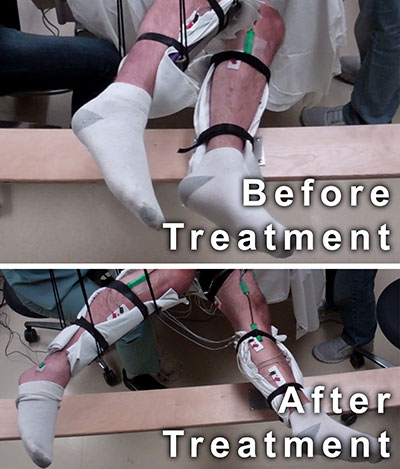
Image showing legs before and after treatment
Range of voluntary movement prior to receiving stimulation compared to movement after receiving stimulation, physical conditioning, and buspirone. The subject’s legs are supported so that they can move without resistance from gravity. The electrodes on the legs are used for recording muscle activity.
In a study published a little over a year ago, Edgerton — along with Susan Harkema, Ph.D., and Claudia Angeli, Ph.D., from the University of Louisville, Kentucky — reported that four men with complete motor paralysis were able to generate some voluntary movements while receiving electrical stimulation to their spinal cords. The stimulation came from a device called an epidural stimulator that was surgically implanted on the surface of the men’s spinal cords. On the heels of that success, Edgerton and colleagues began developing a strategy for delivering stimulation to the spinal cord non-invasively, believing it could greatly expand the number of paralyzed individuals who could potentially benefit from spinal stimulation.
“There are a lot of individuals with spinal cord injury that have already gone through many surgeries and some of them might not be up to or capable of going through another,” said Edgerton. “The other potentially high impact is that this intervention could be close to one-tenth the cost of an implanted stimulator.”
During this most recent study, five men — each paralyzed for more than two years — underwent a series of 45 minute sessions, once a week, for approximately 18 weeks, to determine the effects of non-invasive electrical stimulation on their ability to move their legs.
In addition to stimulation, the men received several minutes of conditioning each session, during which their legs were moved manually for them in a step-like pattern. The goal of the conditioning was to assess whether physical training combined with electrical stimulation could enhance efforts to move voluntarily. For the final four weeks of the study, the men were given the pharmacological drug buspirone, which mimics the action of serotonin and has been shown to induce locomotion in mice with spinal cord injuries. While receiving the stimulation, the men were instructed at different points to either try to move their legs or to remain passive.
At the initiation of the study, the men’s legs only moved when the stimulation was strong enough to generate involuntary step-like movements. However, when the men attempted to move their legs further while receiving stimulation, their range of movement significantly increased. After just four weeks of receiving stimulation and physical training, the men were able to double their range of motion when voluntarily moving their legs while receiving stimulation. The researchers suggest that this change was due to the ability of electrical stimulation to reawaken dormant connections that may exist between the brain and the spinal cord of patients with complete motor paralysis.
Surprisingly, by the end of the study, and following the addition of buspirone, the men were able to move their legs with no stimulation at all and their range of movement was — on average — the same as when they were moving while receiving stimulation.
“It’s as if we’ve reawakened some networks so that once the individuals learned how to use those networks, they become less dependent and even independent of the stimulation,” said Edgerton.
The researchers also made extensive recordings of electrical signals generated in the calf muscle and the muscle directly below the calf while the men attempted to flex their feet during stimulation. Over time, these signals increased with the same amount of stimulation, further supporting the hypothesis of re-established communication between the brain and spinal cord.
Edgerton has already initiated a new study to see whether these same men can be trained with non-invasive spinal stimulation to fully bear their weight, a feat that the four men with surgically implanted stimulators have already achieved. In addition, he is interested in determining whether, similar to epidural stimulation, non-invasive stimulation can help individuals regain some autonomic functions lost due to paralysis such as the ability to sweat, regulate blood pressure, and control bladder, bowel, and sexual function.
The hope is that further research can help determine whether non-invasive stimulation can restore function that will truly impact patient lives.
Edgerton also wants to test non-invasive stimulation on individuals who have partial paralysis. “We have focused on individuals with complete paralysis throughout this whole process because we knew that was going to be the toughest patient population to see changes in. We’ve always thought, and we have every reason to believe, that those individuals with partial injuries have even more room for improvement,” said Edgerton.
Though a non-invasive stimulation could offer advantages over a surgically implanted device, Edgerton says both need to continue to be developed. For example, a non-invasive stimulator might be useful in determining whether a patient will be receptive to neuromodulation, which could then help determine whether undergoing surgery to implant a stimulator is warranted. Alternatively, Edgerton speculates it may be possible early after an injury for non-invasive stimulation to help patients achieve a certain level of motor control that then allows them to continue to improve with physical rehabilitation and avoid surgery altogether.
“All patients are going to need something slightly different, and maybe non-invasive stimulation is going to be best in some cases and epidural stimulation in others,” said Edgerton. “What we need to do is maximize the clinical tool box that we have so that the physician and the patient can select a therapy that is best for them.”

Health News: Six firms selling pesticide tainted imported produce ♦ Predict amount of nicotine emitted from e-cigarettes ♦ Cheaper, high-performance prosthetic knee

Six firms selling pesticide tainted imported produce The California Department of Pesticide Regulation has fined six companies that ignored warnings and repeatedly sold imported fruits and vegetables with illegal pesticide residues to predominantly ethnic minority customers. According to an agency statement released July 28, the fines range from $10,000 to more than $20,000 for violating pesticide laws and potentially endangering consumers....
When surgeons listen to their preferred music, their stitches are better and faster From classical to rock, music can be heard in operating rooms across the world. When plastic surgeons listen to music they prefer, their surgical technique and efficiency when closing incisions is improved.
Novel model developed to predict amount of nicotine emitted from e-cigarettes Researchers have developed the first ever, evidence-based model that can predict with up to 90 percent accuracy the amount of nicotine emitted by an electronic cigarettes.
Paralyzed men move legs with new non-invasive spinal cord stimulation Five men with complete motor paralysis were able to voluntarily generate step-like movements thanks to a new strategy that non-invasively delivers electrical stimulation to their spinal cords. The strategy, called transcutaneous stimulation, delivers electrical current to the spinal cord by way of electrodes strategically placed on the skin of the lower back. This expands to nine the number of completely paralyzed individuals who have achieved voluntary movement while receiving spinal stimulation.
Cheaper, high-performance prosthetic knee Researchers report that they have designed a cheap prosthetic knee that mimics normal walking motion. They have calculated the ideal torque that a prosthetic knee should produce, given the mass of the leg segments, in order to induce able-bodied kinematics, or normal walking

Sunday, July 19, 2015

Health News: Frozen raw tuna likely source of salmonella infections ♦ Marine litter undermines benefits of coastal environments ♦ Electrical signals could help repair injured spinal cords

Frozen raw tuna likely source of salmonella infections As of July 14, 2015, 60 people infected with the outbreak strain of Salmonella Paratyphi B variant L(+) tartrate(+) have been reported from 11 states. Eleven ill people have been hospitalized. No deaths have been reported. That’s according to the latest update from the U.S. Centers for Disease Control and Prevention (CDC), which was posted July 15...
Marine litter undermines benefits of coastal environments Marine litter has the potential to undermine the psychological benefits of coastal environments.
Common diabetes drug can also treat liver cirrhosis Diabetes drug metformin can treat portal hypertension--high blood pressure in the liver resulting from cirrhosis, new research shows. This study adds to the growing body of evidence showing that use of metformin goes beyond treating type 2 diabetes.
Therapeutic target identified for treatment of spinal cord injuries Therapeutic target for the treatment of acute spinal cord injuries has been identified. According to research, conducted on mice, the administration of a drug that prevents loss of myelin -- the insulating sheath around nerve fibers that allows signals to be transmitted -- increases the mobility of the mice after an injury.
Electrical signals could help repair injured spinal cords Wichita State University's Li Yao is taking a special approach to the study of spinal cord injuries through research that uses an electrical signal to repair tissue damage.
Bilinguals of two spoken languages have more gray matter than monolinguals A new study suggests people who speak two languages have more gray matter in the executive control region of the brain

Friday, July 17, 2015

Brain Research: Magnetic nanoparticles could be key to effective immunotherapy ♦ New antibody treats traumatic brain injury ♦ New approach to spinal cord, brain injury research

New antibody treats traumatic brain injury (TBI) and prevents long-term neurodegeneration New research provides the first direct evidence linking traumatic brain injury to Alzheimer's disease and chronic traumatic encephalopathy (CTE) -- and offers the potential for early intervention TBI can result from repetitive contact sport injuries or from exposure to military blasts, and is one of the most significant risk factors for both Alzheimer's disease and CTE
New evidence linking brain mutation to autism, epilepsy and other neuro disorders The extent a mutation associated with autism and epilepsy plays in impairing a biochemical process in the brain has been revealed by researchers. The study  could provide a new target for treating neurological disorders
Gene associated with thinking skills Researchers have identified a gene that underlies healthy information processing -- a first step on a complicated road to understand cognitive aging and age-related diseases, such as Alzheimer's disease.
New approach to spinal cord, brain injury research Many an injury will heal, but the damaged spinal cord is notoriously recalcitrant. There's new hope on the horizon, though. Researchers has reported an innate repair mechanism in central nervous system axons that might be harnessed to regenerate nerves after brain or spinal cord injuries.
Magnetic nanoparticles could be key to effective immunotherapy In recent years, researchers have hotly pursued immunotherapy, a promising form of treatment that relies on harnessing and training the body's own immune system to better fight cancer and infection. Now, results of a new study suggests that a device composed of a magnetic column paired with custom-made magnetic nanoparticles may hold a key to bringing immunotherapy into widespread and successful clinical use.

Tuesday, July 7, 2015

Senior Health: Alzheimer's disease works differently in patients with Down Syndrome ♦ Omega-3 supplements help with preclinical Alzheimer's disease ♦ Age-related cognitive decline tied to immune-system molecule

SSRI antidepressants taken for menopausal symptoms may boost bone fracture risk The class of antidepressants known as SSRIs (selective serotonin reuptake inhibitors), taken to curb menopausal symptoms, may boost bone fracture risk.
Alzheimer's disease works differently in patients with and without Down Syndrome A study revealed differences in the way brain inflammation -- considered a key component of AD-- is expressed in different subsets of patients, in particular people with Down syndrome (DS) and AD.
Omega-3 supplements, antioxidants may help with preclinical Alzheimer's disease Here's more evidence that fish oil supplementation and antioxidants might be beneficial for at least some people facing Alzheimer's disease: A new report describes the findings of a very small study in which people with mild clinical impairment, such as those in the very early stages of the disease, saw clearance of the hallmark amyloid-beta protein and reduced inflammation in neurological tissues.
Older patients with traumatic spinal cord injuries less likely to get surgery Older patients with traumatic spinal cord injuries are less likely to receive surgery compared with younger patients and they experience a significant lag between injury and surgery.
Age-related cognitive decline tied to immune-system molecule A blood-borne molecule that increases in abundance as we age blocks regeneration of brain cells and promotes cognitive decline. The molecule in question, known as beta-2 microglobulin, or B2M, is a component of a larger molecule called MHC I, which plays a major role in the adaptive immune system. A growing body of research indicates that the B2M-MHC I complex, which is present in all cells in the body except red blood cells and plasma cells, can act in the brain in ways not obviously related to immunity--guiding brain development, shaping nerve cell communication, and even affecting behavior

Wednesday, July 1, 2015

Health News: Parasitic worms in fish ruins AZ couples dinner plans ♦ Humane Society files complaint against Costco's egg supplier ♦ 232 sickened in outbreak linked to NC restaurant

Parasitic worms in fish ruins AZ couples dinner plans“She was screaming my name, and I thought something horrible had happened. I come rushing in, and she was like ‘You need to look at these worms, these worms!” For this Arizona couple, it was supposed to be a quiet night with a home-cooked meal. But, when Jen Chafitz found two parasitic worms crawling around the salmon she had just purchased, those plans went flying out the window.
Humane Society files complaint with FDA against Costco's egg supplier The Humane Society of the United States has filed legal complaints with the U.S. Food and Drug Administration (FDA) and the Federal Trade Commission (FTC) alleging that Hillandale Farms, a Costco egg supplier, has deceived consumers with its poor animal welfare standards and “filthy and unsanitary conditions,” resulting in food safety concerns. complaints come.
232 sickened in outbreak linked to NC restaurant The North Carolina Department of Health and Human Services reported Tuesday that 232 cases of diarrheal illness have been identified which are associated with eating food from the Tarheel Q restaurant in Lexington, NC. The case distribution includes 16 North Carolina counties and five states.
Causal pathway may link job stress, sleep disturbances There may be a reciprocal, causal pathway between job strain and disturbed sleep, implying that interventions to treat sleep problems may improve work satisfaction, researchers have learned.
Innovative imaging study shows that the spinal cord learns on its own The spinal cord engages in its own learning of motor tasks independent of the brain, according to an innovative imaging study. The results of the study may offer new opportunities for rehabilitation after spinal cord injury.

Sunday, May 3, 2015

Health News:Taiwan: DDT tainted tea ♦ Swine farming a risk factor for drug-resistant staph infections ♦ New mechanism controlling cell response to DNA damage

Taiwan: DDT tainted tea Routine food safety inspections were conducted by the Chiayi City Government at a PX mart on May 1, which resulted in the discovery of DDT contaminations in 3:15 Milk Tea's Jhihuo Oolong Rose Tea teabags. Tipped off by the Chiayi City Government, the Taichung Health Department then sent investigators to the headquarters of Shih Chen.
Spinal cord axon injury location determines neuron's regenerative fate A previously unappreciated phenomenon has been reported in which the location of injury to a neuron's communication wire in the spinal cord -- the axon -- determines whether the neuron simply stabilizes or attempts to regenerate. The study demonstrates how advances in live-imaging techniques are revealing new insights into the body's ability to respond to spinal cord injuries.
Swine farming a risk factor for drug-resistant staph infections Swine farmers are six times more likely to be carriers of staph bacteria, including the MRSA strain, than others, new research shows. S. aureus is a type of bacteria commonly found on the skin as well as in the noses and throats of people and animals.

New mechanism controlling cell response to DNA damage discovered DNA can be damaged by different environmental insults, such as ultraviolet light, ionizing radiation, oxidative stress or certain drugs. If the DNA is not repaired, cells may begin growing uncontrollably, leading to the development of cancer. Therefore, cells must maintain an intricate regulatory network to ensure that their DNA remains intact. Researchers have discovered a novel mechanism that controls a cell's response to DNA damage

Sunday, March 15, 2015

Health News: injured kidneys can be used for transplants ♦ Alternative way to pay for expensive drugs ♦ Injured spinal cord: Regeneration possible ♦ Epilepsy

Even injured kidneys can be used for transplants,  Kidneys from deceased donors that have acute injuries are frequently discarded instead of being used for transplant. However, a study finds that such kidneys may be more viable than previously thought, and should be considered to meet the growing demand for organ transplants. Continue Reading
Alternative way to pay for expensive drugs may be needed  A major challenge facing the world's health care systems is paying for a new breed of expensive breakthrough drugs. One way to address the issue is to approach it the same way as other industries where suppliers encourage investment through approaches such as equipment leases or supplier-financed credit. Continue Reading
Gene linked with early epilepsy discovered  Certain types of early-onset epilepsy are caused by previously unknown mutations of a potassium channel gene, KCNA2. The mutations disrupt the electrical balance in the brain in two ways. In some patients, the flow of potassium is greatly reduced; while in others, it is raised enormously. Both states can lead to hard-to-treat epileptic seizures. New information may lead .Continue Reading
Injured spinal cord: Regeneration possible with epothilon  Damage to the spinal cord rarely heals because the injured nerve cells fail to regenerate. The regrowth of their long nerve fibers is hindered by scar tissue and molecular processes inside the nerves. Scientists in now report that help might be on the way from an unexpected quarter Continue Reading:

Wednesday, December 3, 2014

New drug may lead to spinal cord injury treatments

Injections of a new drug may partially relieve paralyzing spinal cord injuries, based on indications from a study in rats, which was partly funded by the National Institutes of Health.
The results demonstrate how fundamental laboratory research may lead to new therapies.
“We’re very excited at the possibility that millions of people could, one day, regain movements lost during spinal cord injuries,” said Jerry Silver, Ph.D., professor of neurosciences, Case Western Reserve University School of Medicine, Cleveland, and a senior investigator of the study published in Nature.
Every year, tens of thousands of people are paralyzed by spinal cord injuries. The injuries crush and sever the long axons of spinal cord nerve cells, blocking communication between the brain and the body and resulting in paralysis below the injury.
On a hunch, Bradley Lang, Ph.D., the lead author of the study and a graduate student in Dr. Silver’s lab, came up with the idea of designing a drug that would help axons regenerate without having to touch the healing spinal cord, as current treatments may require.
“Originally this was just a side project we brainstormed in the lab,” said Dr. Lang.
Barrier used to develop spinal cord injury drug
Scientists developed a drug that allows axons to cross impenetrable barriers leading to the treatment of spinal cord injuries.  Courtesy of Silver lab, Case Western Reserve School of Medicine.
After spinal cord injury, axons try to cross the injury site and reconnect with other cells but are stymied by scarring that forms after the injury. Previous studies suggested their movements are blocked when the protein tyrosine phosphatase sigma (PTP sigma), an enzyme found in axons, interacts with chondroitin sulfate proteoglycans, a class of sugary proteins that fill the scars.
Dr. Lang and his colleagues designed a drug called ISP to block the enzyme and facilitate the drug’s entry into the brain and spinal cord. Injections of the drug under the skin of paralyzed rats near the injury site partially restored axon growth and improved movements and bladder functions.
“There are currently no drug therapies available that improve the very limited natural recovery from spinal cord injuries that patients experience,” said Lyn Jakeman, Ph.D., a program director at the NIH’s National Institute of Neurological Disorders and Stroke, Bethesda, MD. “This is a great step towards identifying a novel agent for helping people recover.”
Initially, the goal of the study was to understand how interactions between PTP sigma and chondroitin sulfate proteoglycans prevent axon growth. Drugs were designed to mimic the shape of a critical part of PTP sigma, called the wedge. Different designs were tested on neurons grown in petri dishes alongside impenetrable barriers of proteoglycans. Treatment with ISP freed axon growth.
“It was amazing. The axons kept growing and growing,” said Dr. Silver.
Next the researchers tested the potential of the drug on a rat model of spinal cord injury. For seven weeks they injected rats with the drug or a placebo near the site of injury. A few weeks later the rats that received the drug showed improvements in walking and urinating while the placebo treatments had no effect. The results suggested the drug passed into the brain and spinal cord.
When the researchers looked at the spinal cords under a microscope they found that the drug induced sprouting of axons that use the neurochemical serotonin to communicate. The sprouting axons were seen below the injury site. Treating some rats with a blocker of serotonin communication partially reversed the beneficial effects of ISP injections, suggesting the newly sprouting axons helped the rats recover.
The ISP drug did not cause spinal cord axons known to control movements to cross the scar and reconnect with brain neurons above the injury site. Dr. Silver and his colleagues think this means the ISP-induced sprouting helped the rats recover by increasing the signal sent by the few remaining intact axons.
“This is very promising. We now have an agent that may work alone or in combination with other treatments to improve the lives of many,” said Dr. Silver. He and his colleagues are seeking to test the ISP drug in preclinical trials.

Tuesday, April 8, 2014

Spinal Stimulation Helps Four Patients with Paraplegia Regain Voluntary Movement

Groundbreaking results bring new hope for those with spinal cord injury – NIH study
Four people with paraplegia are able to voluntarily move previously paralyzed muscles as a result of a novel therapy that involves electrical stimulation of the spinal cord, according to a study funded in part by the National Institutes of Health and the Christopher & Dana Reeve Foundation. The participants, each of whom had been paralyzed for more than two years, were able to voluntarily flex their toes, ankles, and knees while the stimulator was active, and the movements were enhanced over time when combined with physical rehabilitation. Researchers involved in the study say the therapy has the potential to change the prognosis of people with paralysis even years after injury.
“When we first learned that a patient had regained voluntary control as a result of spinal stimulation, we were cautiously optimistic,” said Roderic Pettigrew, Ph.D., M.D., director of the National Institute of Biomedical Imaging and Bioengineering (NIBIB) at NIH, which provided support for the study. “Now that spinal stimulation has been successful in 4 out of 4 patients, there is evidence to suggest that a large cohort of individuals, previously with little realistic hope of any meaningful recovery from spinal cord injury, may benefit from this intervention.”Picture of the four participants in the spinal stimulation study
First four participants to undergo task-specific training while undergoing spinal cord stimulation at the Human Locomotion Research Center laboratory, Frazier Rehab Institute, as part of the University of Louisville's Kentucky Spinal Cord Injury Research Center. Left to right: Andrew Meas, Dustin Shillcox, Kent Stephenson and Rob Summers. Photo courtesy of the University of Louisville.
One of the most impressive and unexpected findings of the study is that two of the patients who benefited from the spinal stimulation had complete motor and sensory paralysis. In these patients, the pathway that sends information about sensation from the legs to the brain is disrupted, in addition to the pathway that sends information from the brain to the legs in order to control movement. The researchers were surprised by the outcome; they had assumed that at least some of the sensory pathway needed to be intact for the therapy to be effective.
The study is the continuation of a groundbreaking pilot trial initiated in 2009 to determine whether spinal stimulation, in conjunction with daily training on a treadmill, could help patients with paralysis regain some ability to move. In that trial, Rob Summers, a young man paralyzed below his chest, had a 16-electrode array implanted on his spinal cord. He then underwent daily training in which he was suspended in a harness over a treadmill while a team of researchers supported his legs, helping him to either stand or walk. At the same time, the array delivered electrical pulses to his spinal cord just below his injury.
According to the researchers, the goal of the stimulation was to increase the sensitivity of local circuits within the spinal cord that carry out basic motor functions without input from the brain—such as the knee jerk that occurs after stepping on a tack, or even more complex patterned movements like stepping. While not strong enough to directly induce muscle activation by itself, the researchers believed the stimulation could lead to movement when combined with sensory input from stepping on a treadmill.
With his stimulator active, Summers was able to gradually bear his own weight and could eventually stand without assistance from physical therapists for up to four minutes. Surprisingly, seven months into the trial, Summers also discovered that he had regained some voluntary control of his legs. The researchers were amazed by this latter outcome, as intentional movement requires information to travel from the brain down to the lower spinal cord, a path that had been rendered nonfunctional by his injury. Other impairments caused by Summers’ injury also began to improve over time, in the absence of stimulation, such as blood pressure control, body temperature regulation, bladder control, and sexual function.
Now, in this follow-up study, Claudia Angeli, Ph.D., assistant professor at the University of Louisville’s Kentucky Spinal Cord Injury Research Center and her research colleagues report that three additional patients with paralysis have recovered voluntary muscle control following electrical stimulation of the spine. Their report, which also includes results from new tests conducted on Summers, was published in the April 8 online issue of Brain.
The three patients in the new study include two with complete motor and sensory paralysis, and one, similar to Summers, with complete motor paralysis but some ability to experience sensation below his injury. Within just a few days of the start of stimulation, all three patients regained some voluntary control of previously paralyzed muscles.
The first person they implanted after Summers was unable to move or experience any sensation below his injury and was initially meant to be their baseline patient. “What was astounding about him was that not only was there voluntary movement, but we saw it in the first week of stimulation. We then saw it in the next two patients as well,” said Susan Harkema, Ph.D., the director of rehabilitation research at the Kentucky Spinal Cord Injury Research Center at the University of Louisville, and a researcher in the study.Photo of participant Kent Stephenson raising his leg while his spinal cord is stimulated
Study participant Kent Stephenson voluntarily raises his leg while his spinal stimulator is active. Photo courtesy of the University of Louisville.
The researchers point to the speed at which each subject recovered voluntary movement as evidence that there may be dormant connections that exist in patients with complete motor paralysis. “Rather than there being a complete separation of the upper and lower regions relative to the injury, it’s possible that there is some contact, but that these connections are not functional,” said V. Reggie Edgerton, Ph.D., a UCLA distinguished professor of integrative biology and physiology, and the researcher responsible for developing the novel approach to rehabilitation. “The spinal stimulation could be reawakening these connections.”
An important aspect of the new study involved assessing the ability of each patient to modulate his movements in response to auditory and visual cues. "We hoped to determine if they could voluntarily move in the presence of stimulation, and also how controlled they could be about their movements," said Angeli.
All participants, including Summers, were able to synchronize leg, ankle, and toe movements in unison with the rise and fall of a wave displayed on a computer screen, and three out of the four were able to change the force at which they flexed their leg, depending on the intensity of three different auditory cues.
“The fact that the brain is able to take advantage of the few connections that may be remaining, and then process this complicated visual, auditory, and perceptual information, is pretty amazing. It tells us that the information from the brain is getting to the right place in the spinal cord, so that the person can control, with fairly impressive accuracy, the nature of the movement,” said Edgerton.
The same tests were also administered following several months of spinal stimulation applied in conjunction with locomotor training. During this time, patients also carried out home-based training, which consisted of hour-long stimulation while practicing intentional movements lying down. At the end of the training, some subjects were able to execute voluntary movements with greater force and with reduced stimulation, while others experienced enhanced movement accuracy. Harkema says it’s unclear whether the improvement was a result of the training or due to the cumulative effects of stimulation over time. They plan to test this distinction in their next study.
“With this study the investigators show that their findings about a motor complete patient regaining movement, reported three years ago in The Lancet, were not an anomaly,” said Susan Howley, executive vice president for research at the Christopher & Dana Reeve Foundation, Short Hills, N.J., which provides patient advocacy and funding for spinal cord injury research. “The implications of this study for the entire field are quite profound and we can now envision a day where epidural stimulation might be part of a cocktail of therapies used to treat paralysis.”
With support from NIBIB, Edgerton, along with collaborators Joel Burdick and Y.C. Tai, professors of mechanical and electrical engineering and bioengineering at Caltech, are also working to develop a new high-density, 27-electrode array in rats to determine if it can provide finer, more robust control of locomotion.
“The technology we used in these four individuals was initially designed for the suppression of back pain, and our animal experiments have told us that we can do much better,” said Edgerton. “For a given type of movement, we want to be able to select exactly where and how to stimulate the spinal cord. We just don’t have that flexibility in the current technology.”Photo of participant Kent Stephenson doing voluntary training while a lab tech tracks his level of muscle activity and force.
Study participant Kent Stephenson does voluntary training while undergoing spinal stimulation. Katelyn Gurley tracks his level of muscle activity and force. Photo courtesy of the University of Louisville
Edgerton is also working with various collaborators on NIBIB-funded projects to explore whether epidural stimulation can be used to help patients with paralysis of the upper limbs. They are also developing a technology that can deliver spinal stimulation through the skin (transcutaneously), which would bypass the need for surgical implantation.
Though there is much work to be done, Harkema believes the results from this newest study already provide enough evidence to challenge currently held beliefs about the prognosis of patients with severe spinal cord injuries.
“Right now, the clinical perspective for individuals with complete motor paralysis is that there is nothing we can do,” said Harkema “I think we need to rethink that. In our study, we demonstrated potential beyond any expectation. We need to relook at what the perceived potential is for this group of individuals.”
“This is a wake-up call for how we see motor complete spinal cord injury,” said Edgerton. “We don’t have to necessarily rely on regrowth of nerves in order to regain function. The fact that we’ve observed this in all four patients suggests that this is actually a common phenomenon in those with complete paralysis.”