Saturday, August 1, 2015

Health Research:New treatment of type 1 diabetes ♦ Starvation effects handed down for generations ♦ Perfectionism linked to burnout at work, school and sports,

Promising progress for new treatment of type 1 diabetes New research shows promising progress in the use of anti-inflammatory cytokine for treatment of type 1 diabetes. The study reveals that administration of interleukin-35 (a protein made by immune cells) to mice with type 1 diabetes, reverses or cures the disease by maintaining a normal blood glucose level and the immune tolerance
Affordable genetic diagnostic technique for target DNA analysis developed A technique to analyze various target DNAs has been developed using an aptamer, a DNA fragment that can recognize and bind to a specific protein or enzyme.
Perfectionism linked to burnout at work, school and sports, Perfectionistic concerns have a positive relationship with overall burnout and symptoms of burnout, research has found. Perfectionistic concerns can create stress, interfere with relationships and more.
Starvation effects handed down for generations Starvation early in life can alter an organism for generations to come, according to a new study in nematodes. The epigenetic effects are a 'bet-hedging strategy.' Famine survivors are smaller and less fertile, and they acquire a toughness that lasts at least two generations. The mechanism of the epigenetic inheritance has not been identified, however.
Self-assembling, biomimetic membranes may aid water filtration A synthetic membrane that self assembles and is easily produced may lead to better gas separation, water purification, drug delivery and DNA recognition, according to an international team of researchers

Weight Loss Research: Effects of spinach extract on satiety: Feel full, curb craving ♦ Overeating caused by a hormone deficiency in brain? ♦ New York Times can predict your future weight


The New York Times can predict your future weight What you're reading now secretly tells you whether your country will be skinnier or fatter in three years. After analyzing 50 years of all the food words mentioned in major newspapers like the New York Times and London Times, a new study shows that the food words trending today in 2015 will predict a country's obesity level in three years -- in 2018.
Is Facebook use always associated with poorer body image and risky dieting? College women who are more emotionally invested in Facebook and have lots of Facebook friends are less concerned with body size and shape and less likely to engage in risky dieting behaviors. But that's only if they aren't using Facebook to compare their bodies to their friends' bodies.
Overeating caused by a hormone deficiency in brain? When hormone glucagon like peptide-1 was reduced in the central nervous system of laboratory mice, they overate and consumed more high fat food, scientists have found. Although this is not the only reason why people overeat, the study provides new evidence that targeting neurons in the mesolimbic dopamine system -- a reward circuit in the brain -- rather than targeting the whole body might be a better way to control overeating and obesity with fewer side effects.
Effects of spinach extract on satiety: Feel full, curb cravings A new study examines how consuming the concentrated extract of thylakoids found in spinach can reduce hunger and cravings. Thylakoids encourage the release of satiety hormones, which is very beneficial in slowing down fat digestion.

Cancer Research:Gold-diamond nano device for hyper localized cancer therapy ♦ Robotic surgery for kidney cancer ♦ New therapeutic target for breast cancer

Gold-diamond nano device for hyper localized cancer therapy Precise targeting biological molecules, such as cancer cells, for treatment is a challenge, due to their sheer size. Now, scientists have proposed an advanced solution that can potentially be applied to thermal cancer therapy. An improved sensing technique for nanometer-scale heating and temperature sensing uses a chemical method to attach gold nanorods to the surface of a diamond nanocrystal, the authors have invented a new biocompatible nanodevice.
Newly identified mechanism of p53-induced cell death could aid cancer therapy Research reveals how the tumor suppressor protein p53 works in the cytoplasm to trigger death via apoptosis and identifies a potential cancer treatment strategy.
HPV16 detection in oral rinses for oropharyngeal cancer The presence of persistent human papillomavirus type 16 DNA in oral rinses after treatment for HPV-related oropharyngeal cancer was rare but it appears to be associated with poor prognosis and therefore may have potential as a long-term tool for tumor surveillance.
First reports of robotic surgery for advanced vena cava tumor thrombus due to kidney cancer Surgery is required when cancer of the kidney causes a Level III thrombus, or clot, to develop in the major vein leading back to the heart. Traditionally this complicated procedure, inferior vena cava (IVC) thrombectomy, is performed using a large open incision, primarily because the vein is often difficult to reach. In a new article, a team of surgeons describe the first cases in which this procedure has been successfully performed robotically, using only seven small incisions and four robotic tools.
New cancer marker identified; possible therapeutic target for breast cancer Basal-like breast cancer (BLBC) is an aggressive form of breast cancer and is often referred to as "triple negative," which means it is not responsive to the common medical therapeutics. BLBC is more likely to metastasize -- or spread to different areas of the body -- quicker and earlier, and is associated with a poor prognosis. A new way to detect - and perhaps treat -- this deadly form of breast cancer has now been found.

Brain Research: Take a Trip Through the Brain: New Imaging Tool ♦ Blood test predicts prognosis for traumatic brain injuries ♦ Brain protein causes rethink on development of Alzheimer's

The body and the brain: Impact of mental, physical exertion on fatigue development Do you ever notice how stress and mental frustration can affect your physical abilities? When you are worried about something at work, do you find yourself more exhausted at the end of the day? This phenomenon is a result of the activation of a specific area of the brain when we attempt to participate in both physical and mental tasks simultaneously.
Take a Trip Through the Brain: New Imaging Tool A new imaging tool could do for the brain what the telescope did for space exploration. In the first demonstration of how the technology works, the researchers look inside the brain of an adult mouse at a scale previously unachievable, generating images at a nanoscale resolution. The inventors' goal is to make the resource available to the scientific community in the form of a national brain observatory.
Blood test predicts prognosis for traumatic brain injuries A new blood test could help emergency room doctors quickly diagnose traumatic brain injury and determine its severity. The findings could help identify patients who might benefit from extra therapy or experimental treatments.

Discovery about brain protein causes rethink on development of Alzheimer's disease A protein involved in the progression of Alzheimer's disease also has properties that could be helpful for human health, a research study has found. The discovery helps researchers better understand the complicated brain chemistry behind the development of Alzheimer's disease.

Public Health Warning pig roasts.illness

The U.S. Department of Agriculture’s Food Safety and Inspection Service (FSIS) is issuing a public health alert due to concerns about illnesses caused by Salmonella that may be associated with pork products, specifically whole pigs used for pig roasts.
FSIS was notified of Salmonella illness clusters (groups of illnesses) on July 15, 2015. FSIS suspects that there is a link between the illnesses associated with whole pigs used for pig roasts and eight illness clusters based on information gathered in conjunction with the Washington State Department of Health and the Centers for Disease Control and Prevention (CDC). Case-patients have been identified in Washington with illness onset dates ranging from April 25, 2015 to July 21, 2015.
This investigation is ongoing. FSIS continues to work with the Washington State Department of Health and the CDC on this investigation. Updated information will be provided as it becomes available.
Roasting a pig is a complex undertaking with numerous potential food handling issues. FSIS urges consumers to keep the four food safety steps in mind: Clean, Separate, Cook, and Chill.
  1. CLEAN: Obtain your pig from a reputable supplier. Have the supplier wrap it in plastic, or a large plastic bag to contain the juices. Keep the pig cold until it is time to cook it. If you can’t keep it under refrigeration or on ice, consider picking it up just before you are ready to cook it.
  2. SEPARATE: Anything that comes into contact with whole pig should be washed with hot soapy water afterwards. This includes hands and utensils.
  3. COOK: FSIS recommends that all pork products are cooked to a minimum internal temperature of 145º F with a three minute rest time. Make sure to check the internal temperature with a food thermometer in several places. Check the temperature frequently and replenish wood or coals to make sure the fire stays hot. Remove only enough meat from the carcass as you can serve within 1-2 hours.
  4. CHILL: Once the meat is cooked, transfer to clean serving dishes. Pack leftovers in shallow containers and refrigerate within 1-2 hours. It is not necessary to cool before you refrigerate it.
FSIS advises all consumers to safely prepare their raw meat products, including fresh and frozen items, and only consume pork products (such as pork roast or tenderloin) that have been cooked to a minimum internal temperature of 145° F with a three minute rest time. The only way to confirm that whole pigs are cooked to a temperature high enough to kill harmful bacteria is to use a food thermometer that measures internal temperature,
Consumption of food contaminated with Salmonella can cause salmonellosis, one of the most common bacterial foodborne illnesses. The most common symptoms of salmonellosis are diarrhea, abdominal cramps, and fever within 12 to 72 hours after exposure to the organism. The illness usually lasts 4 to 7 days. Most people recover without treatment. In some persons, however, the diarrhea may be so severe that the patient needs to be hospitalized. Older adults, infants, and persons with weakened immune systems are more likely to develop a severe illness. Individuals concerned about an illness should contact their healthcare provider.

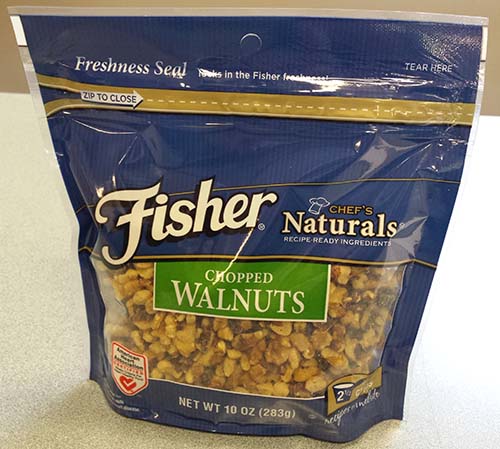
Fisher Walnuts Recalled due to Salmonella

Fisher, Chef's Naturals, Chopped Walnuts, 10 oz. bag, front of packageJohn B. Sanfilippo & Son, Inc. announced today that it is voluntarily recalling Fisher brand chopped walnuts packaged in 10 ounce plastic bags because some of these products may be contaminated with Salmonella.
Salmonella is an organism which can cause serious and sometimes fatal infections in young children, frail or elderly people and others with weakened immune systems. Healthy persons infected with Salmonella often experience fever, diarrhea (which may be bloody), nausea, vomiting and abdominal pain. In rare circumstances, infection with Salmonella can result in the organism getting into the bloodstream and producing more severe illnesses such as arterial infections (i.e., infected aneurysms), endocarditis and arthritis.
Consumers who have recently purchased the items with the BEST BY DATES listed in the table below at retail stores located nationwide and in Puerto Rico should not consume this product and should return it to the store of purchase for a full refund or replacement. The BEST BY DATES can be found on the back of the bags.
Item Code
UPC #
BRAND
PRODUCT DESCRIPTION
UNIT WT.
BEST BY DATE
P03004
070690 02365 8
Fisher
Chopped Walnuts
10 oz
03/23/16 HC1
P03004
070690 02365 8
Fisher
Chopped Walnuts
10 oz
03/23/16 HC2
To date, JBSS has not received any reports of illnesses in connection with the items listed above.
This voluntary recall is the result of a routine sampling program conducted by the FDA in the retail marketplace which revealed that a 10 ounce package of Fisher brand chopped walnuts contained Salmonella.
Contact for Consumers:
Consumers or customers who have questions about the above recall may contact John B. Sanfilippo & Son, Inc. Customer Service toll-free at (800) 874-8734 Monday through Friday from 8:15 AM to 5:15 PM Central Time.

Turkey and pork products recalled

Pork Strips & Turkey Sausage Breakfast BowlTurkey Sausage Breakfast Burrito Good Food Made Simple, is recalling approximately 3,574 pounds of previously exported and pork strips and turkey sausage breakfast bowls that were returned from Canada and were not presented for U.S. returned export inspection, the U.S. Department of Agriculture’s Food Safety and Inspection Service (FSIS) announced today. Without the opportunity of inspection, a possibility of adverse health consequences exists.
The following products are subject to recall
  • 1998.75 lbs. (533 cases) of “Good Food Made Simple Turkey Sausage Breakfast Burrito” bearing expiration date “03/22/2016.”
  • 1575 lbs. (450 cases) of “Good Food Made Simple Pork Strips & Turkey Sausage Breakfast Bowl” bearing expiration date “03/19/2016.”
The products were exported to Canada, brought back into the United States, and distributed in California without the opportunity for FSIS to inspect.
The problem was discovered during failure to present monitoring. FSIS and the company have received no confirmed reports of adverse reactions due to consumption of these products. Anyone concerned about a reaction should contact a healthcare provider.  
FSIS routinely conducts recall effectiveness checks to verify recalling firms notify their customers of the recall and that steps are taken to make certain that the product is no longer available to consumers. When available, the retail distribution list(s) will be posted on the FSIS website at www.fsis.usda.gov/recalls.
Consumers and media with questions about the recall can contact Corinne Lupi, sales and marketing administrator at Good Food Made Simple, at clupi@foodmark.com.