As any parent whose baby has spent some time in the hospital knows, all cribs are not created equal. In most cases, hospital cribs (also called pediatric medical cribs) differ significantly from what’s in your child’s bedroom at home.
“Each type of crib is specially designed for safe use in the environment in which it is being used,” says Victoria Wagman, M.A., a senior science health advisor at the Food and Drug Administration (FDA).
And it’s important that you, as a parent, know how to use these cribs correctly, both in and out of the hospital—especially if your special needs child uses one of these cribs at home.
Caring for Your Child in the Hospital
In the hospital, pediatric medical cribs provide easier access to sick or special needs babies who are hooked up to medical devices or otherwise need frequent attention or treatment, most often provided by medical staff. Unlike home cribs, hospital or medical cribs have fixed or movable bed end rails, movable and latchable side rail components, and a mattress designed to fit the crib. Hospital nurses and other staff are well trained in operating these cribs safely.
Often when babies need to stay in the hospital overnight or for several nights, the parents stay there, too. “If your baby has rotavirus, for example, you might be the main caretaker in charge of feeding or constant diaper changing throughout the night,” says Joan Ferlo Todd, R.N., M.S. a senior nurse consultant at FDA.
“If so, you need to ask the nursing staff to train you in the proper use of pediatric medical cribs,” she adds.
“Naturally enough, parents in this kind of situation are often frazzled, sleep-deprived and anxious,” Todd says. The last thing they need is to feel uncomfortable or inept in how to operate the crib.
Among other things, Todd explains that parents whose children are using hospital cribs in either setting need to become skilled in the safe use of the crib and comfortable with:
- latching, locking and opening side rails;
- raising and lowering the side;
- raising and lowering the mattress;
- angling the mattress if necessary; and
- locking and unlocking the wheels.
“If you are switching off with another caregiver, make sure that person is also proficient in using the crib correctly,” Todd says. If the other caregiver is much taller, for instance, knowing how to raise and lower the mattress can be essential, both for the baby and for the caregiver, who doesn’t want to add back injury—a common problem among caregivers—to the mix.
New safety requirements for pediatric medical cribs:
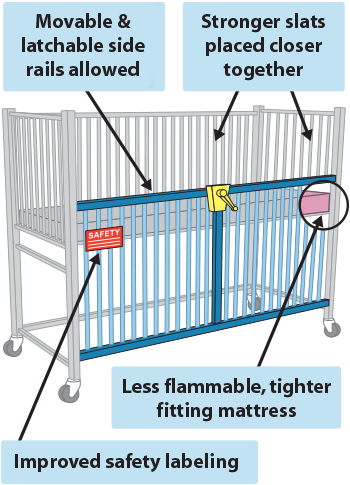
Caring for Your Child in the Home
The same goes if you have bought a pediatric medical crib for use at home. While these cribs are currently available from manufacturers, a new FDA regulation proposes that they will need to be prescribed by a physician for home use.
“Parents with sick children should evaluate the risks and benefits of using a pediatric medical crib in their private home and discuss whether it is medically necessary with their child’s health care professional,” Wagman adds.
If your doctor ever prescribes a pediatric medical crib for home use, it’s important not to continue to use the crib once your baby is well, or to use it for another child. “Just as you would not give your child’s prescription drug to a sibling, do not use the prescribed pediatric medical crib for the other child’s care,” Todd says.
By the same token, if you find your daycare facility is using a pediatric medical crib for your child who does not have special needs, make sure your child is transferred to a non-pediatric medical crib.
“Healthy kids are ingenious at pushing latches and accidentally lowering side rails,” Todd says. “Pediatric medical cribs should be used only with sick children who need easy access from the caregiver.”
Regulating Cribs for Safety
Just as such equipment as wheelchairs and walkers are considered medical devices and as such regulated by FDA, so too are pediatric medical cribs. “For this reason, we have proposed that these cribs should be physician prescribed for use at home,” Wagman says.
Cribs used for nonmedical purposes at home are considered consumer products and are regulated by the Consumer Product Safety Commission (CPSC).
In 2011, CPSC prohibited the making or selling of drop-side rail cribs for non-medical purposes. Children had been suffering frequent injuries, including entrapment and strangulation due to slat and side rail disengagement. CPSC instituted rules to improve slat strength, make hardware stronger, prohibit traditional drop sides, improve mattress support durability, and make safety testing more rigorous.
Since that time, the FDA has been conducting a full-scale review of the best available data on pediatric medical cribs and medical bassinets.
In addition to proposing that pediatric medical cribs be physician-prescribed, FDA’s proposed regulation includes special controls for cribs used in hospitals and other medical facilities that align with those proposed by CPSC in 2011. These controls include establishing standards for spacing between crib slats and improving the quality of hardware and crib testing.
“Many hospitals are already using cribs that meet the FDA’s proposed standards,” says Wagman. “But we need to be sure that every pediatric medical crib is engineered specifically for child safety.”
This article appears on FDA’s Consumer Updates page, which features the latest on all FDA-regulated products.

