Showing posts with label safety. Show all posts

Friday, December 4, 2015

Keep a Sick Child Safe: Learn to Use a Hospital Crib

As any parent whose baby has spent some time in the hospital knows, all cribs are not created equal. In most cases, hospital cribs (also called pediatric medical cribs) differ significantly from what’s in your child’s bedroom at home.
“Each type of crib is specially designed for safe use in the environment in which it is being used,” says Victoria Wagman, M.A., a senior science health advisor at the Food and Drug Administration (FDA).
And it’s important that you, as a parent, know how to use these cribs correctly, both in and out of the hospital—especially if your special needs child uses one of these cribs at home.
Caring for Your Child in the Hospital
In the hospital, pediatric medical cribs provide easier access to sick or special needs babies who are hooked up to medical devices or otherwise need frequent attention or treatment, most often provided by medical staff. Unlike home cribs, hospital or medical cribs have fixed or movable bed end rails, movable and latchable side rail components, and a mattress designed to fit the crib. Hospital nurses and other staff are well trained in operating these cribs safely.
Often when babies need to stay in the hospital overnight or for several nights, the parents stay there, too. “If your baby has rotavirus, for example, you might be the main caretaker in charge of feeding or constant diaper changing throughout the night,” says Joan Ferlo Todd, R.N., M.S. a senior nurse consultant at FDA.
“If so, you need to ask the nursing staff to train you in the proper use of pediatric medical cribs,” she adds.
“Naturally enough, parents in this kind of situation are often frazzled, sleep-deprived and anxious,” Todd says. The last thing they need is to feel uncomfortable or inept in how to operate the crib.
Among other things, Todd explains that parents whose children are using hospital cribs in either setting need to become skilled in the safe use of the crib and comfortable with:
  • latching, locking and opening side rails;
  • raising and lowering the side;
  • raising and lowering the mattress;
  • angling the mattress if necessary; and
  • locking and unlocking the wheels.
“If you are switching off with another caregiver, make sure that person is also proficient in using the crib correctly,” Todd says. If the other caregiver is much taller, for instance, knowing how to raise and lower the mattress can be essential, both for the baby and for the caregiver, who doesn’t want to add back injury—a common problem among caregivers—to the mix.
New safety requirements for pediatric medical cribs:
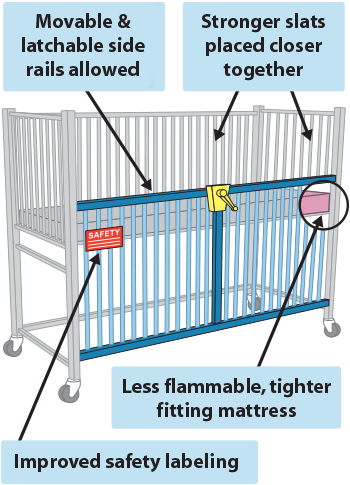
Medical Crib New Safety Features: movable and latchable side rails allowed, stronger slats placed closer together, improved safety labeling, less flammable tighter fitting mattress
Download this high-resolution graphic from Flickr.
Caring for Your Child in the Home
The same goes if you have bought a pediatric medical crib for use at home. While these cribs are currently available from manufacturers, a new FDA regulation proposes that they will need to be prescribed by a physician for home use.
“Parents with sick children should evaluate the risks and benefits of using a pediatric medical crib in their private home and discuss whether it is medically necessary with their child’s health care professional,” Wagman adds.
If your doctor ever prescribes a pediatric medical crib for home use, it’s important not to continue to use the crib once your baby is well, or to use it for another child. “Just as you would not give your child’s prescription drug to a sibling, do not use the prescribed pediatric medical crib for the other child’s care,” Todd says.
By the same token, if you find your daycare facility is using a pediatric medical crib for your child who does not have special needs, make sure your child is transferred to a non-pediatric medical crib.
“Healthy kids are ingenious at pushing latches and accidentally lowering side rails,” Todd says. “Pediatric medical cribs should be used only with sick children who need easy access from the caregiver.”
Regulating Cribs for Safety
Just as such equipment as wheelchairs and walkers are considered medical devices and as such regulated by FDA, so too are pediatric medical cribs. “For this reason, we have proposed that these cribs should be physician prescribed for use at home,” Wagman says.
Cribs used for nonmedical purposes at home are considered consumer products and are regulated by the Consumer Product Safety Commission (CPSC).
In 2011, CPSC prohibited the making or selling of drop-side rail cribs for non-medical purposes. Children had been suffering frequent injuries, including entrapment and strangulation due to slat and side rail disengagement. CPSC instituted rules to improve slat strength, make hardware stronger, prohibit traditional drop sides, improve mattress support durability, and make safety testing more rigorous.
Since that time, the FDA has been conducting a full-scale review of the best available data on pediatric medical cribs and medical bassinets.
In addition to proposing that pediatric medical cribs be physician-prescribed, FDA’s proposed regulation includes special controls for cribs used in hospitals and other medical facilities that align with those proposed by CPSC in 2011. These controls include establishing standards for spacing between crib slats and improving the quality of hardware and crib testing.
“Many hospitals are already using cribs that meet the FDA’s proposed standards,” says Wagman. “But we need to be sure that every pediatric medical crib is engineered specifically for child safety.”
This article appears on FDA’s Consumer Updates page, which features the latest on all FDA-regulated products.

Friday, March 20, 2015

Herbal Medicine:Herbal Products -- Contamination Is Common ♦ Herbal Products Missing Key Safety Info ♦ Herbal Medicines Can Be Lethal + more

Rising Demand for Herbal Medicine Can Increase Cultivation of Medicinal Trees Formalizing trade in herbal medicinal products has the potential to increase the demand for on-farm grown raw material and raise the level of cultivation of medicinal tree species in smallholder Continue Reading
Analysis of Herbal Products Shows Contamination Is Common Most herbal products, available to buy as alternative medicines, may be contaminated. Researchers demonstrate the presence of contamination and substitution of plant species in a selection of herbal  Continue Reading
Buyer Beware: Herbal Products Missing Key Safety Information  Many herbal remedies available over-the-counter in pharmacies and health food shops are still lacking important information needed for safe use, according to Continue Reading

Herbal Medicines Can Be Lethal, Pathologist Warns A forensic pathologist has sounded a worldwide warning of the potential lethal dangers of herbal medicines if taken in large quantities, injected, or combined with prescription.  Continue reading

Wednesday, December 31, 2014

12/31/14 Health News: Activating hair growth with immune cells ♦ Walmart enhancing poultry safety ♦ Doctored food labels in China ♦ Christmas dinner that left dozens ill, one dead

Activating hair growth by modifying immune cells
How to restore hair loss is a task not undertaken exclusively by beauty practitioners. The discover reveals a novel angle to spur hair follicle growth. This also adds new knowledge to a broader problem: how to regenerate tissues in an adult organism, especially the skin Continue Reading
Walmart enhancing poultry safety measures
Walmart said Thursday it will implement enhanced poultry safety measures for suppliers, designed to further protect customers against food-borne illnesses. The company said all poultry suppliers for its Walmart and Sam’s Club stores must be in compliance with the new requirements by June 2016. Walmart said the new guidelines are in addition to the company’s food safety program … Continue Reading
Subway to investigate allegation on doctored food labels in China
FBR Staff Writer Published 30 December 2014 American fast food restaurant chain Subway has announced an investigation over a media report in China alleging that workers at a Beijing franchise manipulated food labels. The report said that workers in Beijing Subway outlet doctored the expiry and production dates on meat, drink and vegetable products in order to extend the use, … Continue Reading
Lions club says it's not responsible for dinner that left dozens ill, one dead
A club in Nackawic, N.B., is defending its image after a Christmas dinner at the club’s location left more than 30 people ill and one dead. More than 100 people attended the Dec. 5 turkey dinner, which was hosted by a local church. After eating, more than 30 people became sick.  Continue Reading

Saturday, May 24, 2014

Prevent Recreational Water Illness and Injury

Photo: Young girls playing in pool

Having fun while you swim this summer means knowing how to prevent recreational water illnesses (RWIs) and injuries. Learn how to stay healthy and safe while enjoying the water!
Swimming is one of the most popular sports activities in the United States1. Although swimming is a physical activity that offers many health benefits, pools and other recreational water venues are also places where germs can be spread and injuries can happen.

Prevent Illnesses

Recreational water illnesses (RWIs) are caused by germs spread by swallowing, breathing in mists or aerosols of, or having contact with contaminated water in swimming pools, hot tubs/spas, interactive fountains, lakes, rivers, or oceans.
Contrary to popular belief, chlorine and other disinfectants do not kill germs instantly. While most germs are killed within minutes, Crypto (short for Cryptosporidium) can live for days. Before they are killed, these germs can cause RWIs, such as gastrointestinal, skin, ear, respiratory, eye, neurologic, and wound infections. The most commonly reported RWI is diarrhea caused by germs such as Crypto, Giardia, Shigella, norovirus and E. coli O157:H7. Swallowing just a mouthful of water that contains these germs can make you sick.
We all share the water we swim in, and we each need to do our part to keep ourselves, our families, and our friends healthy. To help protect yourself and loved ones from germs, here are a few simple and effective steps all swimmers can take each time we swim:
Keep the poop, germs, and pee out of the water.
  • Don't swim when you have diarrhea.
  • Shower with soap before you start swimming.
    • Take a rinse shower before you get back into the water.
  • Take bathroom breaks every 60 minutes.
  • Wash your hands after using the toilet or changing diapers.
Check the free chlorine level and pH before getting into the water.
  • Pools: Proper chlorine (1–3 mg/L or parts per million [ppm]) and pH (7.2–7.8) levels maximize germ-killing power.
  • Hot tubs/spas: Proper disinfectant level (chlorine [2–4 parts per million or ppm]) or bromine [4–6 ppm]) and pH (7.2–7.8) maximize germ-killing power.
  • Most superstores, hardware stores, and pool-supply stores sell pool test strips.
    • Free pool test strips: Go to the Water Quality & Health Council (WQHC)'s Healthy Pools page to order and receive free test strips. (Please note that any questions regarding your order or the availability of test strips should be addressed to the WQHC,
    • Don't swallow the water you swim in.
Parents of young children should take a few extra steps:
  • Take children on bathroom breaks every 60 minutes or check diapers every 30–60 minutes.
    • Change diapers in the bathroom or diaper-changing area and not at poolside where germs can rinse into the water.
Visit CDC's Healthy Swimming website for more information. A variety of materials for the public, including infographics, brochures, posters, videos, podcasts, and fact sheets are available in the Health Promotion Materials section.

Prevent Drowning

Drowning is the leading cause of injury death among children 1–4 years old. Every day, 10 people die from drowning, and 2 of those 10 are children under the age of 15 years. Of drowning victims who survive and are treated in emergency rooms, more than half are hospitalized or transferred for further care. These individuals often experience brain damage, which can cause memory problems, learning disabilities, or permanent loss of basic functioning (or permanent vegetative state).
Keep swimmers safe in the water.
  • Make sure everyone knows how to swim.
  • Use life jackets appropriately.
  • Provide continuous, attentive supervision close to swimmers.
  • Know CPR (for older children and adults).
Prevent access to water when pool is not in use.
  • Install and maintain barriers like 4-sided fencing and weight-bearing pool covers.
  • Use locks/alarms for windows and doors.
Visit the Water-Related Injuries webpage for more information.

Prevent Pool Chemical Injuries

Pool chemicals are added to the water to kill germs and maximize disinfection. However, the same pool chemicals can also injure us if they're not handled and stored safely. Preventable injuries from pool chemicals led to nearly 5,000 emergency room visits in 2012. Nearly half of these preventable injuries were in children and teenagers and more than a third of these preventable injuries occurred at a home rather than a community pool.
Residential pool owners and public pool operators can follow these simple and effective steps to prevent pool chemical injuries:
  • Read and follow directions on product labels.
  • Wear appropriate safety equipment, such as goggles and masks, as directed, when handling pool chemicals.
  • Secure pool chemicals to protect people and animals.
    • Keep young children away when handling chemicals.
  • NEVER mix different pool chemicals with each other, especially chlorine products with acid.
  • Pre-dissolve pool chemicals ONLY when directed by product label.
    • Add pool chemical to water, NEVER water to any pool chemical.
Visit the Pool Chemical Safety page for more information, including free posters and a video on pool chemical safety.
Remember: Think Healthy. Swim Healthy. Be Healthy!

Saturday, November 16, 2013

11/16/13 Health News:, Disease Diagnosing Smartphone, Labeling Meat for Growth Chemicals,

USDA INTRODUCES CERTIFICATION PROGRAM FOR MEAT WITHOUT GROWTH-ENHANCING DRUGS
A new U.S. Department of Agriculture certification program for livestock producers may permit them to market their products with a special “Never Fed Beta Agonists” label. Beta agonists are feed additives used to increase muscle mass and promote weight gain in livestock animals. The drugs are typically added to feed along with vitamins and given...Continue Reading

FDA SHOULD EXPAND FOCUS AND ADOPT FOOD SYSTEMS APPROACH TO SAFETY
Want to hear something delicious? Recently the Food and Drug Administration reported that 12 percent of all U.S. spice imports were contaminated with non-spice-like objects, including whole insects and rodent hairs. As Americans, we are lucky to have FDA, which has been (for years) comprehensively studying the issue of spice safety and is moving toward... Continue Reading

Health IT Could Reduce Demand For Physicians
If health IT were fully implemented in 30% of community-based physicians' offices, the gains in efficiency would reduce demand for physicians by 4% to 9%, according to a new study in Health Affairs. If 70% of office-based physicians adopted comprehensive health IT -- including interoperable EHRs, clinical decision support, provider order entry and patient Web portals with secure messaging -- the impact on physician workforce requirements would be twice as large, the study said.
In addition, the study pointed out, 5% to 10% of real-time "office-based care" could be delivered remotely by providers whose patients are not in the physician's office. Continue reading

Utah Physician Invents Disease-Diagnosing Smartphone App
Intermountain Medical Center physician Joel Ehrenkranz has invented a smartphone app that diagnoses diseases. To show how his i-calQ app works, Ehrenkranz drew a small amount of blood from Brittnie, an expectant mother. She was not in a clinic or a lab, but outside in a small park. Ehrenkranz placed the blood sample in a holder then inserted it into an inexpensive reader attached to a smartphone.  In one minute, the smartphone had the results of her blood hemoglobin. Within 15 minutes, it had evaluated her thyroid test.
…Ehrenkranz got the idea for this new technology in 2007 while working on the border between Uganda and the Congo. During an Ebola outbreak he theorized the beginnings of smartphone technology that could evolve into an immediate diagnosing tool. continue reading

Tuesday, October 29, 2013

Lucky 13' Tips for a Safe Halloween


Whether you’re goblin or ghoul, vampire or witch, poor costume choices—including decorative contact lenses and flammable costumes—and face paint allergies can haunt you long after Halloween if they cause injury.
Enjoy a safe and happy Halloween by following the “lucky 13” guidelines from FDA, the Consumer Product Safety Commission, and the Centers for Disease Control and Prevention:
  1. Wear costumes made of fire-retardant materials; look for “flame resistant” on the label. If you make your costume, use flame-resistant fabrics such as polyester or nylon.
  2. Wear bright, reflective costumes or add strips of reflective tape so you’ll be more visible; make sure the costumes aren’t so long that you’re in danger of tripping.
  3. Wear makeup and hats rather than masks that can obscure your vision.
  4. Test the makeup you plan to use by putting a small amount on the arm of the person who will be wearing it a couple of days in advance. If a rash, redness, swelling, or other signs of irritation develop where the makeup was applied, that's a sign of a possible allergy.
  5. Check FDA’s list of color additives to see if makeup additives are FDA approved. If they aren’t approved for their intended use, don’t use it.
  6. Don’t wear decorative contact lenses unless you have seen an eye care professional and gotten a proper lens fitting and instructions for using the lenses.
Safe Treats
Eating sweet treats is also a big part of the fun on Halloween. If you’re trick-or-treating, health and safety experts say you should remember these tips:
  1. Don’t eat candy until it has been inspected at home.
  2. Trick-or-treaters should eat a snack before heading out, so they won’t be tempted to nibble on treats that haven’t been inspected.
  3. Tell children not to accept—or eat—anything that isn’t commercially wrapped.
  4. Parents of very young children should remove any choking hazards such as gum, peanuts, hard candies, or small toys.
  5. Inspect commercially wrapped treats for signs of tampering, such as an unusual appearance or discoloration, tiny pinholes, or tears in wrappers. Throw away anything that looks suspicious.
For partygoers and party throwers, FDA recommends the following tips for two seasonal favorites:
  1. Look for the warning label to avoid juice that hasn’t been pasteurized or otherwise processed, especially packaged juice products that may have been made on site. When in doubt, ask! Always ask if you are unsure if a juice product is pasteurized or not. Normally, the juice found in your grocer’s frozen food case, refrigerated section, or on the shelf in boxes, bottles, or cans is pasteurized.
  2. Before bobbing for apples—a favorite Halloween game—reduce the amount of bacteria that might be on apples by thoroughly rinsing them under cool running water. As an added precaution, use a produce brush to remove surface dirt.
Eye Safety
FDA joins eye care professionals—including the American Academy of Ophthalmology, the American Association for Pediatric Ophthalmology and Strabismus, the Contact Lens Association of Ophthalmologists and the American Optometric Association—in discouraging consumers from using decorative contact lenses.
These experts warn that buying any kind of contact lenses without an examination and a prescription from an eye care professional can cause serious eye disorders and infections, which may lead to permanent vision loss. Despite the fact that it’s illegal to sell decorative contact lenses without a valid prescription, FDA says the lenses are sold on the Internet and in retail shops and salons—particularly around Halloween.
The decorative lenses make the wearer’s eyes appear to glow in the dark, create the illusion of vertical “cat eyes,” or change the wearer’s eye color.
"Although unauthorized use of decorative contact lenses is a concern year-round, Halloween is the time when people may be inclined to use them, perhaps as costume accessories," says FDA eye expert Bernard Lepri, O.D., M.S., M.Ed.. "What troubles us is when they are bought and used without a valid prescription, without the involvement of a qualified eye care professional, or without appropriate follow-up care. This can lead to significant risks of eye injuries, including blindness."

Monday, September 9, 2013

Hospital-Acquired Infections Rack Up $9.8 billion a Year

At least 15 people may have been exposed to Creutzfeldt-Jakob disease from neurosurgery instruments that had first been used at Catholic Medical Center in Manchester, N.H.
This is one example of our  nation's hospitals, nursing homes and outpatient clinics continue to fall short when it comes to performing necessary steps to prevent the spread of infection that can cause illness or death, new data from the Joint Commission show.
Hospital-acquired infections (HAI) cost $9.8 billion per year, with surgical site infections alone accounting for one-third of those costs, followed closely by ventilator-associated pneumonia at devices and supplies. Among ambulatory care operators, such as outpatient surgery centers, 37% failed to meet the same standard.  One out of five long-term care providers and one out of four home care providers did not meet guidelines for hand hygiene.
The Joint Commission accredits the quality and safety of healthcare operators. It released its ranking of standards that proved most problematic for healthcare companies in the first six months of 2013.   Preventing infection and hand washing were standards where ambulatory care, hospital and long-term-care providers struggled. There had been no improvement over the previous two years.
47% of hospitals did not comply with processes to reduce the risk of infections associated with medical equipment, devices and supplies. Among ambulatory care operators, such as outpatient surgery centers, 37% failed to meet the same standard.
Infections spread by medical devices or health care providers have long been identified as a major source of cost, illness and death. A growing body of research has sought to pinpoint the cost and harm from healthcare-associated infections and ways to prevent their spread.
Hand washing ranks highly as a way to prevent patients from acquiring infections in healthcare facilities, but compliance remains a stubborn problem among healthcare providers. Reasons for the lack of progress are unrealistic and inflated appraisal by providers of their own performance. Also time pressures on the staff or floor plans that tuck sinks in out-of-the-way locations.
Some organizations now deploy staff to secretly observe adherence and provide feedback to the organization or problematic individuals.
That type of accountability is necessary to improve performance, said Patricia McGaffigan, a nurse, chief operating officer and senior vice president of the National Patient Safety Foundation. “A true culture of safety will not tolerate these misses in hand hygiene and they will hold people accountable for not practicing their hand hygiene appropriately,” many organizations now deploy staff to secretly observe adherence and provide feedback to the organization—or problematic individuals.
One Company has come out with a badge for caregivers to wear. By using GPS the badge rings if the caregiver goes to a patient without stopping by the sink to wash their hands.