Showing posts with label dendritic cells. Show all posts

Wednesday, January 13, 2016

Immunity Research: Life-extending hormone bolsters the body's immune function ♦ Compound found to trigger innate immunity against viruses

Compound found to trigger innate immunity against viruses A drug-like molecule can activate innate immunity and induce genes to control infection in a range of RNA viruses, including West Nile, dengue, hepatitis C, influenza A, respiratory syncytial, Nipah, Lassa and Ebola.
Neanderthal genes gave modern humans an immunity boost, allergies When modern humans met Neanderthals in Europe and the two species began interbreeding many thousands of years ago, the exchange left humans with gene variations that have increased the ability of those who carry them to ward off infection. This inheritance from Neanderthals may have also left some people more prone to allergies.
Life-extending hormone bolsters the body's immune function A hormone that extends lifespan in mice by 40% is produced by specialized cells in the thymus gland, according to a new study. The team also found that increasing the levels of this hormone, called FGF21, protects against the loss of immune function that comes with age.
Novel mechanism that helps activated dendritic cells to initiate effective immunity Phagocytosis represents a critical innate barrier against infection and serves the clearance of extracellular microbes, infected and dying cells. Different immune cells use phagocytosis for microbial killing, but in dendritic cells (DCs) it mainly serves the processing and presentation of specific molecules (antigens) that are able to alert the immune system and to initiate immune responses. Researchers describe now a mechanism of how the fusion between phagosomes and lysosomes influences the presentation of antigens on major histocompatibility complex (MHC) I molecules to cytotoxic T cells, a process called cross-presentation

Thursday, June 18, 2015

Immune System Research: Restoring natural immunity against cancers ♦ Scientists map surface of immune cells ♦ Returning killer T cells back to barracks could improve vaccines

Dendritic cells of elite controllers able to recognize, mount defense against HIV Investigators have added another piece to the puzzle of how a small group of individuals known as elite controllers are able to control HIV infection without drug treatment. The research team reports finding that dendritic cells of elite controllers are better able to detect the presence of HIV, which enables them to stimulate the generation of T cells specifically targeting the virus.
Scientists map surface of immune cells The immune system must constantly adapt to its environment in order to protect a body effectively. The so-called T cells are an important example in this regard. One of their functions is to form the immune system's "memory". Researchers recently examined the surface of precursors of these T cells and identified previously unknown proteins there. According to the scientists, the results could lead to new approaches for therapies for asthma and allergies.
Returning killer T cells back to barracks could improve vaccines Just as militaries need to have trained, experienced soldiers ready for future wars, making sure that the immune system has enough battle-ready T cells on hand is important for fast-acting, more effective vaccines, according to researchers
Restoring natural immunity against cancers Scientists have successfully increased the infiltration of immune cells into tumors, thus inducing the immune system to block tumor growth. In a new article, the scientists show that, in combination with existing immunotherapies, this process efficiently destroys cancer cells.
Adenosine in Ambrosia pollen increases allergic response Ragweed (Ambrosia artemisiifolia) -- an otherwise unremarkable plant -- produces pollen that can trigger strong allergic reactions such as asthma even in very small quantities. Scientists have now published a study showing that the substance previously identified as the major allergen only induces such a vigorous allergic response in combination with the adenosine also present in the pollen.

Monday, March 30, 2015

Boosting Immunotherapy Against Brain Cancer

Cancer immunotherapies harness the potential of the immune system to seek and destroy cancers. They first came into use in the 1990s, and the field is now quickly advancing. One innovative approach being developed is to use dendritic cells. These are a type of immune cell that captures microorganisms and processes their proteins to present to other immune cells and prompt a response.
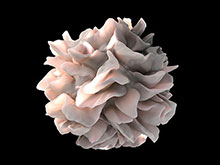
Dendritic cell.
An artist’s representation of the surface of a human dendritic cell. Image courtesy of NCI.
Dendritic cells have recently been used for immunotherapy to target a variety of tumor types. Dendritic cells are isolated from the patient’s blood, engineered to express antigens from the tumor, and then injected back into the patient as a vaccine. Once in the patient, the engineered dendritic cells migrate to the lymph node and activate T cells to fight the tumor and create an immune memory to prevent the cancer from coming back.
Researchers led by Drs. Duane A. Mitchell and John H. Sampson at Duke University Medical Center tested whether a strategy to increase dendritic cell migration to lymph nodes would improve the effects of a dendritic cell vaccine against glioblastoma multiforme, the most common form of malignant brain cancer in adults. The vaccine targeted an antigen from cytomegalovirus. The role of this virus in disease progression is unclear, but past studies have found that cytomegalovirus proteins are specifically expressed in glioblastoma tumors but not in normal brain cells.
Twelve patients newly diagnosed with glioblastoma were given standard radiation and chemotherapy, and randomly divided into 2 groups. One group received a tetanus booster shot, designed to set off an inflammatory response at the site of the vaccination and prep the immune system. The other patients were injected with their own unaltered dendritic cells instead of a tetanus shot. All were then treated with the dendritic cell vaccine against the cytomegaloviral antigen. The research was funded in part by NIH’s National Institute of Neurological Disorders and Stroke (NINDS) and National Cancer Institute (NCI).
The results, published on March 19, 2015, in Nature, showed that administering a tetanus booster before the vaccine increased dendritic cell migration to lymph nodes and significantly improved both the time without disease progression and overall survival. Patients who received the tetanus booster lived an average of more than 3 years after diagnosis compared to 1.5 years in those who received dendritic cells alone.
The team used a mouse model to determine how the tetanus booster increased dendritic cell migration to lymph nodes. They found that migration depended on memory T cells specific to the tetanus toxoid. Migration also depended on 2 signaling proteins known to guide cell migration: chemokines CCL3 and CCL21.
“We did not expect that enhancing dendritic cell migration would be associated with such a dramatic improvement on clinical outcomes in our patients,” Mitchell says.
Larger clinical studies will be needed to confirm this approach of boosting immune responses and targeting cytomegalovirus in glioblastomas. Continued research into the mechanisms involved in the response to cancer vaccines—and how best to target cytomegalovirus and other tumor proteins—may also lead to further improvements.