Showing posts with label intestinal bacteria. Show all posts

Thursday, December 3, 2015

Bacterial Research:Promising new antimicrobials could fight drug-resistant MRSA infection ♦ Novel intestinal bacterium provides human gut with healthy compounds

Promising new antimicrobials could fight drug-resistant MRSA infection A novel class of antimicrobials that inhibits the function of a key disease-causing component of bacteria could be effective in fighting methicillin-resistant Staphylococcus aureus (MRSA), one of the major drug-resistant bacterial pathogens.
Important step toward preventing, treating some MRSA post-implant infections Staphylococcus aureus infections take hold after prosthetic surgery that are resistant to both the body's natural defenses as well as antibiotic treatments.
Intestinal bacteria are affected by antidiabetic drugs Intestinal bacteria change their composition and function when diabetic patients are treated with the drug metformin, shows new research. In the field of disease research, changes in the composition and function of the complex intestinal bacterial communities -- so-called dysbioses -- have become a focus area. It is, however, a weakness of the studies that researchers have not taken into account the potential effects of drugs on the patient's  intestinal bacteria, say investigators.
Novel intestinal bacterium provides human gut with healthy compounds Fibers in our food are thought to be good for health since they are converted in the intestinal tract into the favorable compound butyrate, that is crucial to maintain intestinal health. In contrast, protein is believed to be less healthy since intestinal fermentation of the building blocks of proteins, amino acids, generates undesired compounds. This latter picture is now changing since a novel intestinal bacterium has been isolated by researchers.

Friday, August 7, 2015

Cardiovascular Research:Get up for your heart health, move for your waistline ♦ Social factors linked to heart disease for all ♦ Why the human heart cannot regenerate

Get up for your heart health, move for your waistline More time spent standing rather than sitting could improve your blood sugar, fats in the blood and cholesterol levels. The study also shows that replacing time spent sitting with time walking could have additional benefits for your waistline and body mass index.
Byproduct of intestinal bacteria may jeopardize heart health in patients with kidney disease Blood levels of TMAO, a byproduct generated from intestinal bacterial as they metabolize dietary nutrients, progressively increase with advancing severity of kidney disease. TMAO levels are dramatically reduced when kidney function is restored following kidney transplantation, researchers say, noting that high TMAO levels are linked with an increased risk of atherosclerosis and premature death in patients with chronic kidney disease.
Social factors linked to heart disease for all The social determinants of health are multi-dimensional and multi-level, yet we have few studies that examine the social determinants in large, diverse populations. More extensive research and new interventions are needed, an expert writes, if we are to reach the a goal of increasing the proportion of the population in ideal cardiovascular health by 2020
Why the human heart cannot regenerate Damage to the human heart causes cardiac muscle cells to die, which in turn leads to reduced heart function and death. However, this is not the case for zebrafish or amphibians. If their hearts become damaged and cardiac muscle cells die, their remaining cardiac muscle cells can reproduce, allowing the heart to regenerate. Researchers have now found a possible explanation as to why this does not happen in humans.
Working to ensure the heart's ideal performance Utilizing a pharmaceutical treatment for systolic heart failure, that is being tested in clinical trials, new research determined the precise interaction between the drug and the cardiac myosin protein or the cardiac “motor,” forming a structure that regulates the contraction of cardiac muscle and allows the heart to efficiently pump oxygen-rich blood throughout the body.

Friday, July 31, 2015

Bacterial Research:Link between intestinal bacteria, depression found ♦ Atomic view of bacterial enzymes that help human digestion ♦ Treatment of relapsing bacterial infections

Link between intestinal bacteria, depression found The complex mechanisms of interaction and dynamics between the gut microbiota and its host have been illuminated by recent research. Data show that relatively minor changes in microbiota profiles or its metabolic activity induced by neonatal stress can have profound effects on host behavior in adulthood.
New research opens the door for treatment of relapsing bacterial infections A new discovery could put people with relapsing urinary tract infections (UTIs) on the fast track for a new therapeutic regimen. An estimated 150 million UTIs occur each year worldwide, accounting for $6 billion in healthcare costs, according to the American Urological Association.
Atomic view of bacterial enzymes that help human digestion A group of researchers has reached deep into the human gut, plucked out a couple enzymes produced by bacteria residing there and determined their biological activities and molecular structures -- details that should shed new light on how we digest many of the foods we eat.

Evolutionary war between microorganisms affecting human health Health experts have warned for years that the overuse of antibiotics is creating 'superbugs' able to resist drugs treating infection. Now scientists have found evidence that an invisible war between microorganisms may also be catching humans in the crossfire.

Thursday, April 2, 2015

Health Research: Deadly fungus evades the immune system ♦ Why skin is resistant to tearing ♦ Bionic hand, powered by his thoughts

How a deadly fungus evades the immune system New research has scientists rethinking how a lethal fungus grows and kills immune cells. The study hints at a new approach to therapy for Candida albicans, one of the most common causes of bloodstream infections.
Protein may improve liver regeneration: GF21 boosts regenerative ability in mice carrying human PPAR alpha protein Researchers have illuminated an important distinction between mice and humans: how human livers heal. The difference centers on a protein called PPAR alpha which activates liver regeneration.
Skin tough: Why skin is resistant to tearing Researchers have recorded the first direct observations of the micro-scale mechanisms behind the ability of skin to resist tearing. The results could be applied to the improvement of artificial skin, or to the development of thin film polymers for flexible electronics.
Non-invasive technique allows amputee to use bionic hand, powered by his thoughts Medical researchers have created an algorithm that allowed a man to grasp a bottle and other objects with a prosthetic hand, powered only by his thoughts.
Intestinal bacteria can be used to classify effects of different diseases It is possible to quantify and classify the effects of different diseases on the activity of intestinal bacteria, new research demonstrates for the first time. Human intestinal flora, known as microbiota, can be considered as an additional organ in the body. It consists of millions of bacteria that interact with each other and with the body, thus affecting its functioning and health. It is known that many intestinal disorders such as Crohn's disease and ulcerative colitis, and diseases such as obesity, cancer and autoimmune diseases can cause changes in the composition of gut bacteria.

Monday, October 6, 2014

Diet Affects Autoinflammatory Disease Via Gut Microbes

At a Glance
  • A study in mice revealed how diet-induced changes to intestinal bacteria can influence susceptibility to autoinflammatory disease.
  • The results could help guide new approaches to treat autoinflammatory diseases in susceptible people.
In autoinflammatory diseases, the innate immune system, for unknown reasons, becomes activated and triggers inflammation. This part of the immune system is the body’s rapid first line of defense against infection. The short-term heat, swelling, and redness of inflammation are a normal part of the body’s protective response to injury or infection. But prolonged inflammation can seriously damage the body.
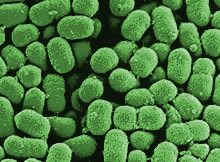
Prevotella
Prevotella in the gut has been linked to inflammation. Image by Yamanaka et al., courtesy of BMC Microbiol., 2009, 9:11.
Recent research suggests that diet can affect certain autoimmune diseases. A team led by Dr. Thirumala-Devi Kanneganti of St. Jude Children’s Research Hospital studied mutant mice that develop a condition resembling chronic recurrent multifocal osteomyelitis in humans. This rare inflammatory bone condition is marked by pain and joint swelling, and can cause slow growth and permanent bone deformity. Their study was funded in part by NIH’s National Institute of Arthritis and Musculoskeletal and Skin Diseases (NIAMS), National Cancer Institute (NCI), and National Institute of Allergy and Infectious Diseases (NIAID). It appeared online on September 28, 2014, in Nature.
As expected, mutant mice fed a regular diet developed hind paw inflammation, bone erosion, and enlarged lymph nodes by day 100. Tissue analysis showed infiltrating immune cells, such as neutrophils, and significant bone destruction. However, mutant mice fed a diet rich in saturated fats and cholesterol were largely protected.
Diets high in fat and cholesterol are known to cause changes in gut microbe communities. The team’s analysis showed that the intestinal microbiota in regular-fed mutant mice was markedly different from that of healthy wild-type mice. Some of the differences, such as increased Prevotella bacteria in the mutant animals, have been linked to inflammation. These changes were significantly reduced in mutant mice fed a high-fat diet.
Antibiotics protected the regular-diet mutant mice from osteomyelitis. To further explore the role of the intestinal microbiota in autoinflammatory disease, the team performed fecal transplantation studies. Transplanting the microbiota of regular-fed mutant mice to young mice boostedPrevotella levels and sped osteomyelitis. Conversely, transplanting the microbiota of high-fat-fed mice into young mice limited Prevotella and protected mice from osteomyelitis.
To better understand the mechanisms involved, the researchers analyzed levels of interleukin-1β (IL-1β), which has previously been linked to inflammatory bone disease, in the animals’ footpads. IL-1β protein concentrations were significantly increased in the footpads of regular-fed mutant mice, whereas levels in those fed a high-fat diet were comparable to healthy controls. This suggests that the high-fat diet suppressed osteomyelitis in the susceptible mice by affecting levels of IL-1β.
Together, these findings show that diet affects osteomyelitis in susceptible mice by altering the intestinal microbiota, which in turn influence IL-1β levels in distant neutrophils. Exactly how the microbiota affect IL-1β levels remains to be determined.
“Multiple lines of evidence suggest that dietary consumption can impact human disease; however, the scientific mechanisms involved have been lacking,” Kanneganti says. “Our results demonstrate that diet can influence immune-mediated disorders by shaping the composition of commensal bacteria.”
—by Harrison Wein, Ph.D.