Showing posts with label seniors. Show all posts

Monday, November 23, 2015

Senior's Health: How fast you move can predict how healthy you'll be ♦ New app helps seniors live better ♦Team approach may reduce readmissions due to falls in seniors

A comprehensive care program that involves a team of specialists from multiple medical disciplines for treating injuries sustained from falls in older adults could help reduce hospital readmissions, according to researchers. Under the program, the 30-day readmission rate for falls declined 10 percent from 2012-13 and remained unchanged in 2014. The 30-90 day readmission rate from 2012-13 also declined, before rising slightly in 2014.
A new technological solution developed by researchers is aimed at enhancing the physical health, vitality and brain fitness of seniors residing in independent living communities.
Instead of focusing on drawing out the length of life, researchers have created a tool that can be used for accurately predicting lifespan as well as assessing the current health state, and discovered the regulatory mechanism that extends “healthspan”, the time in which an organism is at its optimal health.
Even among Americans in their mid-70's and older, being more active, including walking at a reasonable pace or distance, is linked to a lower risk of cardiovascular events,

Monday, March 23, 2015

Physical Activity May Reduce Age-Related Movement Problems

Age-related brain lesions known as white matter hyperintensities have been linked to movement problems and disabilities later in life. These lesions, which appear as bright spots on MRI images, can be used as a proxy measure of brain white matter disease. They are thought to reflect small blood vessel disease, and have also have been associated with dementia and other health issues in older people.
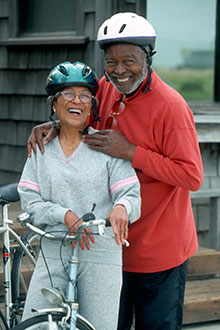
Healthy older cyclists.
Research has found that, whatever your health and physical abilities, you can gain a lot by being active.
Previous research has found that seniors who are more physically active are at lower risk for walking difficulties and other movement problems. Researchers led by Dr. Debra A. Fleischman of Rush University Medical Center in Chicago examined whether physical activity can affect the link between age-related brain lesions and motor function in older adults.
The researchers scanned the brains of 167 healthy older adults who were participating in a larger study of memory and aging. The participants’ average age was 80. The investigators gave the participants various movement and strength tests. Participants also wore monitors on their wrists for up to 11 days to measure daily physical activity. The study appeared online in Neurology on March 11, 2015.
As expected, the researchers found that more physical activity was associated with better motor function. More age-related brain lesions were generally linked to poorer motor function. Physical activity levels were not related to the amount of lesions. However, among participants who were most active, the lesions weren’t linked to poorer motor skills. Other factors like body mass index and vascular disease had no effect on the relationship between the brain lesions, daily activity, and motor function.
These results suggest that the level of physical activity later in life doesn’t affect white matter hyperintensities but influences motor function via some other pathway. How physical activity might protect motor skills from the effects of these age-related brain lesions remains unknown. Previous studies suggest that physical activity may enhance brain health by increasing blood flow and other vascular functions in the brain.
“These results underscore the importance of efforts to encourage a more active lifestyle in older people to prevent movement problems, which is a major public health challenge,” Fleischman says. “Physical activity may create a ‘reserve’ that protects motor abilities against the effects of age-related brain damage.”
The associations found in this study suggest, but don’t prove, that physical activity can protect against the loss of motor function caused by age-related brain lesions. The group is now monitoring brain scans over time to more closely examine the relationships between white matter hyperintensities, physical activity, and motor function.