Showing posts with label Physical Activity. Show all posts

Friday, October 30, 2015

Health Research: Learning in your sleep, the right way ♦ Language, immigrant status tied to toxic exposure ♦ Treatments offer hope for chronic fatigue syndrome

Prevention of mental disorders through physical activity Adults who perform high or mild levels of total physical activity present higher levels of mental health than those performing low levels of physical activity, a study concludes. They also found that the level of exercise performed in leisure time is inversely related to vulnerability to mental disorders.
Learning in your sleep, the right way You can swot up on vocabulary in your sleep, but only if you don’t confuse your brain in the process. Researchers have invited people to their sleep lab for a Dutch language course.
Language, immigrant status tied to toxic exposure Economically disadvantaged immigrant neighborhoods of non-English speaking Latinos are more likely to be exposed to cancer-causing air toxins than comparable communities of any other racial group in the United States.
Treatments offer hope for chronic fatigue syndrome Two treatments for chronic fatigue syndrome have long term benefits for people affected by chronic fatigue syndrome. The team was following up patients who took part in a study published in 2011. In that study they looked at four potential treatments for Chronic Fatigue Syndrome (CFS) and found that cognitive behavioural therapy (CBT) and graded exercise therapy (GET) achieved better outcomes than standard medical care (SMC) and adaptive pacing therapy (APT) at one year

Monday, October 26, 2015

Women's Health: Most healthy women would benefit from light meal during labor ♦ Magnesium during labor may reduce risk of fever in mothers and complications in babies

Physical activity has greater impact on body composition in postmenopausal women Everyone knows that exercise is good for you, regardless of your age. But a new study shows that some types of physical activity have a greater impact on body composition in postmenopausal compared to premenopausal women.
Unhealthy pregnancy weight gain tips the scales for mothers seven years later For the first time, researchers studied the association between gestational weight gain and long-term weight retention among a multiethnic urban population. Results show that mothers with excessive weight gain during pregnancy weighed more and had greater body fat seven years after delivery if they began pregnancy at normal or at slight overweight and suggest that excessive gestational weight gain has long-term consequences for women who are normal weight or a little overweight before pregnancy.
Most healthy women would benefit from light meal during labor Most healthy women can skip the fasting and, in fact, would benefit from eating a light meal during labor, suggests new research. Improvements in anesthesia care have made pain control during labor safer, reducing risks related to eating, researchers note.
Magnesium during labor may reduce risk of fever in mothers and complications in babies Women who received magnesium sulfate during labor were less likely to develop maternal fever, a condition that can lead to a variety of complications in newborns including difficulty breathing, seizures, cerebral palsy and a condition known as “floppy baby syndrome,” characterized by inadequate muscle tone.

Saturday, October 17, 2015

Cardiovascular Research:3D scans spot earliest signs of heart disease ♦ Lower systolic blood pressure reduces risk of hypertension complication ♦ Low physical activity responsible for 17 percent of cardiovascular deaths

Low physical activity responsible for 17 percent of cardiovascular deaths in Argentina Low levels of physical activity are responsible for 17 percent of cardiovascular deaths in Argentina.
Lower systolic blood pressure reduces risk of hypertension complication Lowering systolic blood pressure below the currently recommended target can reduce the risk of left ventricular hypertrophy (LVH), the most common complication of high blood pressure.
Favorable one-year clinical outcomes for catheter-based aortic valve replacement with latest generation of device Findings from the PARTNER II Trial, which examined one-year clinical outcomes among high-risk or inoperable patients who received TAVR with the latest generation of balloon-expandable (SAPIEN 3) device, are being released by researchers, suggesting that the new device offers promising outcomes for patients.
Zebrafish study sheds new light on human heart defects Researchers working with zebrafish have published a study providing new insights into the causes of the congenital heart defects associated with a rare developmental disorder. The disorder, Cornelia de Lange Syndrome (CdLS), is estimated to occur in up to one in 10,000 births worldwide. CdLS causes a range of developmental anomalies, both physical and cognitive, and up to 70 percent of people with CdLS have congenital heart defects.
3D scans spot earliest signs of heart disease People with high blood pressure develop changes in their hearts even before symptoms appear, new research shows. These changes are known to put people at risk of dying early, and the new work suggests it is possible for doctors to recognize such signs of heart disease earlier than they can today -- by examining detailed images of the heart.

Tuesday, May 19, 2015

Senior's Health: New Alzheimer's drug to enter clinical trials ♦ Physical activity linked to lower risk of early death ♦ Age-friendly communities essential to urban elders' well-being

Age-friendly communities essential to urban elders' well-being  The future of communities around the world will in large part be determined by the efforts to achieve a high quality of life for their older citizens. Age-friendly communities are designed to promote aging-in-place, which is the ability to live in one's own home and community safely, independently, and comfortably regardless of age, income, or ability level.
Half hour of physical activity 6 days a week linked to 40 percent lower risk of early death Thirty minutes of physical activity -- irrespective of its intensity -- six days a week is linked to a 40 percent lower risk of death from any cause among elderly men, finds new research. Boosting physical activity levels in this age group seems to be as good for health as giving up smoking.
Aging baby boomers, childless and unmarried, at risk of becoming 'elder orphans'  With an aging baby boomer population and increasing numbers of childless and unmarried seniors, nearly one-quarter of Americans over age 65 are currently or at risk to become 'elder orphans,' a vulnerable group requiring greater awareness and advocacy efforts.
New Alzheimer's drug to enter clinical trials A new drug that may help to prevent the early stages of Alzheimer’s disease is to enter clinical trials. The number of people with dementia is steadily increasing. The most common cause of dementia is Alzheimer's disease. It begins when a protein called beta-amyloid forms senile plaques that start to clump together in the brain, damaging nerve cells and leading to memory loss and confusion.
.

Monday, March 23, 2015

Physical Activity May Reduce Age-Related Movement Problems

Age-related brain lesions known as white matter hyperintensities have been linked to movement problems and disabilities later in life. These lesions, which appear as bright spots on MRI images, can be used as a proxy measure of brain white matter disease. They are thought to reflect small blood vessel disease, and have also have been associated with dementia and other health issues in older people.
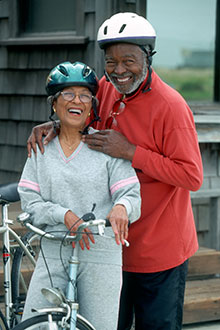
Healthy older cyclists.
Research has found that, whatever your health and physical abilities, you can gain a lot by being active.
Previous research has found that seniors who are more physically active are at lower risk for walking difficulties and other movement problems. Researchers led by Dr. Debra A. Fleischman of Rush University Medical Center in Chicago examined whether physical activity can affect the link between age-related brain lesions and motor function in older adults.
The researchers scanned the brains of 167 healthy older adults who were participating in a larger study of memory and aging. The participants’ average age was 80. The investigators gave the participants various movement and strength tests. Participants also wore monitors on their wrists for up to 11 days to measure daily physical activity. The study appeared online in Neurology on March 11, 2015.
As expected, the researchers found that more physical activity was associated with better motor function. More age-related brain lesions were generally linked to poorer motor function. Physical activity levels were not related to the amount of lesions. However, among participants who were most active, the lesions weren’t linked to poorer motor skills. Other factors like body mass index and vascular disease had no effect on the relationship between the brain lesions, daily activity, and motor function.
These results suggest that the level of physical activity later in life doesn’t affect white matter hyperintensities but influences motor function via some other pathway. How physical activity might protect motor skills from the effects of these age-related brain lesions remains unknown. Previous studies suggest that physical activity may enhance brain health by increasing blood flow and other vascular functions in the brain.
“These results underscore the importance of efforts to encourage a more active lifestyle in older people to prevent movement problems, which is a major public health challenge,” Fleischman says. “Physical activity may create a ‘reserve’ that protects motor abilities against the effects of age-related brain damage.”
The associations found in this study suggest, but don’t prove, that physical activity can protect against the loss of motor function caused by age-related brain lesions. The group is now monitoring brain scans over time to more closely examine the relationships between white matter hyperintensities, physical activity, and motor function.