Tuesday, September 1, 2015

Corn Beef Recalled

Ocho Rios is recalling approximately 7,228 pounds of canned corned beef produced in Brazil that were not presented at the U.S. point of entry for inspection, the U.S. Department of Agriculture’s Food Safety and Inspection Service (FSIS) announced today. Without the benefit of full inspection, a possibility of adverse health consequences exists.
The canned corned beef was imported on August 7, 2015. The following products are subject to recall: [View Labels]      
  • 18-lb. packages containing 24- 12 oz. cans of “Corned Beef with Juices.”
The products subject to recall bear establishment number “Brasil 226 S.I.F.” inside the mark from Brazil’s Ministry of Agriculture. The cases of products contain the shipping mark “BT/7100366 MIAMI” and the can codes “16952U,” “16951U,” “15251U,” or “15252U.” These products were shipped to retail locations in Fla. and one distribution center in Ga. to be further distributed.                             
The problem was discovered by FSIS personnel during routine failure to present surveillance activities.
FSIS and the company have received no reports of adverse reactions due to consumption of these products. Anyone concerned about a reaction should contact a healthcare provider.  
Consumers who have purchased these products are urged not to consume them. These products should be thrown away or returned to the place of purchase.
Consumers and media with questions about the recall may contact Donovan Chang, Ocho Rios’ Recall Coordinator, at (305) 696-1237.

Fat vs. Carbohydrate for Reducing Body Fat

Choosing a weight-loss program can be confusing. Some programs recommend restricting fat, while others recommend cutting carbohydrates. It can be difficult to separate fad from fact, and to determine what’s safe and effective.
A balance scale with pasta/carbs weighed against butter/fat.
The study compared the effects of cutting carbs vs. cutting fat in a very carefully controlled environment. Image courtesy of Dr. Kevin Hall, NIDDK.
A research team led by Dr. Kevin Hall of NIH’s National Institute of Diabetes and Digestive and Kidney Diseases (NIDDK) conducted a study under carefully controlled conditions to determine the way the body responds to fat vs. carbohydrate restriction. They designed the study using a mathematical model the team had previously developed. The findings appeared online on August 13, 2015, in Cell Metabolism.
The team enrolled 10 men and 9 women with obesity. Participants averaged 35 years of age, did not have diabetes, and had an average body mass index (BMI) of 36 (30 or greater is considered obese).
The participants stayed in the metabolic clinical research unit on the NIH campus for 2 visits of about 2 weeks each. Having participants reside in a metabolic ward 24 hours/day allowed the researchers to carefully control the volunteers’ diet and meticulously monitor their energy expenditure.
For the first 5 days of each stay, the volunteers were given a balanced diet (50% carbohydrate, 35% fat, and 15% protein) of about 2,740 calories/day, which matched energy expenditure. Over the next 6 days, they received a diet with 30% fewer calories. The amount of protein remained the same. On one visit, the calorie decrease came solely by cutting carbohydrates. On the other visit, the calories were cut only from dietary fat. The diets were given in random order with 2-4 weeks between visits.
While in the metabolic ward, the participants walked on a treadmill for 60 minutes each day. Part of the time, they resided in a metabolic chamber to measure their energy expenditure and the relative balance of fat and carbohydrate they used to produce energy.
The scientists found that when participants ate the reduced-carb diet, they lowered production of the hormone insulin. This diet caused a shift in metabolism; participants increased fat oxidation (“burning”) and decreased carbohydrate oxidation. While on the reduced carb diet, they lost about 53 grams of body fat per day.
When participants consumed the reduced-fat diet, they had no observed changes in insulin production or fat burning. However, they lost about 89 grams per day of body fat—68% more than when they cut the same number of calories from carbohydrates.
The researchers note that given the short time frame of the study, it would be difficult to extrapolate the findings to a longer time frame. More research is needed to assess the long-term effects of fat and carb reduction in the body.
“Compared to the reduced-fat diet, the reduced-carb diet was particularly effective at lowering insulin secretion and increasing fat burning, resulting in significant body fat loss. But interestingly, study participants lost even more body fat during the fat-restricted diet, as it resulted in a greater imbalance between the fat eaten and fat burned,” Hall says. “Our data tell us that when it comes to body fat loss, not all diet calories are exactly equal.”

Predicting Suicide Risk

More than 41,000 Americans commit suicide each year. That’s more than twice the number killed annually by homicide. Most people who end their own lives have a mental disorder such as depression, schizophrenia, or bipolar disorder.
Man looking out a window.
Researchers have been seeking a way to objectively measure a person’s risk for suicide. Image Credit: Katarzyna Bialasiewicz/iStock/Thinkstock.
Efforts to reduce suicides have focused on identifying and treating those at risk. However, asking people if they’re suicidal isn’t always a reliable approach. Finding a way to objectively measure a person’s risk for suicide is thus an important area of research. Some researchers are developing questionnaires that measure the likelihood of someone committing suicide. Others are looking for biological markers of people who are suicidal.
A study led by researchers at Indiana University School of Medicine combined these approaches. Their work was funded by an NIH Director’s New Innovator Award and the U.S. Department of Veterans Affairs. Results appeared online in Molecular Psychiatry on August 18, 2015.
The researchers studied 217 male psychiatric patients at the Indianapolis VA Medical Center during multiple visits several months apart. The scientists measured the men’s thoughts of suicide through extensive interviews and took blood samples. They identified 37 patients whose thoughts of suicide increased between visits. Those patients’ blood samples were analyzed to find genes with changes in activity, or expression, between visits. Those genes were ranked based on prior research linking them to suicide risk. The researchers then measured the expression of these top-ranked genes in blood samples from 26 men who had committed suicide.
The team also developed 2 apps that use questionnaires to measure risk factors for suicide. The first collects details on a patient's’ emotional state. The second asks about factors known to influence suicide risk, such as life events, stress, and mental health. Both could predict thoughts of suicide more than 85% of the time. These questionnaires were then combined with the most predictive gene biomarkers to create a universal predictive measure called UP-Suicide.
The team tested UP-Suicide in a separate group of 108 psychiatric patients to examine its ability to predict thoughts of suicide and a group of 157 patients to examine ability to predict future hospitalizations. The tool predicted which patients would go on to have serious suicidal thoughts with 92% accuracy. It also predicted with 71% accuracy which patients would be hospitalized for suicidal behaviors in the year following testing. The tool was even more accurate for patients with bipolar disorder, with 98% and 94% accuracy, respectively.
“We believe that widespread adoption of risk prediction tests based on these findings during health care assessments will enable clinicians to intervene with lifestyle changes or treatments that can save lives,” says lead researcher Dr. Alexander B. Niculescu.
Because the team studied only male psychiatric patients, further research will be needed to understand how well this approach can predict suicidal thoughts and behaviors in other populations, such as women and those who aren’t psychiatric patients.

How the eye sees small moving objects

NIH-funded study reveals how motion-sensing cells in mice link to other cells in the eye
When we move our head, the whole visual world moves across our eyes. Yet we can still make out a bee buzzing by or a hawk flying overhead, thanks to unique cells in the eye called object motion sensors. A new study on mice helps explain how these cells do their job, and may bring scientists closer to understanding how complex circuits are formed throughout the nervous system. The study was funded by the National Institutes of Health, and was published online in Nature.
“Understanding how neurons are wired together to form circuits in the eye is fundamental for advancing potential new therapies for blinding eye diseases,” said Paul A. Sieving, M.D., Ph.D., director of NIH’s National Eye Institute (NEI). “Research aimed at regenerating photoreceptors, for example, is enriched by efforts to understand the circuitry in the eye.”
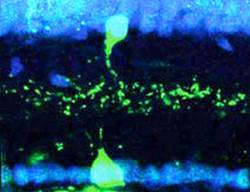
Object motion and amacrine cells in retina
A VG3 amacrine cell (top, in green) is shown superimposed with an object motion detector cell (bottom, green). Each of the neurons is expressing sidekick-2, an adhesion molecule that allows the two neurons to find each other and connect.
Object motion sensors are one of about 30 different types of retinal ganglion cells (RGCs) in the retina, the light-sensitive tissue at the back of the eye. These cells are unique because they fire only when the timing of a small object’s movement differs from that of the background; they are silent when the object and the background move in sync. Researchers believe this is critical to our ability to see small objects moving against a backdrop of complex motion.
The cells in the retina are wired up like an electrical circuit. Vision begins with photoreceptors, cells that detect light entering the eye and convert it into electrical signals. Middleman neurons, called interneurons, shuttle signals from photoreceptors to the RGCs. And each RGC sends the output visual information deeper into the brain for processing. This all takes place within fractions of a second, so the scientists were surprised to discover that before it reaches object motion sensors, visual information about object motion takes a detour through a unique type of interneuron. Their results represent an ongoing effort by scientists to map out complex circuits of the nervous system.
“Getting these connections precisely correct is incredibly important, as each specific feature of vision, such as seeing a particular direction of motion or a color, relies on it,” said the study’s lead investigator, Arjun Krishnaswamy, Ph.D., of Harvard University’s Center for Brain Science, Cambridge, Massachusetts. “It’s also incredibly complex. Within the retina, all these different types of RGCs and interneurons intermingle as they develop. There have to be remarkable ways to sort them out so they connect up properly.”
Using a genetically engineered mouse line, the researchers recorded the activity of object motion sensors and found that the cells form synapses (or connections) with interneurons called VG3 amacrine cells. What’s interesting about this connection is that most retinal circuits tend to follow a more direct, and therefore faster, route. RCGs typically are two synapses away from a photoreceptor, but with the addition of VG3 amacrine cells to the circuit, object motion sensors appear to be three synapses away, slowing visual information delivered to the cells.
To test this idea, the scientists flashed light on the retinas of the mice and found that on average the object motion sensors responded later than other types of retinal ganglion cells. They also selectively activated the sensors by projecting light patterns onto the retinas that mimicked the movement of small objects against a desynchronized background. Mice with genetically eliminated VG3 amacrine cells did not show these responses.
The researchers theorize that the longer pathway contributes to an essential delay, ensuring that information from the central field of view and from the periphery arrive at the object motion sensor at the same time. This in turn allows the object motion sensors to accurately assess the difference between the motion of a hawk and the slow-moving clouds above it, or the flight of a baseball and the undulating crowd in the stadium.
Dr. Krishnaswamy and his colleagues then investigated how the circuit develops. They found that object motion sensors and VG3 amacrine cells each make a protein called sidekick-2, specifically where they contact each other. Sidekick-2 is an adhesion molecule that allows the two cell types to find each other and stick together so they can communicate across a synapse.
Mice genetically engineered to block sidekick-2 production lacked synapses connecting VG3 cells to object motion sensors. Moreover, electrical recordings showed that sensors in these mice did not distinguish the motion of a small object from background motion.
For Dr. Krishnaswamy, the next steps are to investigate the role of sidekick-2 in brain development, first in mice and eventually in humans.
“Neurons in the brain work just like neurons in the retina, and scientists are beginning to understand how they make precise connections to form circuits that control thoughts, senses and emotions,” said Edmund Talley, Ph.D., program director at the National Institute of Neurological Disorders and Stroke (NINDS), part of the NIH. “This pioneering work demonstrates the molecular specificity behind these connections.”

Weight Loss Research: Possible 'obesity gene' discovered ♦ Physician support key to successful weight loss ♦ Eating 'on the go' could lead to weight gain

Possible 'obesity gene' discovered A gene that could be an important cause of obesity has been discovered by researchers. Discovery of this direct link between a protein and fat production points the way to a possible drug therapy. Scientists theorize that by suppressing the gene or blocking the protein, they could prevent fat accumulation in people who are overweight, or are on their way to becoming so
Obesity breakthrough: Metabolic master switch prompts fat cells to store or burn fat Obesity is one of the biggest public health challenges of the 21st century. Affecting more than 500 million people worldwide, obesity costs at least $200 billion each year in the United States alone, and contributes to potentially fatal disorders such as cardiovascular disease, type 2 diabetes, and cancer. Scientists have now revealed the mechanism underlying the genomic region most strongly associated with obesity. The findings uncover a genetic circuit that controls whether our bodies burn or store fat. Manipulating that genetic circuit may offer a new approach for obesity treatments.
Physician support key to successful weight loss A review of survey data from more than 300 obese people who participated in a federally funded weight loss clinical trial found that although the overall weight loss rates were modest, those who rated their primary care doctor’s support as particularly helpful lost about twice as many pounds as those who didn’t.
Eating 'on the go' could lead to weight gain Dieters who eat 'on the go' may increase their food intake later in the day which could lead to weight gain and obesity, new research shows. The findings from the study also showed that eating while walking around triggered more overeating compared to eating during other forms of distraction such as watching TV or having a conversation with a friend.
Food may be addictive: Food craving may be 'hard-wired' in the brain An international group of researchers have found that food craving activates different brain networks between obese and normal weight patients. This indicates that the tendency to want food may be ‘hard-wired’ into the brain of overweight patients, becoming a functional brain biomarker

Cardiovascular Research: CPR: It's not always a lifesaver, but it plays one on TV ♦ High protein foods boost cardiovascular health ♦ Cold weather linked to increased stroke risk

CPR: It's not always a lifesaver, but it plays one on TV If you think that performing CPR on a person whose heart has stopped is a surefire way to save their life, you may be watching too much TV. The truth is more depressing than fiction, according to a new study. While medical dramas Grey's Anatomy and House show cardiopulmonary resuscitation saving a patient's life nearly 70 percent of the time, the real immediate survival rate is nearly half that -- around 37 percent.
High protein foods boost cardiovascular health, as much as quitting smoking or getting exercise Eating foods rich in amino acids could be as good for your heart as stopping smoking or getting more exercise.
Treating left atrial appendage could dampen long standing persistent atrial fibrillation In patients with long-standing persistent atrial fibrillation (AF) despite standard treatment, additional electrical isolation of an area called the left atrial appendage (LAA) can improve freedom from AF without increasing complications, results of the BELIEF study show.
Cold weather linked to increased stroke risk in atrial fibrillation patients Cold weather is associated with increased risk of ischaemic stroke in patients with atrial fibrillation, according to new research. The study in nearly 290,000 patients suggests that cool climate may be an underrated issue for health that deserves more attention.
Refractory cardiac arrest patients brought to hospital with ongoing CPR can recover Refractory cardiac arrest patients brought to hospital with ongoing cardiopulmonary resuscitation (CPR) can survive with good brain function, according to research in nearly 4,000 patients

Health News: Knee and Hip Replacements May Be Bad for the Heart ♦ A single cocaine dose lowers perceptions of sadness and anger ♦ Testosterone changes brain structures

Testosterone changes brain structures in female-to-male transsexuals Brain imaging shows that testosterone therapy given as part of sex reassignment changes the brain structures and the pathway associated with speech and verbal fluency. This result supports research that women in general may deal with speech and interaction differently than men.
Clinical trial shows first treatment for ‘emotional flatness’ associated with schizophrenia Results of a clinical trial seem to show the first effective treatment for the negative symptoms – withdrawal, lack of emotion, and apathy – associated with schizophrenia.
Psychotic patients distinguished from controls while watching movie Alice in Wonderland Researchers using fMRI (functional Magnetic Resonance Imaging) have found that even first-episode psychotic patients process information differently from a control group. To ensure both groups experienced the same brain stimuli, the measurements were taken while the subjects watched a movie, Tim Burton’s Alice in Wonderland.
Knee and Hip Replacements May Be Bad for the Heart Contrary to recent reports, researchers found that osteoarthritis patients who had total knee or hip joint replacement surgery, known as arthroplasty, were at increased risk of heart attack (myocardial infarction) in the early postoperative period. However, findings indicate that long-term risk of heart attack did not persist, while the risk for venous thromboembolism -- blood clot in veins and lungs -- remained years after the procedure
A single cocaine dose lowers perceptions of sadness and anger A single dose of cocaine can interfere with the ability to recognize negative emotions such as anger and sadness.