Showing posts with label Osteoporosis. Show all posts

Sunday, November 8, 2015

Food Research: Find way to focus on dietary supplement safety ♦ Living alone can dent healthy diets ♦ Soybean foods may protect menopausal women against osteoporosis

Find way to focus on dietary supplement safety A former principal deputy commissioner of the US Food and Drug Administration is proposing a solution to the current gridlock over the regulation of dietary supplements: focus less on whether these vitamins, minerals and herbal extracts actually do what they claim and instead take important steps to improve their safety.
Soybean foods may protect menopausal women against osteoporosis Eating a diet rich in both soy protein and isoflavones can protect menopausal women from bone weakening and osteoporosis.
Living alone can dent healthy diets People who live alone are more likely to have unhealthy diets lacking key foods, research has found. The study reported inadequate cooking skills, no partner to go shopping with, the increasing cost of food and a lack of motivation to cook were among the reasons people living alone had different eating practices
Tomatoes get boost in growth, antioxidants from nano-sized nutrients Researchers are using nano-sized nutrients to boost production of food without straining natural resources.

Monday, June 15, 2015

Health Research: Major health consequences for severe dental anxiety ♦ Recurrent major depressive disorderassociated with lower bone density♦ Potential new treatment for osteoporosis

Major health consequences for individuals with severe dental anxiety Adults who suffer from severe dental anxiety (DA) are often dissatisfied with their appearance. The dissatisfaction may be associated with poorer oral health, depression and anxiety. Cognitive behavioral therapy (CBT) help patients with severe DA.
Recurrent major depressive disorder and use of antidepressants associated with lower bone density A recent study shows that recurrent major depressive disorder (MDD) in men is associated with lower bone density. The use of antidepressants was also associated with lower bone mineral density (BMD), but this association was dependent on the person's weight and site of bone measurement.
Potential new treatment for osteoporosis Scientists have identified a new therapeutic approach that, while still preliminary, could promote the development of new bone-forming cells in patients suffering from bone loss.
One in five young venous thromboembolism patients require psychotropic drugs within five years One in five young people who experience a venous thromboembolism (VTE)1 will require psychotropic medication within five years, reveals new research. Young VTE patients were twice as likely to experience mental health problems requiring psychotropic medication as their healthy peers
Research on gonorrhea uncovers new immune system trigger Researchers have uncovered how Gram-negative bacteria -- a broad class of bugs that cause diseases ranging from gonorrhea to diarrhea and pneumonia -- can trigger a reaction from our immune system. This discovery could lead to new therapies and treatments that use the immune system to fight infections instead of antibiotics.

Friday, May 22, 2015

Health Research: Include men in osteoporosis screening ♦ Kidney failure impacts survival of sepsis patients ♦ Natural plant chemicals could help fight tooth decay

Include men in osteoporosis screening guidelines,Osteoporosis affects more men than prostate cancer. In a large study of smokers, men were more likely than women to have osteoporosis and fractures of their vertebrae. Smoking history and chronic obstructive pulmonary disease (COPD) were independent risk factors for low bone density among both men and women. Researchers say screening for low vBMD by using QCT in men and women who are smokers will identify and treat osteoporosis.
Kidney failure impacts survival of sepsis patients Kidney function plays a critical role in the fate of patients being treated for sepsis, a potentially life-threatening complication of an infection. Acute kidney injury is a serious and common health complication, occurring in up to 20 percent of all hospitalized patients and more than 45 percent of patients in a critical-care setting. Sepsis, which is defined as systemic inflammation resulting from an infection, results in an abrupt decrease in the kidney's ability to filter the blood.
Natural plant chemicals could help fight tooth decay Oral-care products containing a natural chemical that stops bacteria harming teeth could help prevent decay. The plant natural product acts against harmful mouth bacteria and to prevent the build-up of plaque.
Discovery of a treatment to block the progression of multiple sclerosis A drug that could halt the progression of multiple sclerosis may soon be developed thanks to a new discovery.
Epstein-Barr virus co-infection may boost malaria mortality in childhood Malaria researchers are calling attention to a trouble-maker whose effects may be underappreciated: Epstein-Barr virus (EBV). Their experiments with mice show that co-infection with a virus closely related to EBV can make a survivable malaria parasite infection lethal.

Tuesday, May 19, 2015

Health Research: Eectronic cigarettes potentially hazardous ♦ Fibromyalgia has central nervous system origins ♦ Men far less likely to prevent, screen for osteoporosis

Mechanical and chemical characteristics of electronic cigarettes contribute to potentially hazardous effects Unlike standard cigarettes, the components of electronic cigarettes are not regulated and standardized, thus they vary widely between products. The characteristics of these e-cigarette elements, including their delivery systems, combustion apparatuses, and the composition of the nicotine solutions they contain may affect the levels of potentially hazardous substances in the vapor they produce.
Evidence that electronic cigarettes are effective for smoking cessation long-term is lacking  There is little reliable evidence that electronic cigarettes are effective for long-term smoking cessation.
One exposure to e-cigarette use diminishes cough reflex sensitivity With just one exposure to electronic-cigarette (e-cigarette) vapor, participants in a study of 30 healthy subjects demonstrated a diminishment of cough reflex sensitivity.
Fibromyalgia has central nervous system origins Fibromyalgia is the second most common rheumatic disorder behind osteoarthritis and, though still widely misunderstood, is now considered to be a lifelong central nervous system disorder, which is responsible for amplified pain that shoots through the body in those who suffer from it.
Men far less likely to prevent, screen for osteoporosis While the consequences of osteoporosis are worse in men than women -- including death -- older males are far less likely to take preventive measures against the potentially devastating bone-thinning disease or accept recommendations for screening.

Friday, March 13, 2015

Health News: Dunkin’ Donuts to phage out whitening agent ♦ New radiation detector for food ♦ Relief for diabetics with painful condition ♦ Male smokers risk osteoporosis

New radiation detector for food uses space technology  A collaboration between two companies has developed a device for detecting radiation-contamination food. After an earthquake and tsunami damaged Japan’s Fukushima nuclear plant in 2011  RIKEN Global Research Cluster and G-Tech began researching methods for detecting radioactive cesium in food. Continue Reading
Dunkin’ Donuts plans to phage out whitening agent In response to a shareholder request, the parent company of Dunkin’ Donuts is reportedly testing alternatives to titanium dioxide as a whitening agent in the powdered sugar used to top some of its doughnuts. Submitting the request was the group As You Sow, a non-profit foundation which focuses on environmental Continue Reading
Neuropathy: Relief for diabetics with painful condition  Those with painful diabetic neuropathy who received two low dose rounds of a non-viral gene therapy called VM202 had significant improvement of their pain that lasted for months,Right now there is no medication that can reverse neuropathy The goal is to develop a treatment.that relieves pain and actually improved function. Continue Reading
Semi-veggie diet effectively lowers heart disease, stroke risk  A pro-vegetarian diet that emphasizes a higher proportion of plant-based foods compared to animal-based foods may help lower the risks of dying from heart disease and stroke by up to 20 percent, according to a large-scale study. Continue Reading
Male smokers at higher risk than females for osteoporosis, fractures  In a large study of middle-aged to elderly smokers, men were more likely than women to have osteoporosis and fractures of their vertebrae. The findings suggest that current and past smokers of both genders should be screened for osteoporosis.Continue Reading

Monday, January 19, 2015

1/19/15 Health News: Potassium salts limit osteoporosis ♦ Ecstasyin rivers near music festival ♦ Check glucose levels without finger prick ♦ Early detection of heart attacks

Potassium salts aid bone health, limit osteoporosis risk, new research finds
The potassium salts (bicarbonate and citrate) plentiful in fruit and vegetables, play an important part in improving bone health, researchers have found. For the first time, the results also showed that these potassium salts reduce bone resorption, the process by which bone is broken down, therefore increasing their strength Continue Reading
Levels of 'Molly,' aka ecstasy, spike in rivers near music festival
The illicit drug called 'Molly' or ecstasy is a serious concern for parents, law enforcement and now for environmentalists. Scientists report that a major music festival in Taiwan coincides with a spike in the drug's levels in nearby rivers. Not only does this highlight drug abuse at the concert, but the scientists say it also focuses attention on potential effects the substance could have on aquatic life. Continue Reading
Tattoo-like sensor can detect glucose levels without painful finger prick
The first ultra-thin, flexible device that sticks to skin like a rub-on tattoo can detect a person's glucose levels. The sensor has the potential to eliminate finger-pricking for many people with diabetes. Continue Reading
Gold nanoparticles show promise for early detection of heart attacks
A novel colloidal gold test strip is demonstrating great potential for early detection of certain heart attacks. Researchers are developing the strip to test for cardiac troponin I (cTn-I); its level is several thousand times higher in patients experiencing myocardial infarctions. The new strip uses mycoplasma-generated gold nanoparticles. Compared to AuNPs produced by traditional chemical methods, the surfaces of these nanoparticles attract more antibodies, which results in significantly higher detection sensitivity. Continue Reading

Monday, January 5, 2015

Osteoporosis in Aging - Protect Your Bones with Exercise

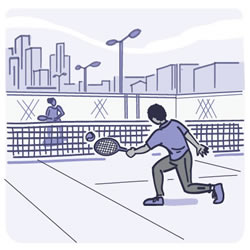
Illustration of 2 people playing tennis.
Bones feel solid, but the inside of a bone is actually filled with holes like a honeycomb. Bone tissues are broken down and rebuilt all the time. While some cells build new bone tissue, others dissolve bone and release the minerals inside.
As we get older, we begin to lose more bone than we build. The tiny holes within bones get bigger, and the solid outer layer becomes thinner. In other words, our bones get less dense. Hard bones turn spongy, and spongy bones turn spongier. If this loss of bone density goes too far, it’s called osteoporosis. Over 10 million people nationwide are estimated to have osteoporosis.
It’s normal for bones to break in bad accidents. But if your bones are dense enough, they should be able to stand up to most falls. Bones weakened by osteoporosis, though, are more likely to break.
“It’s just like any other engineering material,” says Dr. Joan McGowan, an NIH expert on osteoporosis. If you fall and slam your weight onto a fragile bone, “it reaches a point where the structures aren’t adequate to support the weight you’re putting on them.” If the bone breaks, it’s a major hint that an older person has osteoporosis.
Broken bones can lead to serious problems for seniors. The hip is a common site for osteoporosis, and hip fractures can lead to a downward spiral of disability and loss of independence. Osteoporosis is also common in the wrist and the spine.
The hormone estrogen helps to make and rebuild bones. A woman’s estrogen levels drop after menopause, and bone loss speeds up. That’s why osteoporosis is most common among older women. But men get osteoporosis, too.
“A third of all hip fractures occur in men, yet the problem of osteoporosis in men is frequently downplayed or ignored,” says Dr. Eric Orwoll, a physician-researcher who studies osteoporosis at Oregon Health and Science University. Men tend to do worse than women after a hip fracture, Orwoll says.
Experts suggest that women start getting screened for osteoporosis at age 65. Women younger than age 65 who are at high risk for fractures should also be screened. Men should discuss screening recommendations with their healthcare providers.
Screening is done with a bone mineral density test at the hip and spine. The most common test is known as DXA, for dual-energy X-ray absorptiometry. It’s painless, like having an X-ray. Your results are often reported as a T-score, which compares your bone density to that of a healthy young woman. A T-score of −2.5 or lower indicates osteoporosis.
There’s a lot you can do to lower your risk of osteoporosis. Getting plenty of calcium, vitamin D, and exercise is a good start, Orwoll says.
Calcium is a mineral that helps bones stay strong. It can come from the foods you eat—including milk and milk products, dark green leafy vegetables like kale and collard greens—or from dietary supplements. Women over age 50 need 1,200 mg of calcium a day. Men need 1,000 mg a day from ages 51 to 70 and 1,200 mg a day after that.
Vitamin D helps your body absorb calcium. As you grow older, your body needs more vitamin D, which is made by your skin when you’re in the sun. You can also get vitamin D from dietary supplements and from certain foods, such as milk, eggs, fatty fish, and fortified cereals. Talk with your healthcare provider to make sure you’re getting a healthy amount of vitamin D. Problems can arise if you’re getting too little or too much.
Exercise, especially weight-bearing exercise, helps bones, too. Weight-bearing exercises include jogging, walking, tennis, and dancing. The pull of muscles is a reminder to the cells in your bones that they need to keep the tissue dense.
Smoking, in contrast, weakens bones. Heavy drinking does too—and makes people more likely to fall. Certain drugs may also increase the risk of osteoporosis. Having family members with osteoporosis can raise your risk for the condition as well.
The good news is, even if you already have osteoporosis, it’s not too late to start taking care of your bones. Since your bones are rebuilding themselves all the time, you can help push the balance toward more bone growth by giving them exercise, calcium, and vitamin D.
Several medications can also help fight bone loss. The most widely used are bisphosphonates. These drugs are generally prescribed to people diagnosed with osteoporosis after a DXA test, or to those who've had a fracture that suggests their bones are too weak. Bisphosphonates have been tested more thoroughly in women, but are approved for men too.
Researchers are trying to develop drugs that increase bone growth. For now, there’s only one available: parathyroid hormone. It’s effective at building bone and is approved for women and men with osteoporosis who are at high risk for having a fracture.
Another important way to avoid broken bones is to prevent falling and occasions for fracture in the first place. Unfortunately, more than 2 million so-called fragility fractures (which wouldn’t have happened if the bones had been stronger) occur nationwide each year. “To reduce the societal burden of fracture, it’s going to take a combined approach of not only focusing on the skeleton but focusing on fall prevention,” says Dr. Kristine Ensrud, a physician-researcher who studies aging-related disorders at the University of Minnesota and Minneapolis VA Health Care System.
Source NIH