Showing posts with label Malaria. Show all posts

Wednesday, December 9, 2015

Health Research: Stretchy hydrogel 'Band-Aid' senses, lights up, delivers medicine ♦ Modified mosquitoes could help fight malaria ♦ Unique muscle fibers of upper airway in humans

Stretchy hydrogel 'Band-Aid' senses, lights up, delivers medicine Engineers have designed what may be the Band-Aid of the future: a sticky, stretchy, gel-like material that can incorporate temperature sensors, LED lights, and other electronics, as well as tiny, drug-delivering reservoirs and channels. The 'smart wound dressing' releases medicine in response to changes in skin temperature and can be designed to light up if, say, medicine is running low
Modified mosquitoes could help fight against malaria For the first time, malarial mosquitoes have been modified to be infertile and pass on the trait rapidly -- raising the possibility of reducing the spread of disease.
Skin cells play 'dice games' How to maintain healthy skin and heal wounds is an intricate problem. Latest research shows all dividing skin cells can flip between two probability games to either maintain or heal skin, challenging the view that only rare stem cells matter. Understanding the rules of the games not only explains how skin maintains itself and heals wounds, but also shows how skin grafts work and suggests how changes to the rules could lead to cancer.

Discovery of unique muscle fibers of upper airway in humans Unique muscle fibers in the soft palate of the mouth in both infants and adults have been recently discovered. The fibers seem to be present in greater number in snorers and sleep apnea patients.

Saturday, November 28, 2015

Health News:3,000 Hepatitis A vaccines at a cost of $100,000 due to ill NY Mcdonald's worker ♦ Discovered: A cluster of 60 proteins that help cells move and feel

Discovered: A cluster of 60 proteins that help cells move and feel University of Manchester scientists have discovered a cluster of 60 proteins that allow the body's cells to react to their environment and communicate with each other.
3,000 Hepatitis A vaccines at a cost of $100,000 due to ill NY Mcdonald's worker David Shaw of the Finger Lakes Times reported today that the Seneca County Public Health recognized for its response to a recent hepatitis A scare after a McDonald’s worker in Waterloo was diagnosed with the illness. The department set up clinics at Mynderse Academy and the county office building, vaccinating thousands of diners
Scientists create genetically modified malaria-blocking mosquitoes Using a groundbreaking gene editing technique, scientists have created a strain of mosquitoes capable of rapidly introducing malaria-blocking genes into a mosquito population through its progeny, ultimately eliminating the insects' ability to transmit the disease to humans. This new model represents a notable advance in the effort to establish an antimalarial mosquito population, which with further development could help eradicate a disease that sickens millions worldwide each year.

How the introduction of farming changed the human genome Genomic analysis of ancient human remains identifies specific genes that changed during and after the transition in Europe from hunting and gathering to farming about 8,500 years ago. Many of the genes are associated with height, immunity, lactose digestion, light skin pigmentation, blue eye color and celiac disease risk

Sunday, November 1, 2015

Health Research:Biodegradable implant could help heal broken bones ♦ Driving with glaucoma? ♦ Multi-tasking flu vaccine could provide better protection against outbreaks

New studies show Nobel Prize-winning drug that knocks out parasitic worms could have second act fighting malaria A workhorse of a drug that a few weeks ago earned its developers a Nobel prize for its success in treating multiple tropical diseases is showing early promise as a novel and desperately needed tool for interrupting malaria transmission.
Biodegradable implant could help heal broken bones A plastic created from cornstarch combined with a volcanic ash compound could help heal broken bones, say scientists, adding that using a synthetic material will likely lead to a reduction in the surgery complication rate. The patient will only need to heal from one surgery because harvesting bone would not be necessary
Driving with glaucoma? Some patients increase scanning to adapt for impaired vision Some people with glaucoma-related binocular (both eyes) vision loss can pass a standard driving test by adopting increased visual scanning behavior..
Multi-tasking flu vaccine could provide better protection against outbreaks Researchers have found a way to boost the effectiveness and cross-protective capabilities of an influenza A vaccine by adding a simple component. The research in mice could lead to better seasonal flu vaccines for humans, and also vaccines that could provide community protection in the early stages of an outbreak of a novel flu virus strain.    

Wednesday, September 16, 2015

Prenatal Research: New molecule found to prevent preterm birth ♦ Scan may identify best candidates for fetal spina bifida surgery ♦ Iron supplementation during pregnancy and risk of malaria in malaria

Iron supplementation during pregnancy and risk of malaria in malaria-endemic region Among women in a malaria-endemic region in Kenya, daily iron supplementation during pregnancy did not result in an increased risk of malaria, according to a study. Iron supplementation did result in increased birth weight, gestational duration, neonatal length, and a decreased risk of low birth weight and prematurity.
New molecule found to prevent preterm birth Premature births are intimately linked with inflammation of the uterine tissue, a biological response which induces contractions and preterm labor. In their search for a mean to prevent this phenomenon and complications related to deliveries occurring before 37 weeks of gestation, researchers have discovered an agent that shows efficacy in inhibiting inflammation and preventing or delaying uterine contractions and premature delivery in murine models – without adversely affecting the fetus or the mother. This discovery is a giant step towards preventing prematurity, which is the world's leading cause of infant death and the origin of potentially severe, long-lasting physical, intellectual or psychological impairment for the 10% of infants born preterm world-wide.
Research reveals the placenta's oxygen tanks for early embryos A new role for the placenta has been revealed by researchers who have identified sites which store, and gradually release, oxygen for newly formed embryos in the weeks after the baby's heart is developed.
Scan may identify best candidates for fetal spina bifida surgery Fetuses with enlarged ventricles -- the fluid-filled cavities inside the brain -- may be less likely than their counterparts to benefit from surgery in the womb to treat spina bifida.

Tuesday, September 15, 2015

Health News: The 5 most dangerous food borne pathogens ♦ GE plants produce proteins able to reduce E. coli on food ♦ African dams linked to over one million malaria cases annually

Turkey’s food safety problems magnified by unregistered facilities Only about one in 10 food producers and/or retailers in Turkey have an official license issued by the state, which means that the vast majority are never inspected. According to a recent media report, a survey called “Adulterated Foods” from the Turkish Agriculturists Association found that only about 40,000 of the estimated 400,000 food establishments..
The 5 most dangerous foodborne pathogens It can be tricky business to say that one foodborne pathogen is more dangerous than another. Are the criteria the number of illnesses, number of deaths, or percentage of victims who die? Do the severity of an illness or chronic side effects factor into the ranking? The first three pathogens on this list are fairly obvious dangers and ones.
Research shows GMO plants produce proteins able to reduce E. coli on food A team of scientists is genetically engineering plants to produce antimicrobial proteins known as colicins, which can then be extracted and applied to contaminated meat and produce to kill E. coli bacteria. In a study published earlier this month in the Proceedings of the National Academy of Sciences, the team engineered tobacco, leafy beets, spinach, chicory and...
Poor diet and high blood pressure now number one risk factors for early death A new global burden of disease study finds a huge amount of deaths worldwide are due to preventable risk-factors.
African dams linked to over one million malaria cases annually For the first time, research correlates the location of large dams with the incidence of malaria and quantifies the impacts across sub-Saharan Africa. The study looked at over 1,200 dams and found that the population at risk for malaria around dams is at least four times greater than previously estimated.

Monday, August 10, 2015

Health Research: Crime-scene compound may be newest tool in fight against malaria ♦ First steps towards preventing suicide attempts by offenders


Study looks at Google Glass to bring toxicology specialists to remote emergency rooms Google Glass, a head-mounted streaming audio/video device, may be used to effectively extend bed-side toxicology consults to distant health care facilities such as community and rural hospitals to diagnose and manage poisoned patients.
Crime-scene compound may be newest tool in fight against malaria The compound that detectives spray at crime scenes to find trace amounts of blood may one day be used to kill the malaria parasite.
Study shows how aging cripples the immune system, suggesting benefits of antioxidants Scientists have shown how aging cripples the production of new immune cells, decreasing the immune system's response to vaccines and putting the elderly at risk of infection.
Promising drug for Parkinson's disease: Study supports fast track to clinical trials  A drug which has already been in use for decades to treat liver disease could be an effective treatment to slow down progression of Parkinson's disease.
First steps towards preventing suicide attempts by offenders While the risk of suicide by offenders in prison has been identified as a priority for action, understanding and preventing suicides among offenders after release has received far less attention.

Wednesday, July 22, 2015

Health Research: In pursuit of precision medicine for PTSD ♦ Questionnaire beats blood test in identifying at-risk drinking ♦ Stopping malaria in its tracks

Stopping malaria in its tracks A new drug acts as a roadblock for malaria, curing mice of established infection, according to researchers. Treatment was not associated with obvious side effects, suggesting that the drug may also be safe and effective in human.
Keep fears at bay by learning something new Exposure therapy is a commonly used and effective treatment for anxiety disorders, including posttraumatic stress disorder, obsessive-compulsive disorder, and phobias. The goal of such therapy is to extinguish fear, which is accomplished by presenting cues that are known to predict a negative experience in the absence of that experience. Over time, learning that the 'danger cue' is no longer dangerous produces extinction of the fearful response. However, fears and the associated defensive behaviors resulting from that fear often return after they have been extinguished, undermining the long-term effectiveness of treatment
In pursuit of precision medicine for PTSD Brain scans of war veterans with posttraumatic stress disorder have led researchers to an area of the prefrontal cortex that appears to be a good predictor of response to treatment with SSRIs -- the first-line drug treatment for PTSD.
Questionnaire beats blood test in identifying at-risk drinking among ER patients Emergency room physicians treating patients with alcohol-related trauma can better identify those at risk of future drinking-related trauma with a 10-point questionnaire rather than the standard blood alcohol content test, according to a study.
Words jump-start vision,  A new study shows that words have a profound effect even on the first electrical twitches of perception.

Tuesday, July 21, 2015

Health News :3D-printed “smart cap” uses electronics to sense spoiled food ♦ Common mental health drug could be used to treat arthritis ♦ New malaria treatment thwarts parasite resistance

3D-printed “smart cap” uses electronics to sense spoiled food  Engineers at the University of California, Berkeley, in collaboration with colleagues at Taiwan's National Chiao Tung University, are expanding the already impressive portfolio of 3D printing technology to include
Common mental health drug could be used to treat arthritis Lithium chloride which is used as a mood stabiliser in the treatment of mental health problems, mainly bipolar disorder, could be used to treat arthritis according to a new study.
Human activities are jeopardizing Earth's natural systems, health of future generations A new report calls for immediate, global action to protect the health of human civilization and the natural systems on which it depends. The report provides the first ever comprehensive examination of evidence showing how the health and well-being of future generations is being jeopardized by the unprecedented degradation of the planet's natural resources and ecological systems.
New limb-lengthening technique is less cumbersome for patients A highly specialized procedure that lengthens bones can prevent the need for amputations in selected patients who have suffered severe fractures. And now a new study has found that an alternative limb-lengthening technique makes the long recovery process less cumbersome -- while still providing good-to-excellent outcomes.

New malaria treatment thwarts parasite resistance As increasing resistance in parasites undermines the effectiveness of current drugs, two new compounds are raising hopes in the ongoing battle against malaria, scientists report.

Thursday, July 9, 2015

Health News: Wisconsin firm recalls raw pet treats for listeria contamination ♦ General mills pledges to use 100% cage free eggs ♦ Gym steroid use has impact on memory

Wisconsin firm recalls raw pet treats for listeria contamination Carnivore Meat Company of Green Bay, WI, has recalled two limited batches of Vital Essentials Frozen Beef Tripe Patties and Frozen Beef Tripe Nibblets after the product tested positive for Listeria.  
General mills pledges to use 100% cage free eggs As part of a new animal welfare policy, major food manufacturer General Mills has pledged to shift its egg-buying practices in the U.S. to source exclusively from cage-free suppliers. Its Häagen-Dazs ice cream brand already sourced entirely from cage-free suppliers in Europe.
Experts call for more understanding of hospital weekend death risk Two academics say more research is needed to understand why patients are more likely to die in hospital on the weekend. The research found that the heightened risk of death after admission to hospital on the weekend -- the so-called 'weekend effect' -- is a feature of several developed countries' healthcare systems. The international nature of the findings suggests that this is a phenomenon that not only crosses time, but also geography
Gym steroid use has impact on memory People using anabolic steroids to improve muscle growth and sporting performance are far more likely to experience issues with their memory.
Study identifies new way to kill the malaria parasite Scientists have discovered new ways in which the malaria parasite survives in the bloodstream of its victims, a discovery that could pave the way to new treatments for the disease.

Friday, May 22, 2015

Health Research: Include men in osteoporosis screening ♦ Kidney failure impacts survival of sepsis patients ♦ Natural plant chemicals could help fight tooth decay

Include men in osteoporosis screening guidelines,Osteoporosis affects more men than prostate cancer. In a large study of smokers, men were more likely than women to have osteoporosis and fractures of their vertebrae. Smoking history and chronic obstructive pulmonary disease (COPD) were independent risk factors for low bone density among both men and women. Researchers say screening for low vBMD by using QCT in men and women who are smokers will identify and treat osteoporosis.
Kidney failure impacts survival of sepsis patients Kidney function plays a critical role in the fate of patients being treated for sepsis, a potentially life-threatening complication of an infection. Acute kidney injury is a serious and common health complication, occurring in up to 20 percent of all hospitalized patients and more than 45 percent of patients in a critical-care setting. Sepsis, which is defined as systemic inflammation resulting from an infection, results in an abrupt decrease in the kidney's ability to filter the blood.
Natural plant chemicals could help fight tooth decay Oral-care products containing a natural chemical that stops bacteria harming teeth could help prevent decay. The plant natural product acts against harmful mouth bacteria and to prevent the build-up of plaque.
Discovery of a treatment to block the progression of multiple sclerosis A drug that could halt the progression of multiple sclerosis may soon be developed thanks to a new discovery.
Epstein-Barr virus co-infection may boost malaria mortality in childhood Malaria researchers are calling attention to a trouble-maker whose effects may be underappreciated: Epstein-Barr virus (EBV). Their experiments with mice show that co-infection with a virus closely related to EBV can make a survivable malaria parasite infection lethal.

Thursday, May 14, 2015

Health Research: New malaria test could lead to global eradication ♦ Breakthrough in tinnitus research ♦ Starved T cells allow hepatitis B to silently infect liver

New insight into inflammatory bowel disease may lead to better treatments A newly discovered link between bacteria and immune cells sheds light on inflammatory bowel disease, an autoimmune condition that affects 1.6 million people in the United States. Crohn's disease and ulcerative colitis are the most common forms of IBD, an autoimmune condition that are thought to develop from genetic and environmental factors
Starved T cells allow hepatitis B to silently infect liver Hepatitis B stimulates processes that deprive the body's immune cells of key nutrients that they need to function. The work helps to explain why the immune system cannot control hepatitis B virus infection once it becomes established in the liver.
Using CRISPR, biologists find a way to comprehensively identify anti-cancer drug targets Imagine having a complete catalog of the best drug targets to hit in a deadly form of cancer. Imagine having a master catalog of such targets for all major cancers. Scientists have now published a method of doing precisely this, using the revolutionary gene-editing technology called CRISPR.
New malaria test could lead to global eradication of the disease One of the biggest difficulties faced by worldwide programs aimed at eliminating malaria is that the tests they use are not sensitive enough to detect all people who have the disease and need treatment. A study shows that a new test known as capture and ligation probe-PCR (CLIP-PCR) could diagnose the malaria cases that would typically escape detection and lead to new infections.
Breakthrough in tinnitus research could lead to testable model A major breakthrough has been made that provides new insights into how tinnitus, might develop and be sustained. Tinnitus is largely a mystery, a phantom sound heard in the absence of actual sound. Tinnitus patients "hear" ringing, buzzing or hissing in their ears much like an amputee might "feel" pain in a missing limb. It is a symptom and exposure to loud noise may cause it, some cases have no apparent trigger.

Wednesday, May 13, 2015

Health Research: Post-traumatic stress disorder linked to accelerated aging ♦ Malaria's doorway to infect blood cells identified ♦ Pioneering facial recognition cane for the blind

Pioneering facial recognition cane for the blind A revolutionary ‘smart’ cane enabling the visually impaired to instantly identify friends and family could be available soon, thanks to students at a British university. The ‘XploR’ mobility cane uses smartphone technology to recognize familiar faces from up to 10 metres away. The cane also features GPS functionality to aid navigation.
Post-traumatic stress disorder linked to accelerated aging People with PTSD may also be at risk for accelerated aging or premature senescence, research suggests. The researchers noted that there has not been another study that links PTSD,to a basic biological process such as aging.
Malaria's doorway to infect blood cells identified; potential to close it, lock it, throw away the key Scientists have identified a protein on the surface of human red blood cells that serves as an essential entry point for invasion by the malaria parasite. This discovery opens up a promising new avenue for the development of therapies to treat and prevent malaria
Genetic changes to basic developmental processes evolve more frequently than thought Newly evolved genes can rapidly assume control over fundamental functions during early embryonic development. The findings suggest that evolutionary changes to the genetics of fundamental biological processes occur more frequently than previously thought.
'Make like a bat’: Two ears attuned to high frequencies help people find objects using echoes The ability that some people have to use echoes to determine the position of an otherwise silent object, in a similar way to bats and dolphins, requires good high-pitch hearing in both ears, according to new research. This builds on recent research that demonstrated conclusively that some sighted and blind people could use echoes in this way. What wasn't clear until now was how important high-frequency hearing in both ears is.

Monday, May 11, 2015

Health News: Ban Deoxyribonucleic Acid and Dihydrogen Monoxide? ♦ Viagra to prevent transmission of the malaria parasite? ♦ Strong statin-diabetes link seen in large study

Ban Deoxyribonucleic Acid and Dihydrogen Monoxide? The former USDA Undersecretary for Food Safety, Dr. Richard Raymond,is always good for pointing out something we’ve missed, or setting us straight, or both. He recently called out the latest Food Demand Survey conducted by Food and Agriculture Economist Jayson Lusk at Oklahoma State University.

Viagra to prevent transmission of the malaria parasite? By increasing the stiffness of erythrocytes infected by the causal agent of malaria, Viagra favors their elimination from the blood circulation and may therefore reduce transmission of the parasite from humans to mosquitoes. This astonishing discovery could lead to a treatment to reduce the spread of malaria within a population
Strong statin-diabetes link seen in large study In a study of nearly 26,000 beneficiaries of Tricare, the military health system, those taking statin drugs to control their cholesterol were 87 percent more likely to develop diabetes. The research confirms past findings on the link between the widely prescribed drugs and diabetes risk. But it is among the first to show the connection in a relatively healthy group of people.
Light in sight: A step towards a potential therapy for acquired blindness A promising new therapeutic approach for hereditary blindness based on a technology termed 'optogenetics' is to introduce light-sensing proteins into these surviving retinal cells, turning them into 'replacement photoreceptors' and thereby restoring vision. However, several factors limit the feasibility of a clinical optogenetic therapy using traditional light-sensitive proteins, as they require unnaturally high and potentially harmful light intensities and employ a foreign signaling mechanism within the target retinal cells.


Thursday, April 23, 2015

Health News: New Ebola treatment effective three days ♦ Overcoming drug-resistant malaria ♦ Impact study of chronic pain conditions

Stressed-out parasites: Overcoming drug-resistant malaria Drug resistance to the critical antimalarial therapeutics of the artemisinin family has emerged in Southeast Asia, highlighting the need to understand how these drugs work and how they can be used more effectively. Artemisinins may function by chemically damaging the malaria parasite's proteins, causing them to activate a cellular stress response
Discovery could impact study of chronic pain conditions Researchers have uncovered the critical role in pain processing of a gene associated with a rare disease. Their breakthrough paves the way for a better understanding of chronic pain
Missing genetic link found in a challenging immune disease In the largest genome-wide analysis to date of common variable immunodeficiency disorder, scientists have identified a gene that may be a 'missing link' between overactive and underactive immune activity.
Finding effective, cost-effective treatments for complex wounds Two new papers identify which of the hundreds of available treatments for complex wounds are most likely to be effective and which are most likely to be cost-effective. Complex wounds are a significant burden on patients and on the economy, costing the North American health-care system $10 billion a year.
New Ebola treatment effective three days after infection  A post-exposure treatment that is effective against a specific strain of the Ebola virus that killed thousands of people in West Africa has been developed. The treatment uses a sequence specific short strand of RNA, known as siRNA, designed to target and interfere with the Ebola virus, rendering it harmless.

Saturday, April 18, 2015

Health Research: Scientists set out to build a better gut ♦ Smoking increases likelihood of twins ♦ Text messages support mothers with postpartum depression

New genetic mutation could signal start of malaria drug resistance in Africa Early indicators of the malaria parasite in Africa developing resistance to the most effective drug available have been confirmed. Investigators found Plasmodium falciparum malaria parasites with a mutation to the gene Ap2mu were less sensitive to the drug artemisinin.
Text messages a good way to support mothers with postpartum depression New research explores the feasibility of helping low-income mothers through postpartum depression using text messages. The objective of the study was to evaluate the feasibility of sending supportive text messages to low-income mothers of racial and ethnic minority backgrounds with postpartum depression
Diabetes perceptions vary according to risk factors,  Differing perceptions among adult populations at-risk for diabetes have been uncovered by researchers, which may offer new approaches to diabetes education and prevention. The way that people mentally represent their conditions has a concrete effect on the way that they manage these conditions on their prognoses.
Smoking and mother's genetics combine to increase likelihood of twins African American mothers who smoke and have a genetic profile that includes a single nucleotide polymorphism, SNP, of the TP53 gene have an increased likelihood of having twins,

To fight nasty digestive bugs, scientists set out to build a better gut – using stem cells If you’ve ever been hit with an ‘intestinal bug’, you’ve felt the effects of infectious microbes on your digestive system. But scientists don’t fully understand what’s going on in gut infections like that – or in far more serious ones. Now, a team of scientists will tackle that issue in a new way

Friday, March 27, 2015

Health News: Nanoparticle therapy promotes wound healing ♦ Preserving milk using pulsed electric field processing ♦ Laparoscopic hysterectomy may be safer

Nanoparticle therapy promotes wound healing  An experimental therapy successfully tested in mice cut in half the time it takes to heal wounds compared to no treatment at all. "We envision that our nanoparticle therapy could be used to speed the healing of all sorts of wounds,  Continue Reading
Preserving milk using energy efficient pulsed electric field processing  High voltage, short pulsed electric fields selectively damage cell membrane directly killing the contaminating bacteria by a process known as electroporation. Continue Reading
Laparoscopic hysterectomy may be safer than abdominal procedure  A study has compared the relative risks of laparoscopic hysterectomy (with morcellation) with abdominal surgery for hysterectomy in premenopausal women for presumed uterine fibroids. Examining short- and long-term complications,they found that abdominal surgery carries a higher risk of complications Continue Reading
Malaria-infected cells produce odors attractive to mosquitoes   The malaria parasite Plasmodium falciparum produces chemical compounds called terpenes that give off odors that attract mosquitoes, according to new research. The study might explain why the insects are more likely to bite humans or animals infected with the organism. Continue Reading
Soils retain radioactivity in Fukushima  The soil's physical and chemical properties in rice fields around the Fukushima site have been the focus of recent study. Researchers examined factors affecting soil-to-plant transfer of radioactive cesium in the Fukushima area. Continue Reading

Thursday, March 26, 2015

Health Research: BPA can adversely affect reproduction ♦ ink between genetic variation, alcohol dependence ♦ Norovirus candidate vaccine induces broad antibody responses

BPA can adversely affect reproduction of future generations of fish  Bisphenol A is a chemical that is used in water bottles, dental composites and resins used to line metal food and beverage containers. Often, rivers and streams become contaminated with BPA. Fish exposed to BPA will pass adverse reproductive effects onto their offspring Continue Reading
Patients who go home after knee replacement do as well as those discharged to rehab facility  Patients who go home after knee replacement and receive physical therapy at home do as well as those who go to an inpatient rehabilitation facility.   Continue Reading
Link between genetic variation, alcohol dependence found  A biological clue that could help explain why some drinkers develop a dependence on alcohol and others do not has been discovered. The findings help to identifying those at risk of addiction and designing better treatments to help stop drinking Continue Reading
Norovirus candidate vaccine induces broad antibody responses in trial participants  A multivalent candidate vaccine elicits broad antibody responses to a range of norovirus strains,, according to a new study.The results of the study indicate that a vaccine to norovirus may be available in the future.Continue Reading
Discovery of what attracts pregnant mosquitoes is used to fight malaria The battle against malaria is also a battle against its natural host, the mosquito, which means disrupting the insect's life cycle is every bit as important as putting nets over beds. Now, an international research team has discovered what attracts mosquitoes to lay their eggs in specific places Continue Reading

Thursday, December 11, 2014

Scientists Pinpoint Factors Contributing to Resistance to Key Malaria Drug

photo of a Cambodian clinic
Clinic in Preah Vihear, Cambodia.
In two new studies, international research teams including NIAID scientists describe how certain genetic mutations make malaria-causing parasites resistant to artemisinin, a key drug for treating the disease. The findings are published in the Dec. 11, 2014, online issue of Science.
Plasmodium falciparum is the deadliest of the five species of malaria-causing parasites that infect people. Artemisinin, in combination with other drugs, is the first-line treatment for the disease. Over the past decade, use of artemisinin-based combination therapies has contributed to an estimated 30 percent decrease in malaria death rates worldwide.
However, the emergence and spread of artemisinin resistance in P. falciparum threatens this progress in malaria control and elimination. Researchers first detected artemisinin resistance in Cambodia, and it has now spread in Thailand, Vietnam, and Myanmar and is beginning to emerge in parts of Laos. Recently, NIAID researchers and collaborators identified a genetic marker of artemisinin resistance in P. falciparum—mutations in a gene called K13-propeller.
In the current studies, international teams including NIAID researchers from the laboratory of Rick Fairhurst, M.D., Ph.D., investigated whether K13-propeller mutations actually cause artemisinin resistance and, if so, by what mechanism.
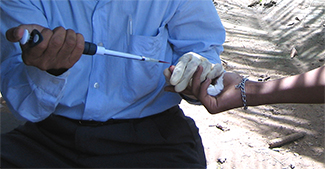
photo of someone giving blood
Malaria patient provides a blood sample.
In one of the studies, researchers genetically modified P. falciparumcollected from malaria patients in Cambodia, as well as reference parasites from various geographical origins. When scientists removed K13-propeller mutations, parasites were 70 to 140 times more likely to die after artemisinin exposure. When they added mutations to the K13-propeller gene, parasites were up to 70 times more likely to survive this drug exposure. Certain K13-propeller mutations conferred higher levels of survival to parasites recently collected from Cambodia than to older reference parasites, suggesting that additional genetic factors may be contributing to artemisinin resistance.
In the second study, researchers analyzed more than 1,000 P. falciparumsamples from 13 malaria-endemic regions of Southeast Asia and Africa, some with no evidence of artemisinin resistance and others where resistance is well-established. Using parasite isolates taken directly from malaria patients, they found that artemisinin resistance was associated with slower progression of blood-stage parasite development and changes in a certain cellular response that may enable the parasites to better withstand the effects of the drug.
These studies provide direct evidence that K13-propeller mutations cause artemisinin resistance and offer insights into the molecular basis of resistance. Understanding the genetic factors and mechanisms underlying drug resistance promises to aid development of new strategies to counter the threat that artemisinin resistance poses to global malaria control and elimination.
The study authors suggest a global K13 sequencing effort to track the spread of artemisinin resistance and mitigate its impact on malaria treatment and control programs.