Showing posts with label pregnancy. Show all posts

Wednesday, January 13, 2016

Trying to conceive soon after a pregnancy loss may increase chances of live birth

NIH study finds no reason for delaying pregnancy attempts after a loss without complications.
Couples who attempt to conceive within three months after losing an early pregnancy, defined as less than 20 weeks gestation, have the same chances, if not greater, of achieving a live birth than those who wait for three months or more, according to a National Institutes of Health study.
This finding, published today in Obstetrics & Gynecology, questions traditional advice that couples should wait at least three months after a loss before attempting a new pregnancy. The World Health Organization, for example, recommends waiting a minimum of six months between a pregnancy loss and a subsequent attempt.
“Couples often seek counseling on how long they should wait until attempting to conceive again,” said Enrique Schisterman, Ph.D., chief of the Epidemiology Branch at NIH’s Eunice Kennedy Shriver National Institute of Child Health and Human Development (NICHD) and senior author of the study. “Our data suggest that women who try for a new pregnancy within three months can conceive as quickly, if not quicker, than women who wait for three months or more.”
Previous studies of pregnancy spacing have focused on when women should become pregnant after experiencing a loss, but few have addressed the question of when couples should start trying to conceive.
In the current study, researchers analyzed data from the Effects of Aspirin in Gestation and Reproduction (EAGeR) trial, a multi site block-randomized, double-blinded, placebo-controlled trial  that took place from 2007 to 2011. The trial, which evaluated the effect of daily low-dose aspirin on reproductive outcomes in women with a history of pregnancy loss, enrolled 1,228 women aged 18 to 40 years. NICHD investigators concentrated on 1,083 of these women, more than 99 percent of whom had lost a pregnancy at less than 20 weeks gestation. None of the women had either of two potential complications of pregnancy: a tubal (ectopic) pregnancy or a molar pregnancy (growth of abnormal fetal tissue in the uterus).  The participants were followed for up to six menstrual cycles and, if they became pregnant, until the outcome of their pregnancy was known.
The researchers found that more than 76 percent of the women attempted to conceive within 3 months after losing a pregnancy. Compared to those who waited longer, this group was more likely to become pregnant (69 percent vs. 51 percent) and to have a pregnancy leading to a live birth (53 percent vs. 36 percent). The investigators did not observe any increase in the risk of pregnancy complications in this group.
“While we found no physiological reason for delaying attempts at conception following a pregnancy loss, couples may need time to heal emotionally before they try again,” said Karen Schliep, Ph.D., primary author of the study. “For those who are ready, our findings suggest that conventional recommendations for waiting at least three months after a loss may be unwarranted.”

Tuesday, November 24, 2015

Food Research:Food industry can help lower cardiovascular diseases by adding little seaweed to products ♦ The unwanted extras in your morning filter coffee

The unwanted extras in your morning filter coffee New research examines chemical leaching into coffee from filter coffee machines and electric kettles. The alarming results suggest that caffeine consumption is not all we have to worry about in our coffee culture.
Healthy' foods differ by individual Ever wonder why that diet didn't work? A new study tracking the blood sugar levels of 800 people over a week suggests that even if we all ate the same meal, how it's metabolized would differ from one person to another. The findings demonstrate the power of personalized nutrition in helping people identify which foods can help or hinder their health goals.
Moderate amounts of caffeine during pregnancy do not harm baby's IQ Women drinking and eating moderate amounts of caffeine during pregnancy should be reassured that they are not harming their child's intelligence.
Food industry can help lower cardiovascular diseases by adding little seaweed to products Adding seaweed to processed foods such as frozen pizzas, hot dogs and dried pasta will reduce cardiovascular diseases, concludes a new scientific article. One suggestion is to replace 5 percent of the flour in pizza dough with dried and granulated seaweed.

Monday, October 26, 2015

Women's Health: Most healthy women would benefit from light meal during labor ♦ Magnesium during labor may reduce risk of fever in mothers and complications in babies

Physical activity has greater impact on body composition in postmenopausal women Everyone knows that exercise is good for you, regardless of your age. But a new study shows that some types of physical activity have a greater impact on body composition in postmenopausal compared to premenopausal women.
Unhealthy pregnancy weight gain tips the scales for mothers seven years later For the first time, researchers studied the association between gestational weight gain and long-term weight retention among a multiethnic urban population. Results show that mothers with excessive weight gain during pregnancy weighed more and had greater body fat seven years after delivery if they began pregnancy at normal or at slight overweight and suggest that excessive gestational weight gain has long-term consequences for women who are normal weight or a little overweight before pregnancy.
Most healthy women would benefit from light meal during labor Most healthy women can skip the fasting and, in fact, would benefit from eating a light meal during labor, suggests new research. Improvements in anesthesia care have made pain control during labor safer, reducing risks related to eating, researchers note.
Magnesium during labor may reduce risk of fever in mothers and complications in babies Women who received magnesium sulfate during labor were less likely to develop maternal fever, a condition that can lead to a variety of complications in newborns including difficulty breathing, seizures, cerebral palsy and a condition known as “floppy baby syndrome,” characterized by inadequate muscle tone.

Saturday, October 10, 2015

Women's Health: Preventive care drops when government cuts close women's health clinics ♦ Menopause diminishes impact of good cholesterol ♦ Should women consume alcohol during pregnancy?

Preventive care drops when government cuts close women's health clinics When women's health clinics close because of government funding cuts aimed at abortion providers, fewer women seek lifesaving preventive care that can identify health threats such as cancer, research shows. The findings also suggest that a clinic's closure affected less-educated women the most.
DNA-based vaccine clears nearly half of precancerous cervical lesions in clinical trial Using a novel synthetic platform for creating vaccines a team of researchers has successfully eradicated precancerous cervical lesions in nearly half of the women who received an investigational vaccine in a clinical trial.
Should women consume alcohol during pregnancy? Experts discuss the evidence and current guidelines on the controversial topic of alcohol consumption during pregnancy
Vaginal microbes influence whether mucus can trap HIV HIV particles are effectively trapped by the cervicovaginal mucus from women who harbor a particular vaginal bacteria species, Lactobacillus crispatus. The findings could lead to new ways to reduce or block vaginal transmission of HIV and other sexually transmitted infections.
Menopause diminishes impact of good cholesterol What has previously been known as good cholesterol -- high density lipoprotein -- has now been shown to be not so good in protecting women against atherosclerosis while they are transitioning through menopause.

Saturday, September 26, 2015

Women's Health: Women with moderate beer consumption run lower risk of heart attack ♦ New treatment may help overcome common pregnancy-related complication

Female gamers a new risk group for ,,overweight Young women who play computer games are a new risk group for developing overweight and obesity. This is the finding of a study that includes more than 2,500 Swedes in their 20s.
Number of young female anesthesiologists increases, but wages lower than male colleagues A study has analyzed a 2013 survey of members of the American Society of Anesthesiologists that found 40 percent of anesthesiologists under the age of 36 were female, a substantial increase over 2007 when 26 percent of young anesthesiologists were women. Despite an increasing number of women anesthesiologists, the study found male anesthesiologists earned 29 percent more than female anesthesiologists, with a reported average annual income of $403,616 for men compared to $313,074 for women.
Women with moderate beer consumption run lower risk of heart attack Women who drink beer at most once or twice per week run a 30 percent lower risk of heart attack, compared with both heavy drinkers and women who never drink beer. These are the findings of a Swedish study which has followed 1,500 women over a period of almost 50 years
New treatment may help overcome common pregnancy-related complication In pregnant women with preeclampsia, a procedure used to remove a protein called sFlt-1 from the blood reduced the amount of protein excreted in the urine and stabilized blood pressure. Pregnancy continued an average of eight days and 15 days in women treated once and multiple times, respectively, compared with three days in untreated women with preeclampsia.

Friday, September 25, 2015

Alcohol Use and Binge Drinking Among Women of Childbearing Age

One in 10 women aged 18-44 years consumes alcohol during pregnancy, putting her baby at risk of physical and behavioral problems known as fetal alcohol spectrum disorders (FASDs) and other pregnancy problems such as miscarriage, stillbirth, and prematurity. Women who are pregnant or who might be pregnant should avoid drinking alcohol because there is no known safe amount, no safe time, and no safe type of alcohol to drink during pregnancy.
One in 10 (10.2 percent ) pregnant women aged 18-44 years in the United States reports drinking alcohol in the past 30 days and 3.1 percent  (1 in 33) reports binge drinking – defined as 4 or more alcoholic beverages on one occasion. Using the 2011-2013 Behavioral Risk Factor Surveillance System data, the study also found that among binge drinkers, pregnant women reported a significantly higher frequency of binge drinking than non-pregnant women (4.6 and 3.1 episodes respectively).
Healthcare professionals can help reduce alcohol consumption among pregnant and nonpregnant women who misuse alcohol by implementing alcohol screening and brief intervention in their primary care practices, and informing women that there is no known safe level of alcohol consumption when they are pregnant or might be pregnant.

Wednesday, September 16, 2015

Prenatal Research: New molecule found to prevent preterm birth ♦ Scan may identify best candidates for fetal spina bifida surgery ♦ Iron supplementation during pregnancy and risk of malaria in malaria

Iron supplementation during pregnancy and risk of malaria in malaria-endemic region Among women in a malaria-endemic region in Kenya, daily iron supplementation during pregnancy did not result in an increased risk of malaria, according to a study. Iron supplementation did result in increased birth weight, gestational duration, neonatal length, and a decreased risk of low birth weight and prematurity.
New molecule found to prevent preterm birth Premature births are intimately linked with inflammation of the uterine tissue, a biological response which induces contractions and preterm labor. In their search for a mean to prevent this phenomenon and complications related to deliveries occurring before 37 weeks of gestation, researchers have discovered an agent that shows efficacy in inhibiting inflammation and preventing or delaying uterine contractions and premature delivery in murine models – without adversely affecting the fetus or the mother. This discovery is a giant step towards preventing prematurity, which is the world's leading cause of infant death and the origin of potentially severe, long-lasting physical, intellectual or psychological impairment for the 10% of infants born preterm world-wide.
Research reveals the placenta's oxygen tanks for early embryos A new role for the placenta has been revealed by researchers who have identified sites which store, and gradually release, oxygen for newly formed embryos in the weeks after the baby's heart is developed.
Scan may identify best candidates for fetal spina bifida surgery Fetuses with enlarged ventricles -- the fluid-filled cavities inside the brain -- may be less likely than their counterparts to benefit from surgery in the womb to treat spina bifida.

Friday, September 4, 2015

Women's Health: Exposure to phthalates could be linked to pregnancy loss ♦ Acupuncture reduces hot flashes in breast cancer survivors ♦ Young women with diabetes have 6-fold risk of heart attack

Young women with diabetes have 6-fold risk of heart attack Women aged 45 years and under with diabetes have a six-fold risk of heart attack, according to new research. The study in more than 7,000 women also found that young women who had a heart attack (myocardial infarction, MI) were more likely to be smokers than older women with MI.
New symptom may help identify sleep apnea in older women Obstructive sleep apnea may be underdiagnosed in postmenopausal women. A new study strongly associates the condition's traditional risk factors with nocturnal enuresis (bedwetting), suggesting that it may be an additional screening factor for doctors to consider.
Exposure to phthalates could be linked to pregnancy loss A new study of more than 300 women suggests that exposure to certain phthalates -- substances commonly used in food packaging, personal-care and other everyday products -- could be associated with miscarriage, mostly between 5 and 13 weeks of pregnancy.
Acupuncture reduces hot flashes in breast cancer survivors Acupuncture may be a viable treatment for women experiencing hot flashes as a result of estrogen-targeting therapies to treat breast cancer, according to a new study. Hot flashes are particularly severe and frequent in breast cancer survivors, but current FDA-approved remedies for these unpleasant episodes, such as hormone replacement therapies are off-limits to breast cancer survivors because they include estrogen.

Saturday, August 29, 2015

Women's Health: Heart medications prolong survival in women with ovarian cancer ♦ Fetal cells influence maternal health during pregnancy

Heart medications that target stress may help prolong survival in women with ovarian cancer A new analysis of patient records indicates that certain drugs taken to improve heart health may also have anti-cancer properties.
New embryo image processing technology could assist in IVF implantation success rates Biologists and engineers have developed a new non-invasive image processing technique to visualize embryo formation. Researchers were able to see, for the first time, the movement of all of the cells in living mammalian embryos as they develop under the microscope. This breakthrough has important implications for IVF treatments and pre-implantation genetic diagnosis. In the future, this approach could help with embryo selection to improve IVF success rates.
The alien within: Fetal cells influence maternal health during pregnancy (and long after) Dramatic research has shown that during pregnancy, cells of the fetus often migrate through the placenta, taking up residence in many areas of the mother's body, where their influence may benefit or undermine maternal health.
Women with hypertension in pregnancy and their siblings face increased risk of heart disease High blood pressure during pregnancy is a risk factor for future hypertension and cardiovascular disease, but it’s not clear if this increased risk is because these women are more likely to have a family history of heart disease or if elevated blood pressure during pregnancy causes long-term metabolic and vascular abnormalities.

Sunday, August 23, 2015

Women's health: Iodine supplementation during pregnancy could offer huge cost savings ♦ Unexpected sexual consequences for young women who drink alcohol

Universal iodine supplementation during pregnancy could offer huge cost savings Giving all pregnant women iodine supplements, even in mildly iodine deficient countries like the UK, could result in huge cost savings for health care systems and society.
Women hurt more by breakups but recover more fully Women experience more emotional pain following a breakup, but they also more fully recover, according to new research. Researchers asked participants to rate emotional and physical pain of a breakup and found that women tend to be more negatively affected by breakups, reporting higher levels of both physical and emotional pain. While breakups hit women the hardest, they tend to recover more fully. Men, on the other hand, never fully recover.
Women having a baby by IVF are at increased risk of reflux disease after birth Women who give birth to babies conceived by in-vitro fertilization are at increased risk of experiencing long-term symptoms of gastro-oesophageal reflux disease, according to the results of a study. Gastro-esophageal reflux disease is a common condition in which acid from the stomach travels up into the esophagus and causes heartburn, regurgitation and pain when swallowing.

Study documents extent of unexpected sexual consequences for young women who drink alcohol In-depth interviews of 20 young women attending an urban sexually transmitted disease clinic have documented a variety of unexpected, unintended sexual encounters linked to their alcohol use before sex occurs.

Thursday, July 30, 2015

Women's Health: Relationship between asthma, cortisol, and complications in pregnancy ♦ Home births lead to higher infant mortality,♦ Socially integrated women have lower suicide risk

Blood markers identify women at risk for postpartum depression The hormone oxytocin, sometimes called 'the love hormone,' may be a factor in postpartum depression, when a mother has a lower than normal level. A blood marker now may help identify the risk.
Home births lead to higher infant mortality, at least for mothers living in poorer areas Home births lead to higher infant mortality than hospital births, at least for mothers living in poorer areas. This is the conclusion of a new study that examines 356,412 low-risk Dutch women who delivered between 2000 and 2008 and who were allowed to choose between a home and a hospital birth.
Hair samples may offer new insights into the relationship between asthma, cortisol, and complications in pregnancy Hair samples can be used to measure the effects of asthma on the cortisol levels of women during pregnancy, according to new research. This research also shows that levels of cortisol, a stress-related hormone, tend to be lower among pregnant women with asthma than among pregnant women without the chronic, inflammatory lung disease
Socially integrated women have lower suicide risk Women who were socially well integrated had a lower risk for suicide in a new analysis of data from the Nurses' Health Study, according to an article. Suicide is among the top 10 leading causes of death among middle-age women in the United States.

Thursday, June 18, 2015

Researchers design placenta-on-a-chip to better understand pregnancy

National Institutes of Health (NIH) researchers and their colleagues have developed a “placenta-on-a-chip” to study the inner workings of the human placenta and its role in pregnancy. The device was designed to imitate, on a micro-level, the structure and function of the placenta and model the transfer of nutrients from mother to fetus. This prototype is one of the latest in a series of organ-on-a-chip technologies developed to accelerate biomedical advances.
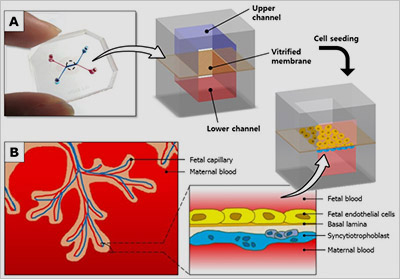
Illustration of placenta-on-a-chip device
Figure: A placenta-on-a-chip micro device: A) The device’s upper (blue) and lower (red) chambers are separated by a semipermeable membrane. B) Researchers placed maternal cells in one chamber and fetal cells in the other. They then added glucose to the maternal-cell chamber and observed how it traveled through the membrane to the fetal-cell chamber
The study, published online in the Journal of Maternal-Fetal & Neonatal Medicine, was conducted by an interdisciplinary team of researchers from the NIH’s Eunice Kennedy Shriver National Institute of Child Health and Human Development (NICHD), the University of Pennsylvania, Wayne State University/Detroit Medical Center, Seoul National University and Asan Medical Center in South Korea.
“We believe that this technology may be used to address questions that are difficult to answer with current placenta model systems and help enable research on pregnancy and its complications,” said Roberto Romero, M.D., chief of the NICHD’s Perinatology Research Branch and one of the study authors.
The placenta is a temporary organ that develops in pregnancy and is the major interface between mother and fetus. Among its many functions is to serve as a “crossing guard” for substances traveling between mother and fetus. The placenta helps nutrients and oxygen move to the fetus and helps waste products move away. At the same time, the placenta tries to stop harmful environmental exposures, like bacteria, viruses and certain medications, from reaching the fetus. When the placenta doesn’t function correctly, the health of both mom and baby suffers.
Researchers are trying to learn how the placenta manages all this traffic, transporting some substances and blocking others. This knowledge may one day help clinicians better assess placental health and ultimately improve pregnancy outcomes.
However, studying the placenta in humans is challenging: it is time-consuming, subject to a great deal of variability and potentially risky for the fetus. For those reasons, previous studies on placental transport have relied largely on animal models and on laboratory-grown human cells. These methods have yielded helpful information, but are limited as to how well they can mimic physiological processes in humans.
The researchers created the placenta-on-a-chip technology to address these challenges, using human cells in a structure that more closely resembles the placenta maternal-fetal barrier. The device consists of a semi-permeable membrane between two tiny chambers, one filled with maternal cells derived from a delivered placenta and the other filled with fetal cells derived from an umbilical cord.
After designing the structure of the model, the researchers tested its function by evaluating the transfer of glucose (a substance made by the body when converting carbohydrates to energy) from the maternal compartment to the fetal compartment. The successful transfer of glucose in the device mirrored what occurs in the body.
“The chip may allow us to do experiments more efficiently and at a lower cost than animal studies,” said Dr. Romero. “With further improvements, we hope this technology may lead to better understanding of normal placental processes and placental disorders.”

Tuesday, May 19, 2015

Health News: Third of Brits at risk of food poisoning ♦ Five salmonella outbreaks food inspectors didn't see coming ♦ Bacteria contribute to immune suppression in skin

Third of Brits at risk of food poisoning from deadly chickens  Campylobacter is found on raw chicken and is the most common cause of food poisoning in Britain, causing an estimated 100 deaths annually. Currently, over 280,000 people contract food poisoning a year. FSA director Nina Purcell said: "More than a quarter of a million people – 280,000 – fall ill each year due to campylobacter food poisoning.
Five salmonella outbreaks food inspectors didn't see coming  Federal inspectors are inside every meat and poultry processing plant in this country. The problem is, their efforts sometimes fail to identify salmonella — a potentially deadly pathogen that sickens more than a million Americans each year, about 200,000 from contaminated poultry.
Genome-wide DNA study shows lasting impact of malnutrition in early pregnancy  Children whose mothers were malnourished at famine levels during the first 10 weeks of pregnancy had changes in DNA methylation known to suppress genes involved in growth, development, and metabolism documented at age 59.
Bacteria contribute to immune suppression in skin after repeated schistosome exposure Our two square meters of skin act as a defensive barrier against environmental pathogens but is also covered by beneficial commensal bacteria. A study explores this delicate balance and reports that when schistosome parasites repeatedly penetrate the skin, they are cloaked in skin bacteria, leading to a tightly controlled and limited immune response, due in part to this cloaking mechanism.
Losing weight can reduce risk of death, ventilator use in lung transplant patients Obesity is a complicating factor for many surgical patients.Researchers have shown that losing weight can have a positive impact on outcomes for lung transplant patients.

Prenatal Research: Prenatal exercise lowers risks of C-sections ♦ Sunshine alone not enough for vitamin D ♦ Maternal obesity compromises baby's' immune system


Prenatal exercise lowers risks of C-sections, higher birth weights Pregnant women who exercise can significantly lower the risk of undergoing cesarean sections and giving birth to large babies. Prenatal exercise has been suggested to be a means to prevent childhood obesity through a "normalization" in birth weight
Sunshine alone not enough for vitamin D during pregnancy Despite high levels of sunshine, low levels of vitamin D during pregnancy are common in Mediterranean women. This finding should help lower the prevalence of early childhood diseases associated with Vitamin D deficiency such as preeclampsia, gestational diabetes, disorders in bone formation, higher risk of emergency caesarean delivery and premature birth.
Maternal obesity compromises baby's' immune system at time of birth Maternal obesity is linked to several adverse health outcomes for the infant that can persist into adulthood. But when does the immune system of babies born to obese mothers get compromised? Very early in the baby's life, according to a study. The research team analyzed umbilical cord blood samples of infants born to lean, overweight and obese mothers, and found that pre-pregnancy maternal weight has a significant impact on the neonate's immune system.
Changes in placentas protective ability during pregnancy linked to transporter proteins An important function of the human placenta is to protect the fetus from detrimental substances in maternal blood, such as glucocorticoids or toxins. Placental membrane-bound transporter proteins, known as multidrug resistance proteins, protect the fetus by returning unwanted materials to the maternal circulation. A study now reports that bacterial and viral infections differentially influence these transporter proteins in early and late pregnancy, suggesting potential mechanisms underlying infection-related pregnancy complications such as preterm birth and fetal brain damage.
.

Thursday, March 12, 2015

Health News:100,s of students exposed to TB ♦ Highest rate of poultry food poisoning ♦ Smoking when pregnant increases cancer risk for daughters ♦ plus More

100,s of students exposed to TB at 2 Elk Grove Schools. School District officials announced that about 100 Franklin Elementary and 300 Franklin High School students will undergo skin tests for TB exposure the week of March 16. Continue Reading
Ireland has highest rate of poultry food poisoning bacteria in Europe  A report this week by Ella McSweeney,The Consumer Show has revealed a bacteria that can cause lethal food poisoning in humans is present on more than 98% of Irish chicken. The bacteria, campylobacter, is a potentially lethal food poisoning bacteria and 98% of Irish chickens tested positive for it when they were assessed Continue Reading
Male partner's healthier lifestyle may help infertile obese female conceive  Male partners of infertile obese females may increase the odds of conceiving a child by improving their own weight and dietary habits, Continue Reading
Exposure to endocrine disruptors during pregnancy affects the brain two generations later  Prenatal exposure to low doses of the environmental contaminants polychlorinated biphenyls, or PCBs, change the developing brain in an area involved in metabolism, Continue Reading
Smoking when pregnant increases cancer risk for daughters  Women who smoke when pregnant are putting their daughters at a greater risk of developing ovarian and breast cancer later in life, a new study has determined. Findings also demonstrated that mothers who reported smoking most days while pregnant had daughters who had an earlier age of first menstruation, or menarche Continue Reading

Monday, January 26, 2015

1/26/15 Health News:Undisclosed Superbug sickened dozens in Virginia ♦ New cancer-fighting strategy ♦ BPA exposure during pregnancy causes oxidative stress in child

Undisclosed superbug sickened dozens at Virginia Mason.
Virginia Mason Medical Center officials in Seattle stated that they overhauled their cleaning protocol for medical scopes after an outbreak of drugresistant superbugs spread by contaminated specialized endoscopes infected at least 32 patients between 2012 and 2014. Authorities believe the bacterium was likely transferred from patient to patient after the devices were cleaned, but still harbored the germs.Continue Reading
New cancer-fighting strategy would harden cells to prevent metastasis
Existing cancer therapies are geared toward massacring tumor cells, but researchers propose a different strategy: subtly hardening cancer cells to prevent them from invading new areas of the body. They devised a way of screening compounds for the desired effect and have identified a compound that shows promise in fighting pancreatic cancer. Continue Reading
Scientists invent system to improve effectiveness of cancer surgery
With the goal of making it easier for surgeons to detect malignant tissue during surgery and hopefully reduce the rate of cancer recurrence, scientists have invented a new imaging system that causes tumors to “light up” when a hand-held laser is directed at them Continue Reading
BPA exposure during pregnancy causes oxidative stress in child, mother
Exposure to the endocrine-disrupting chemical bisphenol A (BPA) during pregnancy can cause oxidative damage that may put the baby at risk of developing diabetes or heart disease later in life, according to a new study. Continue Reading

Friday, November 14, 2014

Sun screen ultraviolet filters linked to pregnancy delays

Researchers identify two chemicals that appear to reduce fertility in men
Certain sunscreen chemicals used to protect against ultraviolet rays may impair men’s ability to father children in a timely manner, according to a study by the National Institutes of Health and the New York state Department of Health’s Wadsworth Center. But the researchers caution that the results are preliminary and that additional studies are needed to confirm their findings.
Benzophenone (BP)-type ultraviolet (UV) filters comprise a class of about 29 chemicals commonly used, among other purposes, in sunscreens and other personal care products to protect skin and hair from sun damage. Some of these chemicals, upon being absorbed by the skin, can interfere with the body’s hormones and endocrine system processes. Researchers found that men with high exposure to UV filters BP-2 or 4OH-BP had a 30 percent reduction in fecundity, the biological ability to reproduce. Lower fecundity may result in a longer time to pregnancy.
“In our study, male fecundity seems to be more susceptible to these chemicals than female fecundity. The women participants actually had greater exposure to the UV filters overall, but their exposure wasn’t associated with any significant pregnancy delays,” said Germaine Louis, Ph.D., director of the Division of Intramural Population Health Research at the Eunice Kennedy Shriver National Institute of Child Health and Human Development. “Our next step is to figure out how these particular chemicals may be affecting couple fecundity or time to pregnancy—whether it’s by diminishing sperm quality or inhibiting reproduction some other way.”
The researchers followed the couples until pregnancy or up to one year of trying, to record the time it took for the women to become pregnant. They also tested participants’ urine samples and measured concentrations of five selected UV filters associated with endocrine-disrupting activity. In their data analysis, the researchers controlled for age, body mass index, and smoking, among other factors.
Their findings suggest that some, but not all, UV filters may be associated with diminished fertility in men, independent of their partners’ exposure. The researchers observed effects among men with the highest exposure (the 75th percentile and above) to UV filters BP-2 or 4OH-BP.
“The skin is the body’s largest organ, and how we care for our skin matters in more ways than one,” said Dr. Louis. “Sunscreen is important for sun protection, and we definitely encourage people to continue using sunscreen to avoid skin cancer. But men who are concerned about fertility may be interested in other ways to reduce their exposure to benzophenone UV filters—whether by cutting back on other products that contain the UV filters or by washing after returning indoors.”
Among the study’s major limitations: the researchers tested single urine samples from participants to assess chemical exposure, but participants’ levels of exposure may have changed over the course of trying for pregnancy. The researchers also had no data on what specific products the participants used that contained the UV filters.
Earlier research findings from the LIFE Study have linked reduced fertility to high cholesterol levels in women and couples and to high concentrations of phthalates and Bisphenol A (BPA) in men.

Wednesday, November 12, 2014

11/12/14 Health News:DIRTY DOZEN LIST FOR FOOD ADDITIVES ♦ Pathway leading to obesity ♦ High-fat diets during pregnancy influence brain functioning &behavior of children

ENVIRONMENTAL WORKING GROUP RELEASES FIRST ‘DIRTY DOZEN’ LIST FOR FOOD ADDITIVES
The Environmental Working Group – famous for its list of produce most likely to be contaminated with pesticides – has now released a “Dirty Dozen” guide for food additives. There are more than 10,000 additives in food distributed in the U.S., and EWG is trying to highlight “some of the worst failures of the regulatory... Continue Reading
Piecing together signaling pathway leading to obesity
A team of researchers has now drawn connections between known regulators of body mass, pointing to possible treatments for obesity and metabolic disorders. As scientists probe the molecular underpinnings of why some people are prone to obesity and some to leanness, they are discovering that weight maintenance is more complicated than the old “calories in, calories out” adage. Continue Reading
Research suggests high-fat diets during pregnancy could influence brain functioning, behavior of children

A diet high in fat can increase one’s risk for diabetes, obesity and metabolic syndrome; however few studies have assessed the effects of a maternal high fat diet on offspring. New research suggests that a high-fat maternal diet during pregnancy and while breastfeeding could have significant and lasting detrimental effects on the brain function and behavior of children. The study is one of few basic science studies conducted to measure the direct effect of a high-fat maternal diet on the cognitive functioning on offspring. Continue Reading

Monday, October 6, 2014

More Knowledge Reduces Prenatal Testing

More Knowledge Reduces Prenatal Testing
At a Glance
  • Pregnant women given computer-based information about prenatal screening were more likely to skip testing, especially invasive tests—even when the tests were free.
  • The findings suggest that multimedia education can help patients make more informed choices about their medical care.
During the first trimester of pregnancy, women are routinely offered a variety of screening tests to assess the risk for genetic disorders in the fetus. For many women, testing provides reassurance. For others, the tests can be inconclusive, leading to uncertainty and anxiety. Some follow-up diagnostic tests, such as amniocentesis and chorionic villus sampling, are invasive and carry risks, including miscarriage. While less invasive tests are now becoming available, studies suggest that women may not understand the risks and benefits of prenatal genetic tests, or even know they’re optional.
Pregnant businesswoman touching her belly sitting at her desk.
A “decision-support” tool helped pregnant women make informed decisions about prenatal screening.
To help women make informed choices, a research team led by Dr. Miriam Kuppermann of the University of California, San Francisco, developed an interactive computer program to educate and guide decisions about prenatal testing. This “decision-support” tool uses video, audio, and text to explain the risks and benefits of various tests. The program also includes questions to help clarify the woman’s values, and emphasizes the personal nature of deciding what to do. It takes about 45 to 60 minutes to complete.
To assess the impact of this tool, the researchers studied 710 pregnant women of diverse backgrounds who hadn’t yet undergone prenatal genetic testing. The women were recruited from 8 clinical sites in the San Francisco area. The study was funded in part by NIH’s Eunice Kennedy Shriver National Institute of Child Health and Human Development (NICHD).
Participants were randomly divided into 2 groups. The intervention group had access to the decision-support program. To remove financial barriers, they were able to receive prenatal tests with no out-of-pocket expense. The control group received standard care with no reimbursement for out-of-pocket costs of prenatal genetic testing. Study results appeared in theJournal of the American Medical Association on September 24, 2014.
The researchers found that women in the intervention group scored significantly higher in their understanding of genetic testing compared to the control group. Women in the intervention group were also much more likely to correctly identify the chance that an amniocentesis will cause a miscarriage and the likelihood that their fetus had Down syndrome.
The number of women who chose prenatal screening alone was similar—68.5% in the intervention group vs. 67.3% in the control group. However, women in the intervention group were less likely to undergo invasive diagnostic testing than women in the control group (5.9% vs. 12.3%). The intervention group was also more likely to forgo prenatal testing entirely (25.6% compared to 20.4% in the control group). Overall, these results suggest that the decision-support program helped women make informed choices about prenatal testing that were more closely aligned with their values.
"This does not mean that women in general don't want testing,” Kuppermann says. “But it does suggest that at least some women have undergone testing without having clarity about the implications.”
The team is now working to develop a clinic-ready decision-support tool for wider distribution. “Decisions about prenatal testing are personal and should be reflective of the patient’s own values and preferences, not those of her health-care providers," Kuppermann says.
—by Vicki Contie