Nearly 50,000 Americans will be diagnosed with pancreatic cancer in 2015, according to NIH’s National Cancer Institute (NCI). Only 7% are expected to survive 5 years or longer because the disease is difficult to detect early enough for effective treatment.
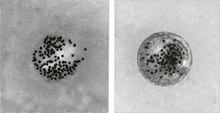
The GPC1biomarker (black dots) on exosomes from 2 patients. Image by the researchers, courtesy of Nature.
One method of spotting cancer early is to find biomarkers—substances in the body that signal the presence of a disease. A team of scientists lead by Dr. Raghu Kalluri of the University of Texas MD Anderson Cancer Center searched for biomarkers on tiny, fluid-filled sacs called exosomes. Exosomes are released by cells and circulate in blood. The research, which was partially funded by NCI, was published in Nature on July 9, 2015.
The scientists compared exosomes from a human cancer cell line and several noncancerous cell lines. They tested a variety of biomarkers and found 48 that were unique to the cancer exosomes. One, called Glypican-1 or GPC1, was found at high levels in pancreatic and breast cancer cells.
The team next isolated exosomes in blood samples taken from healthy people and patients with breast cancer or pancreatic cancer. The researchers found that 75% of the patients with breast cancer (24 out of 32) and all of the 251 pancreatic cancer patients had higher levels of GPC1-containing exosomes in their blood compared to healthy controls. Patients with late-stage pancreatic cancer had more of these exosomes in their blood than patients with early-stage disease.
Patients with precancerous pancreatic lesions had more GPC1-positive exosomes in their blood than both healthy controls and patients with noncancer pancreatic illnesses like pancreatitis. In contrast, a commonly used pancreatic cancer biomarker called carbohydrate antigen 19-9 couldn’t distinguish people with precancerous lesions from healthy controls. This suggests that GPC1-positive exosomes may be a better biomarker than the current standard.
Finally, the group examined a mouse model of pancreatic cancer. GPC1-positive exosomes predicted cancer emergence before tumors could be detected with MRI or other techniques.
If confirmed, this research could lead to fast and accurate tests for detecting early-stage pancreatic cancer, which would allow for earlier treatment and raise the disease’s survival rate.
“This presents an unprecedented opportunity for informative early detection of pancreatic cancer and in designing potential curative surgical options,” Kalluri says.
—by Brandon Levy
