Showing posts with label fertilization. Show all posts

Monday, July 27, 2015

Protein in mice that helps prepare for healthy egg-sperm union

Researchers at the National Institutes of Health have discovered a protein that plays a vital role in healthy egg-sperm union in mice. The protein RGS2 can delay an egg’s development into an embryo in order to allow time for sperm to arrive and merge with the egg in a healthy fertilization process. The embryo cannot survive without the male chromosomes.
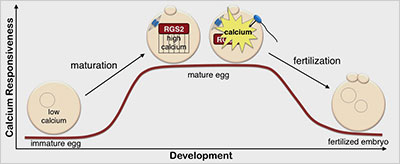
A graphic showing the RGS2 process.
The diagram depicts the interplay between calcium and RGS2 during egg development and fertilization. RGS2 suppresses calcium signaling long enough for the sperm to travel and fuse with the egg.
“These findings show the critical role that the protein RGS2 plays in preserving the fertilizability of the ovulated egg,” said Carmen Williams, M.D., Ph.D., lead researcher at the National Institute of Environmental Health Sciences, part of the NIH.  “Other researchers have shown that RGS2 plays an important role in regulating heart function and blood pressure, but this is the first demonstration of the protein’s significant role in fertilization.”
Dr. Williams explained that the immature egg found in the ovary is not very good at rallying the necessary calcium signaling that is needed to respond to sperm. However, during the maturation process, the egg stores calcium, preparing it for fertilization. At fertilization, the sperm causes calcium to release within the egg, turning it into a developing embryo.
The mouse study, published online in the journal Development, shows that during maturation the egg synthesizes RGS2, which suppresses calcium signaling. This safety mechanism ensures that the egg does not begin releasing calcium and start developing before the sperm arrives. Beginning development too early prevents the egg from merging with the sperm.
The RGS2 protein is being looked at as a therapeutic target for hypertension and other heart ailments. “Understanding the role RGS2 plays in reproduction is important when considering the possible benefits and side effects of any new treatments, as well as understanding the impact that toxins might have on human fertility,” said Linda Birnbaum, Ph.D., director of NIEHS and the National Toxicology Program.

Thursday, March 12, 2015

Physical labor, hypertension and multiple meds may reduce male fertility

Working in a physically demanding job, having high blood pressure, and taking multiple medications are among health risks that may undermine a man’s fertility, according to a study by researchers at the National Institutes of Health and Stanford University, Stanford, California. The study is the first to examine the relationships between workplace exertion, health, and semen quality as men are trying to conceive. The results were published online in Fertility and Sterility.
“Nearly 15 percent of U.S. couples do not become pregnant in their first year of trying,” said Germaine Buck Louis, Ph.D., the study’s senior author and director of the Division of Intramural Population Health Research at NIH’s Eunice Kennedy Shriver National Institute of Child Health and Human Development. “Male infertility plays a significant role, and our aim is to explore the influence of environmental factors and health status on semen quality.”
Semen quality is a measure of a man’s ability to achieve fertilization and is based on the number, shape, and movement ability of sperm, as well as other factors.
The investigators followed more than 500 couples in Texas and Michigan over a yearlong period. The couples were in committed relationships and stopped using contraception. All male participants completed preliminary interviews in which they were asked about their reproductive history, health, lifestyle and occupational activity. Most of the men provided a semen sample for analysis.
The final study group comprised 456 men with an average age of 31.8 years. Most were white (77 percent) and college-educated (91 percent); more than half had never fathered a pregnancy. The researchers found that 13 percent of the men who reported heavy work-related activity had lower sperm counts, compared to 6 percent of the men who reported no workplace exertion. In contrast, no other work-related exposure, such as heat, noise or prolonged sitting, appeared to influence semen quality.
Of the men who reported receiving a physician’s diagnosis of high blood pressure, diabetes, or high cholesterol, the researchers found that only those with high blood pressure had a lower percentage of normally shaped sperm, compared to men who reported no high blood pressure.
“As men are having children later in life, the importance of diseases we once thought as separate from fertility must be re-explored,” said Michael L. Eisenberg, M.D., the study’s principal investigator and director of Male Reproductive Medicine and Surgery at Stanford University in Palo Alto, California. “Future investigations need to examine whether it’s the high blood pressure itself or the treatment that is driving these trends.”
To that end, the researchers observed that the more medications a man reported taking, the higher his risk of a low sperm count. For example, 7 percent of the men who did not take medications had sperm counts below 39 million (a normal sperm count is between 40 million and 300 million). Of the men who reported taking two or more medications, 15 percent had sperm counts below 39 million.
“The good news is that these factors, if they are confirmed to have negative effects on male fertility, can potentially be modified by medical care or changing job-related behaviors ,” said NIH’s Dr. Buck Louis. “We look forward to additional research in this area.”