Showing posts with label Sperm. Show all posts

Monday, December 14, 2015

Weight Loss; Food and Emotions: 90 percent overlook key to weight loss ♦ Gut microbes trigger fat loss ♦ Short sleep linked to distracted secondary eating

Food and Emotions: 90 percent overlook key to weight loss The results of a national survey about weight loss barriers finds 90 percent of respondents discounted one of the most important factors -- your mind. A neuropsychologist says the most crucial factor is your psychological relationship with food and exercise, yet the majority (60 percent) listed diet and exercise to be the biggest barriers of weight loss, and only 10 percent of people thought psychological well being was the biggest barrier to weight loss.
Sperm carries information about dad's weight Turns out dads are also eating for two. A study reveals that a man's weight affects the heritable information contained in sperm. The sperm cells of lean and obese men possess different epigenetic marks, notable at gene regions associated with the control of appetite.
Gut microbes trigger fat loss in response to cold temperatures Exposure to cold temperatures is known to mimic the effects of exercise, protecting against obesity and improving metabolic health. A study now reveals that the beneficial health effects of cold exposure are mediated in part by gut microbes. The researchers found that cold exposure dramatically alters the composition of intestinal bacteria in mice and that this microbial shift is sufficient to burn fat, improve glucose metabolism, and reduce body weight
Short sleep linked to distracted secondary eating, drinking Research suggests a link between short sleep and obesity from secondary eating and drinking while engaged in another activity. Investigators assessed time spent on secondary eating and drinking as well as primary eating and drinking, with sleep duration as the principal independent variable.

Monday, September 28, 2015

Health Research: Lower sperm motility in men exposed to common chemical ♦ Diabetes medication could be used to treat alcohol dependence ♦ Flu vaccine expected to be a 'good match

This year's flu vaccine expected to be a 'good match' Every year at this time, we hear it's time to get the flu shot. After last year's vaccine missed the mark, how does the Center for Disease Control regain the public's confidence that their predictions will hold up this year? With the facts.
Lower sperm motility in men exposed to common chemical Men with higher exposure to the substance DEHP, a so-called phthalate, have lower sperm motility and may therefore experience more difficulties conceiving children, according to a new study.
Diabetes medication could be used to treat alcohol dependence A medication used for diabetes and obesity also could be a valuable tool for the treatment of alcohol dependence, a new study on mice and rats shows.
Chip-based technology enables reliable direct detection of Ebola virus Chip-based technology has been enhanced to provide reliable detection of Ebola virus and other viral pathogens. The system uses direct optical detection of viral molecules and can be integrated into a simple, portable instrument for use in field situations where rapid, accurate detection of Ebola infections is needed to control outbreaks.
Rapidly assessing the next influenza pandemic Influenza pandemics are potentially the most serious natural catastrophes that affect the human population. New findings suggest that with both timely and accurate data and sophisticated numerical models, the likely impact of a new pandemic can be assessed quickly, and key decisions made about potential mitigation strategies.

Monday, July 27, 2015

Protein in mice that helps prepare for healthy egg-sperm union

Researchers at the National Institutes of Health have discovered a protein that plays a vital role in healthy egg-sperm union in mice. The protein RGS2 can delay an egg’s development into an embryo in order to allow time for sperm to arrive and merge with the egg in a healthy fertilization process. The embryo cannot survive without the male chromosomes.
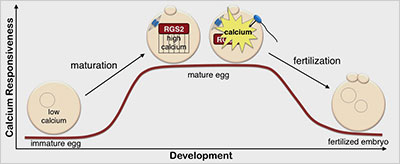
A graphic showing the RGS2 process.
The diagram depicts the interplay between calcium and RGS2 during egg development and fertilization. RGS2 suppresses calcium signaling long enough for the sperm to travel and fuse with the egg.
“These findings show the critical role that the protein RGS2 plays in preserving the fertilizability of the ovulated egg,” said Carmen Williams, M.D., Ph.D., lead researcher at the National Institute of Environmental Health Sciences, part of the NIH.  “Other researchers have shown that RGS2 plays an important role in regulating heart function and blood pressure, but this is the first demonstration of the protein’s significant role in fertilization.”
Dr. Williams explained that the immature egg found in the ovary is not very good at rallying the necessary calcium signaling that is needed to respond to sperm. However, during the maturation process, the egg stores calcium, preparing it for fertilization. At fertilization, the sperm causes calcium to release within the egg, turning it into a developing embryo.
The mouse study, published online in the journal Development, shows that during maturation the egg synthesizes RGS2, which suppresses calcium signaling. This safety mechanism ensures that the egg does not begin releasing calcium and start developing before the sperm arrives. Beginning development too early prevents the egg from merging with the sperm.
The RGS2 protein is being looked at as a therapeutic target for hypertension and other heart ailments. “Understanding the role RGS2 plays in reproduction is important when considering the possible benefits and side effects of any new treatments, as well as understanding the impact that toxins might have on human fertility,” said Linda Birnbaum, Ph.D., director of NIEHS and the National Toxicology Program.

Sunday, April 26, 2015

Health Research: Protein capable of regulating DNA repair ♦ Understanding the body's response to worms and allergies ♦ Are hospitals doing all they can to prevent C. difficile infections?

Beyond genes: Are centrioles carriers of biological information? Scientists have discovered that certain cell structures, the centrioles, could act as information carriers throughout cell generations. The discovery raises the possibility that transmission of biological information could involve more than just genes. Centrioles may actually be carriers of information, which holds profound implications for biology and disease treatment.
Discovery of a protein capable of regulating DNA repair during sperm formation Researchers have discovered that the signalling route - a cascade activation of several molecules - triggered by the ATM protein regulates DNA repair during the production of spermatocytes by meiosis, the cell division process which yields spermatozoa.
Understanding the body's response to worms and allergies Scientists are a step closer to developing new therapies for controlling the body's response to allergies and parasitic worm infections.
Are hospitals doing all they can to prevent C. difficile infections? Not yet, new study suggests Nearly half of American hospitals aren’t taking key steps to prevent C. difficile, a kind of gut infection that kills nearly 30,000 people annually and sickens hundreds of thousands more – despite strong evidence that such steps work
Heavy drinking and binge drinking rise sharply in US counties Today, Americans are more likely to be heavy drinkers and binge drinkers than in recent years due in large part to rising rates of drinking among women, according to a new analysis of county-level drinking patterns in the United States. By contrast, the percentage of people who drink any alcohol has remained relatively unchanged over time

Friday, April 17, 2015

Childrens Health: Disruption of sleep hampers memory processes ♦ Paternal sperm may hold clues to autism ♦ Traumatic childhood increase the risk of being hypertensive

Disruption of sleep in children could hamper memory processes Sleep-disordered breathing can hamper memory processes in children, according to a new study. The research found that disrupted sleep had an impact on different memory processes and how children learn.
Sperm may hold clues to autism Researchers found that DNA from the sperm of men whose children had early signs of autism shows distinct patterns of regulatory tags that could contribute to the condition. Autism affects one in 68 children in the U.S.
Traumatic childhood events appear to increase the risk of being a hypertensive adult Children who experience multiple traumatic events, from emotional and sexual abuse to neglect, have higher blood pressures as young adults than their peers, researchers report. These events include emotional, physical, and sexual abuse; emotional and physical neglect; and household dysfunction, such as substance abuse or domestic violence.
Victorian baby teeth could help predict future health of children today Baby teeth from children who died during the 1845-52 Irish famine could help us predict the future health of children born today. Investigators found that the biochemical composition of teeth that were forming in the womb and during a child's early years not only provided insight into the health of the baby's mother, it even showed major differences between those infants who died and those who survived .