Showing posts with label protein. Show all posts

Thursday, November 26, 2015

Children's Health: Infants under 12 months most at risk of physical abuse ♦ Increase in infant deaths attributed to crib bumpers ♦ Food odors activate impulse area of the brain in obese children

Infants under 12 months most at risk of physical abuse Infants under the age of 12 months are most at risk of serious physical abuse, reveals a large study of severely injured children. Compared with children whose injuries had been accidental, the injuries of abused children were more severe and tended to involve the head/brain.
Increase in infant deaths attributed to crib bumpers The number of infant deaths and injuries attributed to crib bumpers has spiked significantly in recent years, prompting researchers to call for a nationwide ban on the bedding accessory.
Food odors activate impulse area of the brain in obese children The area of the brain associated with impulsivity and the development of obsessive-compulsive disorder is activated in obese children when introduced to food smells.

Lack of protein in rare childhood disease also has role in cancer An expert who has treated rare childhood diseases has found that a protein that is missing in one such disease is also silenced by many cancers. Looking at how the lack of the protein affects the sick children also provides a “lens” on cancer.

Friday, November 20, 2015

Brain Research Bacterial protein can help convert stem cells into neurons ♦ Yin and yang of serotonin neurons in mood regulation ♦ Nanocarriers may carry new hope for brain cancer therapy

Nanocarriers may carry new hope for brain cancer therapy A new family of nanocarriers, called '3HM,' has been developed and meets all the size and stability requirements for effectively delivering therapeutic drugs to the brain for the treatment of a deadly form of cancer known as glioblastoma multiforme.
Yin and yang of serotonin neurons in mood regulation Low levels of serotonin in the brain are known to play a role in depression and anxiety, and it is customary to treat these disorders with medications that increase the amount of this neurotransmitter. It appears that neighboring serotonin-producing brainstem regions exert different and sometimes opposing effects on behavior.
Bacterial protein can help convert stem cells into neurons As the recipe book for turning stem cells into other types of cells keeps growing larger, the search for the perfect, therapeutically relevant blend of differentiation factors is revealing some interesting biology. A protein in E. coli bacteria combined with small molecules can act synergistically to push pluripotent cells into functional neurons.
How exercise may energize brain cell function: As we age or develop neurodegenerative diseases such as Alzheimer's, our brain cells may not produce sufficient energy to remain fully functional. Researchers have discovered that an enzyme called SIRT3 that is located in mitochondria — the cell's powerhouse — may protect mice brains against the kinds of stresses believed to contribute to energy loss. Furthermore, mice that ran on a wheel increased their levels of this protective enzyme.

Friday, November 6, 2015

Cancer Research: World first 3-D image of a protein involved in cancer spread ♦ Cancer cells hijack glucose, alter immune cells ♦ Gut bacteria can dramatically amplify cancer immunotherapy

World first 3-D image of a protein involved in cancer spread Scientific history has been made by determining the first three-dimensional image of a protein linked to the spread of cancer. The 3-D image shows the architecture and intimate atomic-level detail of a bacterial heparanase, an enzyme that degrades a sugar molecule known as heparan sulfate, say scientists.
Cancer cells hijack glucose, alter immune cells When cancer cells compete with immune cells for glucose, the cancer wins. As a result, the immune T cells are not healthy and don't have the weapons to kill the cancer. New research findings, report scientists, have potential as a tool to predict ovarian cancer survival, or a marker to predict effectiveness of immunotherapy including checkpoint blockade or immune vaccination.
Cancer-associated mutations are common in patients with unexplained low blood counts Patients with unexplained low blood counts and abnormally mutated cells who do not fit the diagnostic criteria for recognized blood cancers should be described as having clonal cytopenias of undetermined significance  suggest researchers in a recent paper. The researchers found the condition surprisingly common in older patients with low blood counts.
Gut bacteria can dramatically amplify cancer immunotherapy Introducing certain bacteria into the digestive tracts of mice with melanoma can help their immune systems attack tumor cells. The gains were comparable to treatment with anticancer drugs known as checkpoint inhibitors. The combination of bacteria and anti-PD-L1 nearly abolished tumor outgrowth, report scientists.

Sunday, October 11, 2015

Immune Research: Sleep may strengthen long-term memories in the immune system ♦ How normally protective immune responses kill neurons ♦ Connecting Alzheimer's disease, immune system

Tick spit protein may trigger allergic reactions Ticks have had millions of years to figure out how to bite without triggering their victims' immune response. Proteins in the arachnids' spit evolved to manipulate immune cells so that the bloodsuckers can suck blood and transmit pathogens in peace. But these measures may not always have the desired effect when ticks bite humans, leading to severe allergic reactions, argue infectious disease specialists.
Connecting Alzheimer's disease, immune system Researchers investigate how genetic risk factors for Alzheimer's disease may influence a key type of immune cell. Their results lay the groundwork for designing better therapeutic strategies and better prediction tools for risk of developing Alzheimer's disease.
Sleep may strengthen long-term memories in the immune system More than a century ago, scientists demonstrated that sleep supports the retention of memories of facts and events. Later studies have shown that slow-wave sleep, often referred to as deep sleep, is important for transforming fragile, recently formed memories into stable, long-term memories. Now, in a new article, researchers propose that deep sleep may also strengthen immunological memories of previously encountered pathogens.
Scientists identify how normally protective immune responses kill neurons Scientists have discovered why certain immune responses, which typically help cells recognize and fight viral and bacterial infections, can sometimes be harmful to the brain. Many brain disorders involve the death of neurons, or nerve cells, but how these neurons die is not well understood. A new study describes how the activation of normally protective immune responses causes nerve cells to die and identifies the protein responsible, providing a potential target for therapeutic intervention.
i

Monday, September 21, 2015

Australia: Hemp Protein & Hemp Organic Certified Hemp Powder recalled

Hemp Protein.pngHemp Flour:Powder.png

*Hemp Protein - Hemp seed protein powder - milled hemp seed after extraction of oil
*Hemp Organic Certified Organic Hemp Powder - milled hemp seed after the extraction of oil & protein powder

These products are marked not for human consumption.
Identifying features
Batch Codes:
11JUL16 (presumptive)
25JUL16 (presumptive)
09AUG16 (presumptive)
13AUG16 (Salmonella Infantis - confirmed)
16AUG16 (presumptive)
17AUG16 (presumptive)
23AUG16 (presumptive)
27SEP16 (presumptive)
28SEP16 (presumptive)
What are the defects?
The recall is for Salmonella and Listeria contamination.
What are the hazards?
Food products contaminated with Salmonella may cause illness if consumed.

Listeria may cause illness in pregnant women and their unborn babies, the elderly and people with low immune systems.
Dates available for sale
  • 23rd June 2015 - 17th September 2015
Where the product was sold
  • Nationally
Traders who sold this product
Distribution Companies, Health Food Retailers, General Stores, Independent Retailers & Pharmacies
Supplier
Hemp Foods Australia Pty Ltd
Supplier's web site
What should consumers do?
Return Hemp Protein - Batch code 13AUG16 - to the place of purchase for full refund.

Contact Hemp Foods Australia with any questions: T: (02) 6687 1260

Any consumers concerned about their health should seek medical advice.

Wednesday, July 29, 2015

Food Research:Are fish getting high on cocaine? ♦ Consumers don't view GMO labels as negative 'warnings' ♦ Coffee consumption impact the risk of mild cognitive impairment

Current dietary protein recommendations need updating, New research based on modern techniques suggests that recommendations for protein intake in healthy populations may be incorrect.
Are fish getting high on cocaine? Both prescription and illegal drugs such as morphine, cocaine and oxycodone have been found in surface waters in Canadian rivers. New research shows that wastewater discharged from wastewater treatment plants in the Grand River watershed of southern Ontario has the potential to contaminate sources of drinking water with these drugs.
Consumers don't view GMO labels as negative 'warnings' A new study released just days after the U.S. House passed a bill that would prevent states from requiring labels on genetically modified foods reveals that GMO labeling would not act as warning labels and scare consumers away from buying products with GMO ingredients.
Coffee consumption habits impact the risk of mild cognitive impairment A new study estimates the association between change or constant habits in coffee consumption and the incidence of mild cognitive impairment (MCI), evaluating 1,445 individuals recruited from 5,632 subjects, aged 65-84 year old, from the Italian Longitudinal Study on Aging a population-based sample from eight Italian municipalities with a 3.5-year median follow-up.

Monday, July 27, 2015

Protein in mice that helps prepare for healthy egg-sperm union

Researchers at the National Institutes of Health have discovered a protein that plays a vital role in healthy egg-sperm union in mice. The protein RGS2 can delay an egg’s development into an embryo in order to allow time for sperm to arrive and merge with the egg in a healthy fertilization process. The embryo cannot survive without the male chromosomes.
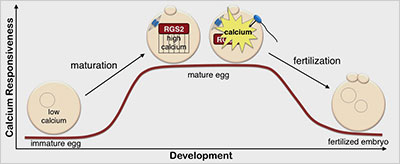
A graphic showing the RGS2 process.
The diagram depicts the interplay between calcium and RGS2 during egg development and fertilization. RGS2 suppresses calcium signaling long enough for the sperm to travel and fuse with the egg.
“These findings show the critical role that the protein RGS2 plays in preserving the fertilizability of the ovulated egg,” said Carmen Williams, M.D., Ph.D., lead researcher at the National Institute of Environmental Health Sciences, part of the NIH.  “Other researchers have shown that RGS2 plays an important role in regulating heart function and blood pressure, but this is the first demonstration of the protein’s significant role in fertilization.”
Dr. Williams explained that the immature egg found in the ovary is not very good at rallying the necessary calcium signaling that is needed to respond to sperm. However, during the maturation process, the egg stores calcium, preparing it for fertilization. At fertilization, the sperm causes calcium to release within the egg, turning it into a developing embryo.
The mouse study, published online in the journal Development, shows that during maturation the egg synthesizes RGS2, which suppresses calcium signaling. This safety mechanism ensures that the egg does not begin releasing calcium and start developing before the sperm arrives. Beginning development too early prevents the egg from merging with the sperm.
The RGS2 protein is being looked at as a therapeutic target for hypertension and other heart ailments. “Understanding the role RGS2 plays in reproduction is important when considering the possible benefits and side effects of any new treatments, as well as understanding the impact that toxins might have on human fertility,” said Linda Birnbaum, Ph.D., director of NIEHS and the National Toxicology Program.

Thursday, July 16, 2015

Food Research: Diversifying your diet may make your gut healthier ♦ Insects may be the answer to consumer demand for more protein ♦ We like seafood, but we don't eat enough,

Scientist works on taste, texture and color of lab-produced hamburger A researcher is confident his recipe for his $300,000 cultured hamburger will not only come down in price but someday make it to market.
Eating wild, foraged mushrooms can result in liver failure or death as misidentification is common Foraging and eating wild mushrooms can result in liver failure and even death because mistaking toxic mushrooms for edible varieties is common.
A loss of dietary diversity during the past 50 years could be a contributing factor to the rise in obesity, Type 2 diabetes, gastrointestinal problems and other diseases.
Insects may be the answer to consumer demand for more protein The growing consumer demand for protein -- and the lack of new farmland to raise more livestock -- could make insects an attractive alternative to traditional protein sources.
We like seafood, but we don't eat enough, report suggests Nearly half of Floridians eat more seafood than they did five to 10 years ago, but 40 percent still do not eat the federally recommended dietary intake of seafood. Floridians also know seafood is good for them, and they like their seafood caught or harvested in the Sunshine State. But many are not sure they’d know Florida seafood if they saw it, and they’re hesitant to pay the higher cost of local seafood.

Wednesday, July 1, 2015

Cancer Research:Small RNAs boosts cell proliferation in cancer ♦ Personalized colon cancer treatment ♦ Protein's impact on colorectal cancer

Braking mechanism identified for cell growth pathway linked to several cancers A self regulating loop in the Hippo pathway, a signaling channel garnering increased attention from cancer researchers due to its role in controlling organ size, cell proliferation and cell death.
New family of small RNAs boosts cell proliferation in cancer Rather than cellular trash, half of a transfer RNA (tRNA) molecule appears to actively spur cell proliferation in breast and prostate cancers, suggesting a new role for tRNA and a possible target for a new class of therapy.
Discovery could lead to personalized colon cancer treatment approach How a certain tumor-suppressing protein helps prevent colon cancer. With this discovery, researchers believe they’ve found a possible drug target for colon cancer patients who lack the tumor suppressor.
Does radiation from X-rays and CT scans really cause cancer? In recent years, there has been widespread media coverage of studies purporting to show that radiation from X-rays, CT scans and other medical imaging causes cancer. But such studies have serious flaws, including their reliance on an unproven statistical model, according to a recent article.
Protein's impact on colorectal cancer is dappled Researchers have discovered a cell signaling pathway that appears to exert some control over initiation and progression of colorectal cancer, the third leading cause of cancer-related death in the United States. A key protein in the pathway also appears to be predictive of cancer survival rates.

Monday, June 15, 2015

Protein Involved in Diabetic Eye Disease

More than 40% of Americans with diabetes develop diabetic retinopathy. It’s the most common cause of vision loss among working-age Americans. The disease is caused by damage to blood vessels in the retina. This restricts the oxygen supply and triggers the growth of new blood vessels, a process called angiogenesis. However, these new blood vessels are extremely fragile and often leak fluid or bleed, causing vision loss and sometimes blindness.
In patients with proliferative diabetic retinopathy, retinal blood vessels (white) become damaged, leading to areas without blood flow (black) and others with leaky, abnormal vessels (bright white). Credit: Wilmer Photography, Wilmer Eye Institute, Johns Hopkins School of Medicine.
Advanced diabetic retinopathy, or proliferative diabetic retinopathy, is treated by using a laser to seal leaky blood vessels and slow the growth of new ones. But this treatment can reduce peripheral, night, and color vision and isn’t always permanent. Patients may also receive drugs that inhibit vascular endothelial growth factor (VEGF), a protein that stimulates angiogenesis. However, anti-VEGF therapy may only temporarily stop the disease and carries its own risks. Some patients don’t respond at all to the therapy, suggesting that other factors may be involved.
A group of researchers led by Dr. Akrit Sodhi of the Johns Hopkins University School of Medicine investigated other factors that might drive angiogenesis in proliferative diabetic retinopathy. Their work, which was funded by NIH’s National Eye Institute (NEI), was published on June 9, 2015, inProceedings of the National Academy of Sciences.
The researchers first compared VEGF levels in aqueous fluid from the eyes of healthy people and from patients with diabetes with and without proliferative diabetic retinopathy. While most of the patients had much more VEGF in their aqueous fluid, some had levels that were below the average for the healthy controls. The low-VEGF fluid from these patients, however, triggered as much angiogenesis in lab-grown cells as high-VEGF fluid. In fact, anti-VEGF therapy didn’t affect the ability of aqueous fluid from patients to trigger angiogenesis, despite low levels of the protein. These findings confirmed that another compound must contribute to the process.
By restricting oxygen flow to retinal cells, the team went on to discover a protein called angiopoietin-like 4 that, like VEGF, is present at much higher levels in the oxygen-deprived cells. The protein was also present at high levels in low-VEGF aqueous fluid from the eyes of patients who had recently received anti-VEGF therapy. Boosting levels of angiopoietin-like 4 greatly increased angiogenesis. In laboratory experiments, decreasing production of angiopoietin-like 4 or blocking its action reduced angiogenesis. Most importantly, inhibiting both VEGF and angiopoietin-like 4 reduced angiogenesis more than targeting just one of the proteins.
“Anti-VEGF therapies have been very effective, but not for 100% of patients,” Sodhi says. “What we suggest is perhaps this other factor, angiopoeitin-like 4, may play an important role in diabetic eye disease and potentially other eye diseases as well.”
These results suggest that a drug that could block the action of angiopoietin-like 4 might help prevent proliferative diabetic retinopathy, particularly if combined with VEGF. Meanwhile, the protein might prove useful for predicting which diabetic retinopathy patients will respond to anti-VEGF therapy.
—by Brandon Levy

Friday, May 22, 2015

Childrens Health: Endocrine disrupting chemicals in baby teethers ♦ Air pollution linked to risk of childhood autism ♦ Snacking on protein can improve appetite control

Fine particulate air pollution linked to risk of childhood autism Exposure to fine particulate air pollution during pregnancy through the first two years of the child's life may be associated with an increased risk of a child developing autism spectrum disorder, a condition that affects one in 68 children.
Workplace intervention improves sleep of employees' children A workplace intervention designed to reduce employees' work-family conflict and increased schedule flexibility also has a positive influence on the sleep patterns of the employees' children.
Snacking on protein can improve appetite control, diet quality in teens Although eating high-protein, afternoon snacks can aid appetite control in adults, little information exists to guide parents on what types of snacks might benefit their adolescent children. Now, researchers have found that afternoon snacking, particularly on high-protein-soy foods, reduces afternoon appetite, delays subsequent eating and reduces unhealthy evening snacking in teenagers.
Endocrine disrupting chemicals in baby teethers In laboratory tests, two out of ten teethers, plastic toys used to sooth babies' teething ache, release endocrine disrupting chemicals. One product contains parabens, which are normally used as preservatives in cosmetics, while the second contains six so-far unidentified endocrine disruptors

Saturday, March 7, 2015

Health News:Hospital patients exposed to E. coli ♦ Superbug outbreak ♦ Protein that may help conquer blindness ♦ Spider venom relieves chronic pain ♦ Robots for stroke rehabilitation

Hartford Hospital says patients might have been exposed to E. coli. Hartford Hospital in Connecticut announced March 4 that it will take cultures from 281 patients who may have been exposed to a strain of E. coli that is resistant to some drugs after the hospital learned that two scopes used in procedures on the patients were not properly disinfected Continue Reading
Superbug outbreak extends to Cedars Sinai hospital, Cedars-Sinai Medical Center in Los Angeles reported March 4 that 4 patients were infected and 67 others may have been exposed to the deadly carbapenem-resistant Enterobacteriaceae (CRE) superbug from a contaminated scope Continue Reading
Retina protein that may help conquer blindness discovered  A protein in the retina that is crucial for vision has been discovered by researchers who report, for the first time, the key molecular mechanisms leading to visual degeneration and blindness. The research reveals events that may be harnessed for prevention, as well as to slow down progression of retinal degenerative diseases.Continue Reading
Analysis of spider venom reveals promising compounds to relieve chronic pain  New research shows that seven compounds of the countless found in spider venom block a key step in the body's ability to pass pain signals to the brain.Continue Reading

Robots for stroke rehabilitation  A prototype of a robotic glove has been developed which stroke sufferers can use in their own home to support rehabilitation and personal independence in receiving therapies. At the chronic stages of stroke, patients are not likely to be receiving treatment but they continue to live with some impairments -- the glove's goal is to provide therapies to target these impairments.Continue Reading

Friday, February 6, 2015

2/6/15 Health News:Drug-resistant bacteria lurk in subway ♦ Stress hormone levels affect fetal growth ♦ Probiotic helps treat diabetes ♦ Blood transfusions increase risk of pneumonia

Drug-resistant bacteria lurk in subway stations, high school students discover
Forget commuters and rats, New York City's subway system is crowded with microbes. After spending her vacation swabbing benches and turnstiles beneath the city, high school students found bacteria impervious to two major antibiotics. Continue Reading
Mother's stress hormone levels may affect fetal growth and long term health of child
Increased levels of stress hormones can lead pregnant mice to overeat, but affect growth of the fetus and, potentially, the long term health of the offspring, according to a new study Continue Reading
Probiotic helps treat diabetes in rats, could lead to human remedy
Researchers have engineered a strain of lactobacillus, a human probiotic common in the gut, to secrete a Glucagon-like peptide. They then administered it orally to diabetic rats for 90 days and found the rats receiving the engineered probiotic had up to 30 percent lower high blood glucose, a hallmark of diabetes. Continue Reading
Blood transfusions during heart surgery increase risk of pneumonia
Patients who receive red blood cell transfusions during coronary artery bypass grafting surgery are at an increased risk of developing pneumonia, "Patients should receive red blood cell transfusions based on clinical need," an investigator noted.." Continue Reading
New protein detonates 'invincible' bacteria from within
The epidemic of 'superbugs,' bacteria resistant to antibiotics, knows no borders -- presenting a clear and present danger around the globe. Now a groundbreaking discovery may strengthen efforts by the medical community to fight this looming superbug pandemic. By sequencing the DNA of bacteria resistant to viral toxins, researchers identified novel proteins capable of stymieing growth in treacherous antibiotic-resistant bacteria. Continue Reading

Friday, January 30, 2015

Protein powder in chocolate and vanilla blends recalled Due to Staphylococcus contamination

Project Healthy Living, Inc. of New York, New York (d/b/a Aloha, Inc.) is voluntarily recalling all packages of Premium Protein powder in chocolate and vanilla blends because it has the potential to be contaminated with Staphylococcus enterotoxin.
The presence of Staphylococcus enterotoxins may be injurious to health and may result in staphylococcal food poisoning. Nausea, vomiting, retching, abdominal cramping, and prostration may occur. In more severe cases there may be headache, muscle cramping, and transient changes in blood pressure and pulse.
The Aloha Premium Protein products were distributed nationwide from November 2014 through January 2015 directly to consumers through online sales and in New York through a very limited number of retail stores. All sizes of Aloha's Vanilla and Chocolate Premium Protein blends are being voluntarily recalled. This product is packaged and sold in both 14-serving sized steel tins and single-serving sized pouches. The single serving pouches may be in kits that contain other products not affected by the voluntary recall.
To date, Aloha has received 17 complaints from customers who have reported transient gastrointestinal symptoms consistent with staphylococcal food poisoning. This voluntary recall is a result of an extensive testing program, which Aloha began immediately following individual customer complaints of gastrointestinal issues. Aloha is working closely with its manufacturer, co-packers, ingredient suppliers and distribution partners to determine the source and cause of the contamination.
Aloha has temporarily ceased production and distribution of the Premium Protein products until further analytical testing can confirm the specific source of the contamination. Aloha has already notified customers via direct e-mail correspondence and created a dedicated website regarding the voluntary recall. In addition, Aloha is offering 24/7 customer support through Monday, February 2nd and then will resume regular customer support hours (Monday - Friday 10am-9pm EST).
All customers who have purchased Aloha's Premium Protein products are instructed to discontinue use and complete the refund form found online at Aloharecall.com. Customers with product remaining are also asked to return the product and its original packaging for further examination.
Customers who have purchased Aloha's Premium Protein products will receive a refund and a store credit. In addition, Aloha will cover 100% of the cost of return shipping. For more information on the recall, please visit www.aloharecall.com. No other Aloha products are affected by this recall.

Monday, July 7, 2014

Superfood Protein Medley Recalled Due to Salmonella

Superfood Protein Medley Bottle LabelOriya Organics, LLC is voluntarily recalling Oriya Organics Superfood Protein Medley which contain Organic Sprouted Chia Seed Powder due to possible health risks related to Salmonella contamination
.Salmonella is an organism that can cause serious and sometimes fatal infections in young children, frail or elderly people, and others with weakened immune systems. Healthy persons infected with Salmonella often experience fever, diarrhea (which may be bloody), nausea, vomiting and abdominal pain. In rare circumstances, infection with Salmonella can result in the organism getting into the bloodstream and producing more severe illnesses such as arterial infections (i.e. infected aneurysms).
Products were sold in retailers in Texas and Louisiana. Products were sold directly to customers through the internet in Texas, Arkansas, Illinois, Florida, New York, Louisiana, and Virginia.
Oriya Organics Superfood Protein Medley, 21.2 oz, UPC Code:85370100401, with Lot #: A14314 and an expiration date of 05/23/2015. Lot codes and expiration dates are located on the bottom of the container.
No other Oriya Organics products are affected by this recall and no illnesses have been reported to date. This recall has been initiated as a precautionary measure due to a contaminated ingredient from one of our suppliers.
Consumers that have purchased any of these products with the above stated lot number and expiration dates are asked not to consume the product and discard it or return the product to the original point of purchase.
Consumers with questions may contact Oriya Organics at 512-992-5100, Monday – Friday from 9am – 5pm CST. Email correspondence can be sent to info@oriyaorganics.com.
Oriya Organics is working closely with the FDA on this matter. Oriya Organics is committed to providing the highest quality, organic products and the safety of our customers is our number one priority.

Thursday, April 10, 2014

Too Much Protein may Kill Brain Cells as Parkinson’s Progresses

NIH-funded study on key Parkinson’s gene finds a possible new target for monitoring the disease
An image of a stained nerve cell.Scientists may have discovered how the most common genetic cause of Parkinson’s disease destroys brain cells and devastates many patients worldwide. The study’s results may help scientists develop new therapies.
Parkinson’s killer lurks within NIH-funded scientists show that the deadly Parkinson’s gene LRRK2 can kill nerve cells (green) by tagging the s15 ribosomal protein (purple), a cog in a cell’s protein-making machinery.Courtesy of Dawson lab, JHU Morris K. Udall Center of Excellence for Parkinson’s Disease.
The investigators found that mutations in a gene called leucine-rich repeat kinase 2 (LRRK2; pronounced “lark two” or “lurk two”) may increase the rate at which LRRK2 tags ribosomal proteins, which are key components of protein-making machinery inside cells. This could cause the machinery to manufacture too many proteins, leading to cell death.
“For nearly a decade, scientists have been trying to figure out how mutations in LRRK2 cause Parkinson’s disease,” said Margaret Sutherland, Ph.D., a program director at NINDS. “This study represents a clear link between LRRK2 and a pathogenic mechanism linked to Parkinson’s disease.”
Affecting more than half a million people in the United States, Parkinson’s disease is a degenerative disorder that attacks nerve cells in many parts of the nervous system, most notably in a brain region called the substantia nigra, which releases dopamine, a chemical messenger important for movement. Initially, Parkinson’s disease causes uncontrolled movements; including trembling of the hands, arms, or legs. As the disease gradually worsens, patients lose ability to walk, talk or complete simple tasks.
“Our results support the idea that changes in the way cells make proteins might be a common cause of Parkinson’s disease and possibly other neurodegenerative disorders,” said Dr. Dawson.

Tuesday, March 18, 2014

Protein Consumption Linked to Longevity

A high-protein diet during middle age was associated with higher mortality in a new study. In adults over 65, however, a high-protein diet was linked to lower mortality.
Calorie restriction increases longevity in many animals. It’s not known, however, if restriction works by lowering calorie intake or by reducing the intake of protein or other nutrients. A team led by Dr. Valter Longo at the University of Southern California set out to explore the link between dietary protein and mortality. The study was funded in part by NIH’s National Institute on Aging (NIA).
The researchers analyzed information on more than 6,800 U.S. adults, ages 50 and over, from the Third National Health and Nutrition Examination Survey (NHANES III), a periodic health and nutritional survey of the U.S. population. The researchers linked the survey data with National Death Index data, which provides the timing and causes of death. Results were published on March 4, 2014, in Cell Metabolism.
Participants were categorized into 3 groups based on the percent of self-reported calorie intake that came from protein: high (20% or more), moderate (10-19%), or low (less than 10%). They were further split into 2 age categories: 50 to 65, and 66 and older.
Adults in the 50 to 65 group who reported a high protein intake had a 75% increase in overall mortality and were 4 times more likely to die from cancer during the following 18 years than those in the low protein group. The moderate-protein diet was associated with a 3-fold increase in cancer mortality compared to the low-protein diet.
These associations—which were adjusted for numerous factors including smoking, waist circumference, and chronic conditions—weren’t altered when the percentage of calories from fat or carbohydrate were considered. However, the associations were only found when the proteins were derived from animal, rather than plant, sources.
Conversely, in participants ages 65 and older, those who consumed high amounts of protein had a 28% lower risk of dying from any cause and a 60% lower risk of dying from cancer. These associations weren’t influenced by whether the protein was derived from animal or plant sources.
A high-protein diet was also associated with a 5-fold increase in diabetes mortality across all ages. One limitation of the study, the researchers note, is that the participants’ protein intake was based on a single 24-hour dietary recall. The study also didn’t examine the effects of specific types of plant- or animal-derived proteins, such as beef or fish.
Mouse studies confirmed the effects of high protein intake. Mice fed a higher protein diet had increased progression of breast and melanoma tumors than those fed a lower protein diet. The low-protein diet, however, had detrimental effects in very old mice. The link between diet and longevity appeared to be moderated by a pathway involving insulin-like growth factor 1 (IGF-1).
“The research shows that a low-protein diet in middle age is useful for preventing cancer and overall mortality, through a process that involves regulating IGF-1 and possibly insulin levels,” says co-author Dr. Eileen Crimmins. “However, we also propose that at older ages, it may be important to avoid a low-protein diet to allow the maintenance of healthy weight and protection from frailty.”
—by Carol Torgan, Ph.D.