Showing posts with label influenza. Show all posts

Friday, August 28, 2015

Health News: Intractable pain may find relief in tiny gold rods ♦ Millions of lives blighted by smokeless tobacco ♦ US hospitals flout CDC recommendations that prevent infections


Intractable pain may find relief in tiny gold rods Scientists have developed a technique that could lead to therapies for pain relief in people with intractable pain, potentially including cancer-related pain. The team coated gold nanorods with a special type of protein that transports fat within the body known as a lipoprotein. This allowed the nanorods to bind efficiently to nerve cell membranes bearing a pain receptor. Gold nanorods are tiny rods that are 1-100 nanometers wide and long. In comparison, a human hair is 100,000 nanometers wide.
Something to chew on: Millions of lives blighted by smokeless tobacco More than a quarter of a million people die each year from using smokeless tobacco, researchers have concluded. The study estimates that in 2010 alone smokeless tobacco resulted in more than 62,000 deaths due to cancers of the mouth, pharynx and esophagus and accounted for more than 200,00 deaths from heart disease.
US hospitals flout CDC recommendations that prevent infections There is significant variability regarding how clinicians manage catheters placed in the arteries of patients in intensive care units, research shows. Some practices may increase risk of infection associated with these catheters. Fewer than half of those surveyed complied with current Centers for Disease Control and Prevention infection prevention guidelines for arterial catheter insertions.
Influenza vaccines provide moderate protection throughout the entire flu season Individuals who received the flu vaccine were protected for up to 6 months post-vaccination, the duration of most flu seasons.

Friday, June 19, 2015

Persons at increased risk for influenza complications

  1. children aged <2 years;
  2. adults aged ≥65 years;
  3. persons with chronic pulmonary (including asthma), cardiovascular (except hypertension alone), renal, hepatic, hematological (including sickle cell disease), metabolic disorders (including diabetes mellitus) or neurologic and neurodevelopment conditions (including disorders of the brain, spinal cord, peripheral nerve, and muscle such as cerebral palsy, epilepsy/seizure disorders, stroke, intellectual disability/mental retardation, moderate to severe developmental delay, muscular dystrophy, or spinal cord injury);
  4. persons with immunosuppression, including that caused by medications or by HIV infection;
  5. women who are pregnant or postpartum (within 2 weeks after delivery);
  6. persons aged <19 years who are receiving long-term aspirin therapy;
  7. American Indians/Alaska Natives;
  8. persons who are morbidly obese (i.e., BMI ≥40); and
  9. residents of nursing homes and other chronic care facilities.

Friday, June 5, 2015

Influenza Activity — United States, 2014–15 Season

While the influenza vaccine varies in how well it works, vaccination remains the best way to prevent influenza illness and its associated complications. Ongoing, timely influenza surveillance is needed to inform the selection of influenza vaccine viruses used for vaccine production. Although vaccine effectiveness was reduced this season against most H3N2 viruses, vaccination was still protective against vaccine-like influenza A (H3N2) viruses, influenza A (H1N1) viruses and influenza B viruses. The 2014-15 influenza season was an H3N2 predominant, moderately severe season overall, and especially severe for people 65 and older. Adults 65 and older had the highest hospitalization rates. Antigenic and genetic characterization showed that most of the circulating influenza A (H3N2) viruses were different from the influenza A (H3N2) component of the 2014–15 Northern Hemisphere vaccines, resulting in reduced vaccine effectiveness against circulating H3N2 viruses.

Tuesday, October 21, 2014

Progress Toward an H7N9 Avian Flu Vaccine

Influenza, or flu, claims thousands of lives nationwide each year. Influenza viruses constantly change, or mutate. Flu pandemics can arise when novel avian strains acquire 2 abilities—to infect humans and to spread easily between people. That’s why health experts keep a close watch on novel viruses.
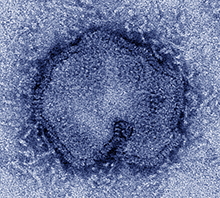
Transmission electron micrograph of H7N9 virus.
The H7N9 avian influenza virus. Image by Cynthia S. Goldsmith and Thomas Rowe, CDC.
The first cases of human H7N9 avian influenza were reported in China in early 2013. Most affected people had contact with infected poultry. The virus doesn’t sicken birds, but can make people seriously ill. About 67% of reported cases have required hospitalization. As of September 4, 2014, more than 450 cases, including 166 deaths, had been reported to the World Health Organization.
The U.S. government, in coordination with researchers and vaccine manufacturers, has been working to develop an H7N9 vaccine. Previously tested vaccines have prompted little or no immune responses in volunteers. In a new study, a team led by Dr. Mark J. Mulligan of Emory University tested an experimental vaccine mixed with adjuvant—a substance that boosts the body’s response to vaccination. The candidate vaccine, manufactured by Sanofi Pasteur, was made from inactivated H7N9 virus grown in chicken eggs. The adjuvant, MF59, is manufactured by Novartis Vaccines. The study was funded in part by NIH’s National Institute of Allergy and Infectious Diseases (NIAID). It appeared on October 8, 2014, in the Journal of the American Medical Association.
The trial enrolled 700 healthy adults, ages 19 to 64. Volunteers were divided into 7 groups. All received 2 injections of vaccine 21 days apart. Two groups received vaccine at either 15 micrograms (µg) or 45 µg without adjuvant. Three groups received injections of vaccine at 3.75 µg, 7.5 µg, or 15 µg with MF59 adjuvant. The final 2 groups received only one dose of adjuvant with either their first or second dose of 15 µg vaccine. Adjuvant and vaccine were mixed just prior to use.
As expected, without adjuvant, even the higher dose vaccine prompted minimal immune responses. Among those who received 2 injections of the lowest vaccine dose (3.75 µg) with adjuvant, 59% showed a substantial immune response within the 42-day study period. Notably, the group that received just one dose of MF59 along with their first 15 µg injection had significant immune responses as well. This suggests that a single dose of adjuvant given with the first dose of vaccine may be enough to provide protection.
“Although this influenza virus does not currently spread easily from person to person, all novel influenza viruses have the potential to evolve to cause widespread illness or death,” says NIAID Director Dr. Anthony S. Fauci. “Therefore, it is prudent to conduct clinical trials such as this one to be prepared in the event of an H7N9 avian influenza pandemic.”
No serious vaccine-related adverse events were reported in any of the groups. Further study will be needed to test the duration of the immune response to the vaccine.

Thursday, March 6, 2014

Reducing Flu in Pre-school Children

Impact of Requiring Influenza Vaccination for Children Attending Licensed Childcare or Preschool Programs — Connecticut, 2012–13 Influenza Season

Preschool-aged children are at high risk for serious consequences of influenza and should be vaccinated against influenza, especially those in settings where transmission is common such as child care facilities.
Effective January 2011, preschool-aged children in Connecticut were required to be vaccinated against influenza to attend licensed child care. Investigators from the Yale School of Public Health and the Connecticut Department of Public Health evaluated the effect of this requirement on vaccination rates and on hospitalizations of young children during the 2012-2013 influenza season. Vaccination rates in Connecticut rose more quickly and were higher than children in the rest of the United States. After the requirement was implemented, hospitalization rates for influenza in young children in Connecticut were lower compared with 10 other sites in the United States with similar monitoring.
Requiring influenza vaccination in children attending child care facilities appears to have contributed to lower hospitalization rates from influenza among young children in Connecticut.

Monday, February 3, 2014

2/3/14 Health News: New Treatment For Peanut Allergy - TB Exposure During Dental Care - Live Subjects infected With Influenza

New treatment may offer hope for peanut allergy
When you live in fear of you or your child accidentally ingesting peanut crumbs, any hope of undoing severe food allergy is welcome.
A large clinical trial published this week in the Lancet confirms what smaller studies have shown in the past: Oral immunotherapy -- swallowing tiny, increasing amounts of peanut over time -- has the ability to desensitize allergic individuals to peanuts. Continue Reading


NIH Researchers Infect Live Subjects With Influenza in Study Intended to Improve Vaccine
As seasonal influenza sweeps much of the country, scores of study volunteers are allowing government scientists — in a rare live study — to infect them with influenza, in hopes of soon improving vaccine capability. Study leader Matthew Memoli, of the National Institutes for Health (NIH), told the Associated Press in an interview, “Vaccines are working, but we could do better.” A few thousand Americans die every year of seasonal influenza,Continue Reading