Thursday, July 30, 2015

Cardiovascular Research:Can we restart the heart? ♦ Some stroke treatments proven to reduce healthcare costs ♦ Blood pressure reduction role of commonly prescribed drug

One in four patients with defibrillators experiences boost in heart function over time A study of outcomes among 1,200 people with implanted defibrillators — devices intended to prevent sudden cardiac death from abnormal heart rhythms — shows that within a few years of implantation, one in four experienced improvements in heart function substantial enough to put them over the clinical threshold that qualified them to get a defibrillator in the first place.
Some stroke treatments proven to reduce healthcare costs Use of mechanical thrombectomy on qualifying stroke patients could result in major savings to the healthcare economy in the United Kingdom and other western countries with a similar healthcare structure.
Can we restart the heart? What if you could use the proliferative and survival properties of cancer-prone cells to rejuvenate cardiac progenitor cells and get them dividing again, without forming tumors? Researchers are exploring the results of taking an enzyme, Pim, known to be associated with growth and survival of certain types of cancer cells, and causing it to be overexpressed in cardiac progenitor cells in mice.
Blood pressure reduction role of commonly prescribed drug A drug commonly prescribed to conserve potassium in the blood also significantly lowers blood pressure when taken in conjunction with a diuretic frequently prescribed to patients with hypertension, a new big data study has found. The combination of the two drugs, both available as generics, has been shown to consistently amplify the blood pressure reduction in patients with or without the presence of other antihypertensive agents such as ACE inhibitors and calcium channel blockers.

Cancer Research: Anti-inflammatory drug acts against ovarian cancer ♦ Prostate cancer is five different diseases ♦ Red grape chemical may help prevent bowel cancer

New tool uses 'drug spillover' to match cancer patients with treatments A new article describes a new tool that improves the ability to match drugs to disease: the Kinase Addiction Ranker predicts what genetics are truly driving the cancer in any population of cells and chooses the best 'kinase inhibitor' to silence these dangerous genetic causes of disease
Anti-inflammatory drug acts against ovarian cancer A non-steroidal anti-inflammatory drug (NSAID) called ketorolac helped women with ovarian cancer to survive longer, researchers report. Ketorolac, marketed as Toradol®, is approved for clinical use in the United States for pain after surgery.
Prostate cancer is five different diseases Scientists have, for the first time, identified that there are five distinct types of prostate cancer and have found a way to distinguish between them.
Targeted therapy shows effectiveness against a subtype of the brain tumor medulloblastoma A subset of medulloblastoma tumors briefly stopped growing or disappeared entirely during treatment with vismodegib, researchers report after a trial with both adults and children.
Red grape chemical may help prevent bowel cancer but less is more Resveratrol, a chemical found in red grapes, is more effective in smaller doses at preventing bowel cancer in mice than high doses, according to new research. Previous research looked at high doses of purified resveratrol to study its potential to prevent cancer. This is the first study to look at the effects of a lower daily dose -- equivalent to the amount of resveratrol found in one large (approx. 250ml) glass of red wine -- comparing it with a dose 200 times higher.

Women's Health: Relationship between asthma, cortisol, and complications in pregnancy ♦ Home births lead to higher infant mortality,♦ Socially integrated women have lower suicide risk

Blood markers identify women at risk for postpartum depression The hormone oxytocin, sometimes called 'the love hormone,' may be a factor in postpartum depression, when a mother has a lower than normal level. A blood marker now may help identify the risk.
Home births lead to higher infant mortality, at least for mothers living in poorer areas Home births lead to higher infant mortality than hospital births, at least for mothers living in poorer areas. This is the conclusion of a new study that examines 356,412 low-risk Dutch women who delivered between 2000 and 2008 and who were allowed to choose between a home and a hospital birth.
Hair samples may offer new insights into the relationship between asthma, cortisol, and complications in pregnancy Hair samples can be used to measure the effects of asthma on the cortisol levels of women during pregnancy, according to new research. This research also shows that levels of cortisol, a stress-related hormone, tend to be lower among pregnant women with asthma than among pregnant women without the chronic, inflammatory lung disease
Socially integrated women have lower suicide risk Women who were socially well integrated had a lower risk for suicide in a new analysis of data from the Nurses' Health Study, according to an article. Suicide is among the top 10 leading causes of death among middle-age women in the United States.

Brain Research:Where memory is encoded and retrieved ♦ Key enzyme implicated in Alzheimer's ♦ Brain chemicals that keep wakefulness in check

Naturally occurring protein fragment found in the brain inhibits key enzyme implicated in Alzheimer's disease A natural protein fragment produced in the brain can act as an inhibitor of a key enzyme implicated in the onset of Alzheimer's disease, researchers have discovered for the first time. This is a finding that could lead to the development of new drugs to treat the disease, they say.
Where memory is encoded and retrieved: New findings in a long-standing debate Are the same regions and even the same cells of the brain area called hippocampus involved in encoding and retrieving memories or are different areas of this structure engaged? This question has kept neuroscientists busy for a long time. Researchers have now found out that the same brain cells exhibit activity in both processes.
Key factor for stability of capillaries in brain identified The brain needs a lot of oxygen – so every last corner of the brain’s tissue is served by a dense network of fine blood vessels. When these capillaries are damaged by high blood pressure or age, doctors call the condition cerebral small vessel disease. They estimate this is the cause of around one in five strokes, and that the condition may also lead to certain forms of dementia.
Study finds brain chemicals that keep wakefulness in check Mice that have a particular brain chemical switched off become hyperactive and sleep for just 65 per cent of their normal time, a new study shows. This discovery could help researchers to develop new drugs that promote better sleep, or control hyperactivity in people with the medical condition mania

Wednesday, July 29, 2015

Ireland: SuperValu and Centra Soups Recalled

Ireland: SuperValu and Centra Soups Recalled
Recall of Batches of SuperValu and Centra Soups Due to Possible Presence of Plastic Pieces

Summary
Category 2:
For Information
Alert Notification:
2015.16
Product:
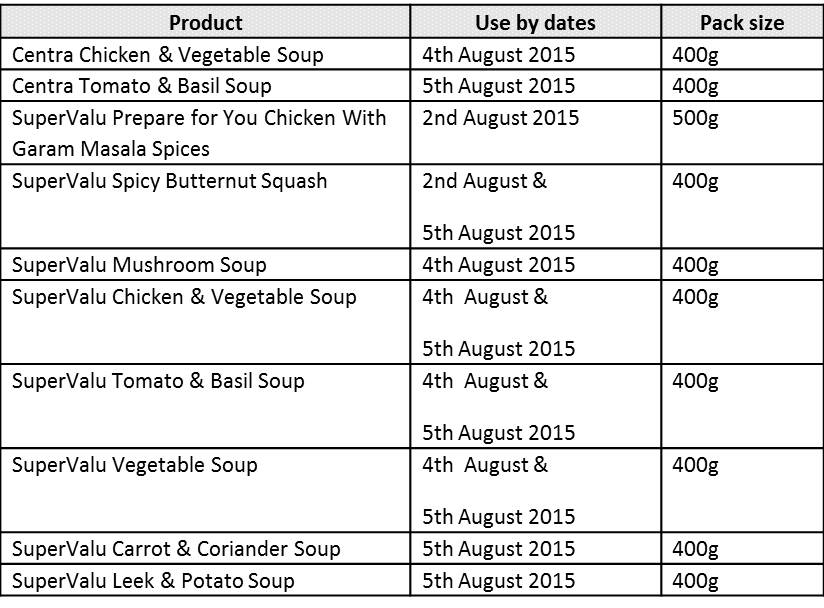
See table below for full details.
Batch Code:
See table below for use by dates.
Country Of Origin:
Ireland
Message:
As a precautionary measure, Musgrave Retail Partners Ireland is recalling the listed implicated batches of soups due to the possible presence of hard plastic pieces.  Customers can contact Musgrave’s helpline with queries on Lo-Call 0818 333 311.  
Table of Implicated Batches
Due to Possible Presence of Plastic Pieces

West Nile virus : Time to wear Mosquito repellent

West Nile virus (WNV) activity reported to CDC, by state — United States, 2015 (as of 28 July 2015)
West Nile virus (WNV) is most commonly transmitted to humans by mosquitoes. You can reduce your risk of being infected with WNV by using insect repellent and wearing protective clothing to prevent mosquito bites. There are no medications to treat or vaccines to prevent WNV infection. Fortunately, most people infected with WNV will have no symptoms. About 1 in 5 people who are infected will develop a fever with other symptoms. Less than 1% of infected people develop a serious, sometimes fatal, neurologic illness.
State
Neuro-invasive
Fever
Total
Deaths
WNV +Blood Donors
Alabama
1
0
1
0
0
Arizona
3
2
5
0
10
California
1
0
1
1
2
Colorado
1
0
1
0
0
Delaware
0
1
1
0
0
Kansas
0
2
2
0
1
Louisiana
3
0
3
0
4
Mississippi
0
2
2
0
0
Montana
1
0
1
0
0
Nebraska
0
3
3
0
4
Nevada
0
0
0
0
2
New Mexico
1
0
1
0
0
Oklahoma
2
3
5
0
0
North Dakota
0
1
1
0
0
South Dakota
0
4
4
0
1
Tennessee
0
0
0
0
1
Texas
1
3
4
0
2
Virginia
1
0
1
0
0
Washington
0
1
1
0
1
Wyoming
0
1
1
0
0
Totals
15
23
38
1
28