Showing posts with label CRISPR. Show all posts

Saturday, August 29, 2015

Health Research: Nasal spray device for mental illness ♦ Medicinal marijuana: Patients battle stigma and misunderstanding ♦ Blood test to catch pancreatic cancer early

Scientists reveal cellular clockwork underlying inflammation Researchers have uncovered key cellular functions that help regulate inflammation -- a discovery that could have important implications for the treatment of allergies, heart disease, and certain forms of cancer. The discovery explains how two particular proteins, Tollip and Tom1, work together to contribute to the turnover of cell-surface receptor proteins that trigger inflammation.
Nasal spray device for mental illness Researchers have tested a new device for delivering hormone treatments for mental illness through the nose. This method was found to deliver medicine to the brain with few side effects.
Medicinal marijuana: Patients battle stigma and misunderstanding New research examines the experiences of California residents who have been prescribed medical marijuana and the stigma they experience from public opinion.  The findings indicate that the stigma of using medical marijuana may contribute to the under-treatment of those who might benefit from medical marijuana
DNA 'clews' used to shuttle CRISPR-Cas9 gene-editing tool into cells Researchers have for the first time created and used a nanoscale vehicle made of DNA to deliver a CRISPR-Cas9 gene-editing tool into cells in both cell culture and an animal model.
Important steps toward developing a blood test to catch pancreatic cancer early Pancreatic cancer is the fourth most common cause of cancer-related death in the United States and has a 5-year survival rate of only 6 percent, which is the lowest rate of all types of cancer.  This low survival rate is partially attributed to the difficulty in detecting pancreatic cancer at an early stage.

Tuesday, July 28, 2015

Health News: Some Drug Manufactures Reporting Adverse Reactions Late ♦ Scientists successfully edit human T cells ♦ Some vaccines support evolution of more-virulent viruses

Some adverse drug events not reported by manufacturers to FDA by 15-day mark About 10 percent of serious and unexpected adverse events are not reported by drug manufacturers to the US Food and Drug Administration under the 15-day timeframe set out in federal regulations.
In CRISPR advance, scientists successfully edit human T cells Scientists have devised a new strategy to precisely modify human T cells using the genome-editing system known as CRISPR/Cas9. Because these immune-system cells play important roles in a wide range of diseases, from diabetes to AIDS to cancer, the achievement provides a versatile new tool for research on T cell function, as well as a path toward CRISPR/Cas9-based therapies for many serious health problems.
Researchers identify model to predict successful wound healing Battlefield surgeons and civilian physicians could have a powerful new tool to help patients recover from traumatic injuries, including life-threatening wounds from explosions. Researchers have identified a model to predict the chances for successful wound healing in individual patients.
Some vaccines support evolution of more-virulent viruses Scientific experiments with the herpesvirus such as the one that causes Marek's disease in poultry have confirmed, for the first time, the highly controversial theory that some vaccines could allow more-virulent versions of a virus to survive, putting unvaccinated individuals at greater risk of severe illness. The research has important implications for food-chain security and food-chain economics, as well as for other diseases that affect humans and agricultural animals.
Strong link between delirium, inflammation in older patients Delirium is an acute state of confusion that often affects older adults following surgery or serious illness. Now a study confirms that inflammation -- an immune response that develops when the body attempts to protect itself from harmful stimuli -- plays a role in the onset of delirium.

Saturday, July 25, 2015

Health Research: Changing the Color of Light ♦ Changing the Color of Light ♦ Fighting mosquito resistance to insecticides ♦ Clues to turning genes off

Changing the Color of Light Researchers have developed a method that could improve medical imaging and cancer treatments and increase the efficiency of commercial solar cells by 25 to 30 percent.
Gene-sequence swap using CRISPR to cure hemophilia For the first time, chromosomal defects responsible for hemophilia have been corrected in patient-specific iPSCs using CRISPR-Cas9 nucleases. Hemophilia A occurs in about 1 in 5,000 male births and almost half of severe cases are caused by identified "chromosomal inversions." In a chromosomal inversion, the order of the base pairs on the chromosome are reversed so the gene doesn't express properly and the sufferer lacks the blood coagulation factor VIII (F8) gene, which causes blood to clot in healthy people.
Fighting mosquito resistance to insecticides Controlling mosquitoes that carry human diseases is a global health challenge as their ability to resist insecticides now threatens efforts to prevent epidemics. Scientists have identified new genetic markers for mosquito resistance to insecticides, which could improve its detection in the field.
Simple flip of genetic switch determines aging or longevity in animals When does aging really begin? Scientists now have a molecular clue. In a study of the roundworm C. elegans, they found that adult cells abruptly begin their downhill slide when an animal reaches reproductive maturity. A genetic switch starts the aging process by turning off cell stress responses that protect the cell by keeping important proteins folded and functional. Germline stem cells throw the switch in early adulthood, after the animal starts to reproduce, ensuring its line will live on.
Clues to turning genes off Scientists have unraveled how an important plant protein, known as TOPLESS, interacts with other molecules responsible for turning genes off. The findings in plants provide a general model across species for this type of gene silencing, which is linked to several vital biological functions in humans.

Friday, June 5, 2015

New role for zebrafish: larger scale gene function studies

New role for zebra fish: larger scale gene function studies
A relatively new method of targeting specific DNA sequences in zebra fish could dramatically accelerate the discovery of gene function and the identification of disease genes in humans, according to scientists at the National Human Genome Research Institute (NHGRI), part of the National Institutes of Health.
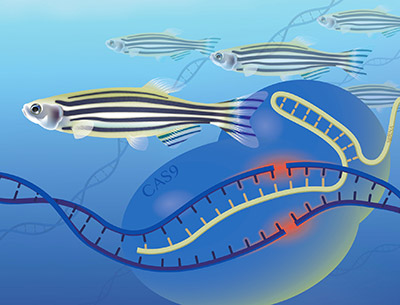
The image depicts several zebrafish swimming in a sea of DNA strands. The CAS9 represents the enzyme used to cut the DNA strand and either incorporate or remove pieces of DNA, which is gene editing. The sgRNA is a genetic template used in the process.
NHGRI scientists are homing in on specific genes in zebrafish to help them better understand the function of genes in people.
In a study posted online on June 5, 2015, and to be published in the July 2015 issue of Genome Research, the researchers reported that the gene-editing technology known as CRISPR/Cas9 is six times more effective than other techniques at homing in on target genes and inserting or deleting specific sequences. The study also demonstrated that the CRISPR/Cas9 method can be used in a “multiplexed” fashion – that is, targeting and mutating multiple genes at the same time to determine their functions.
“It was shown about a year ago that CRISPR can knock out a gene quickly,” said Shawn Burgess, Ph.D., a senior investigator with NHGRI’s Translational and Functional Genomics Branch and head of the Developmental Genomics Section. “What we have done is to establish an entire pipeline for knocking out many genes and testing their function quickly in a vertebrate model.” Researchers often try to determine the role of a gene by knocking it out — turning it off or removing it — and watching the potential effects on an organism lacking it.
Such larger scale — termed high-throughput — gene targeting in an animal model could be particularly useful for human genomic research. Only 10 to 20 percent of recognized human genes have been subjected to such rigorous testing, Dr. Burgess said. The functions of many other genes have been inferred based on analyzing proteins or have been identified as possible disease genes, but the functions of those genes have not been confirmed by knocking them out in animal models and seeing what happens.
“This is a way to do that on a more cost-efficient and large scale,” Dr. Burgess said.
“The study of zebrafish has already led to advances in our understanding of cancer and other human diseases,” said NHGRI Director Eric Green, M.D., Ph.D. “We anticipate that the techniques developed by NHGRI researchers will accelerate understanding the biological function of specific genes and the role they play in human genetic diseases.”
The CRISPR/Cas9 method of gene editing is one of the two essential components in the NHGRI team’s high-throughput method. Modeled on a defense mechanism evolved by bacteria against viruses, CRISPR/Cas9 activity was first described in 2012. Since then, its use has spread quickly in genomic research labs in the United States and abroad.
The acronym CRISPR stands for “clustered, regularly inter spaced, short palindromic repeat,” referring to a pattern of DNA sequences that appears frequently in bacterial DNA. Scientists believe the CRISPR sequences reflect evolutionary responses to past viral attacks.
The Cas9 protein is a nuclease, an enzyme that snips a stretch of DNA in two places, in effect cutting out a piece. Bound together, CRISPR/Cas9 becomes a powerful research tool that permits researchers to target and delete a particular sequence or to insert a new sequence into the DNA of animal-model embryos.
The other essential component of the NHGRI team’s method is the zebrafish. The zebrafish and the mouse are the most commonly studied vertebrate laboratory animals whose genomes have been completely sequenced. The zebrafish is better suited to larger scale gene editing because about 70 percent of zebrafish genes appear to have human counterparts and the fish are far less costly to maintain than are mice. They multiply astonishingly quickly; a female may produce as many as 200 eggs at one time. And the embryos are fertilized externally and are transparent, making them readily accessible to researchers.
To demonstrate the feasibility of high throughput editing, the researchers targeted 162 locations in 83 zebrafish genes – about 50 of which are similar to human genes involved in deafness. (Hearing is one of the other interests of Dr. Burgess’s lab.) This produced mutations in 82 of the 83 genes.
In screening embryos by fluorescent polymerase chain reaction (a technology that allows researchers to produce millions of copies of a specific DNA sequence)
and high-throughput DNA sequencing, the researchers determined that overall, mutations were passed on to the next generation in 28 percent of cases. The transmission rate was higher for some genes than for others, but in most cases, screening offspring from parent fish should be enough to spot most mutations, the researchers reported.
The results demonstrated that using the CRISPR/Cas9 technique in zebrafish will make it possible to both generate mutants for all genes in the zebrafish genome and carry out large-scale phenotyping, they noted in the Genome Research paper.
The CRISPR/Cas9 methodology works in mice, too, but it is more costly and takes far longer. Although mice actually reach sexual maturity earlier than zebrafish, they produce far fewer offspring.
Ultimately, Dr. Burgess hopes that his lab will use the new method to knock out about 10 percent of the zebra fish's roughly 25,000 genes, and he would like to see an even broader effort. “We’ve shown that with relatively moderate resources, you can analyze hundreds of genes,” Dr. Burgess said. “On the scale of big science, you could target every gene in the genome with what would be a relatively modest scientific investment in the low tens of millions of dollars.”
Coauthors of the Genome Research paper with Dr. Burgess were: Gaurav Varshney, PhD.D., Wuhong Pei, PhD., Matthew LaFave, PhD., Lisha Xu, M.S., Viviana Gallardo Mendieta, PhD., Blake Carrington, M.S., Kevin Bishop, M.S, Mary Pat Jones, M.S, Ursula Harper, M.S, and Raman Sood, PhD, all of NHGRI; Mingyu Li , PhD, and Wenbiao Chen, PhD, both of Vanderbilt University School of Medicine in Nashville; Sunny Huang, B.S, formerly of NHGRI, now of the University of Iowa in Iowa City; Jennifer Idol, M.S., formerly of NHGRI, now of the Jackson Laboratory in Bar Harbor, Maine; and Johan Ledin, PhD., of Uppsala University in Uppsala, Sweden.

Thursday, May 14, 2015

Health Research: New malaria test could lead to global eradication ♦ Breakthrough in tinnitus research ♦ Starved T cells allow hepatitis B to silently infect liver

New insight into inflammatory bowel disease may lead to better treatments A newly discovered link between bacteria and immune cells sheds light on inflammatory bowel disease, an autoimmune condition that affects 1.6 million people in the United States. Crohn's disease and ulcerative colitis are the most common forms of IBD, an autoimmune condition that are thought to develop from genetic and environmental factors
Starved T cells allow hepatitis B to silently infect liver Hepatitis B stimulates processes that deprive the body's immune cells of key nutrients that they need to function. The work helps to explain why the immune system cannot control hepatitis B virus infection once it becomes established in the liver.
Using CRISPR, biologists find a way to comprehensively identify anti-cancer drug targets Imagine having a complete catalog of the best drug targets to hit in a deadly form of cancer. Imagine having a master catalog of such targets for all major cancers. Scientists have now published a method of doing precisely this, using the revolutionary gene-editing technology called CRISPR.
New malaria test could lead to global eradication of the disease One of the biggest difficulties faced by worldwide programs aimed at eliminating malaria is that the tests they use are not sensitive enough to detect all people who have the disease and need treatment. A study shows that a new test known as capture and ligation probe-PCR (CLIP-PCR) could diagnose the malaria cases that would typically escape detection and lead to new infections.
Breakthrough in tinnitus research could lead to testable model A major breakthrough has been made that provides new insights into how tinnitus, might develop and be sustained. Tinnitus is largely a mystery, a phantom sound heard in the absence of actual sound. Tinnitus patients "hear" ringing, buzzing or hissing in their ears much like an amputee might "feel" pain in a missing limb. It is a symptom and exposure to loud noise may cause it, some cases have no apparent trigger.

Tuesday, May 12, 2015

Cancer Research:Viral gene therapy eradicates prostate cancer ♦ 80% of cervical cancers preventable ♦ Comprehensively identify anti-cancer drug targets

Discovery accelerates targeted cancer treatment When DNA is damaged, several different proteins start pouring in to repair the damage; their types depend on the damage done. Up until now, it has been common practice to study one protein at a time, but by way of so-called mass spectrometry, researchers are now able to simultaneously see all the proteins that help repair damaged DNA.
80% of cervical cancers preventable with latest 9-valent HPV vaccine The new 9-valent human papillomavirus vaccine, can potentially prevent 80 percent of cervical cancers in the United States, if given to all 11- or 12-year-old children before they are exposed to the virus. The study also found the 9-Valent vaccine, under the trademark of Gardasil-9, has the potential to protect against an additional 8 percent of oropharyngeal cancers, which include the base of the tongue and tonsils.
Study links father's age, baby's risk of blood cancer as an adult The proportion of parents who delay having children until age 35 or older continues to increase, but the long-term health consequences for these children are still emerging. A father's age at his infant's birth is linked to the risk that his child will develop blood and immune system cancers as an adult.
Using CRISPR, biologists find a way to comprehensively identify anti-cancer drug targets Imagine having a complete catalog of the best drug targets to hit in a deadly form of cancer. Imagine having a master catalog of such targets for all major cancers. Scientists have now published a method of doing precisely this, using the revolutionary gene-editing technology called CRISPR.

Advanced viral gene therapy eradicates prostate cancer in preclinical experiments Even with the best available treatments, the median survival of patients with metastatic, hormone refractory prostate cancer is only two to three years. Driven by the need for more effective therapies for these patients, researchers have developed a unique approach that uses microscopic gas bubbles to deliver directly to the cancer a viral gene therapy in combination with an experimental drug that targets a specific gene driving the cancer's growth