Showing posts with label Cholera. Show all posts

Tuesday, August 25, 2015

Bacterial research: Discovery could lead to new antibiotics ♦ Chestnut leaves yield extract that disarms deadly staph bacteria ♦ Bacteria use toxins to turn our own bodies against us

Modelling the effect of vaccines on cholera transmission Cholera is a gonorrheal disease that is caused by an intestinal bacterium, Vibrio cholerae. Recently an outbreak of cholera in Haiti brought public attention to this deadly disease. In this work, the goal of our differential equation model is to find an effective optimal vaccination strategy to minimize the disease related mortality and to reduce the associated costs.
Traitors in our midst: Bacteria use toxins to turn our own bodies against us Researchers who have revealed a highly efficient way that bacteria use toxins to interrupt the immune response say that until now, the trickery of these toxins has been underappreciated in science.
Bioengineers identify key genes, functions for sustaining microbial life A new study defines the core set of genes and functions that a bacterial cell needs to sustain life. The research, which answers the fundamental question of what minimum set of functions bacterial cells require to survive, could lead to new cell engineering approaches for E. coli and other microorganisms.
Chestnut leaves yield extract that disarms deadly staph bacteria The study of a chestnut leaf extract, rich in ursane and oleanene derivatives, shows that it that blocks Staphylococcus aureus virulence and pathogenesis without detectable resistance.
Discovery of trigger for bugs' defenses could lead to new antibiotics Scientists have exposed a chink in the armor of disease-causing bugs, with a new discovery about a protein that controls bacterial defenses

Thursday, February 12, 2015

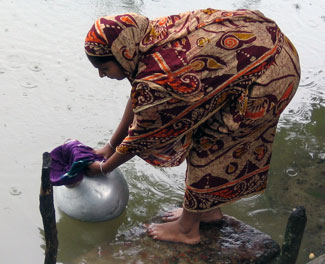
Sari cloth can filter cholera from water, research shows

Woman dressed in sari stands on rock at edge of water, dips urn with sari cloth covering opening into water to filter it
Photo courtesy of Dr. Anwar Huq/University of Maryland
A simple method of filtering water through sari cloth can reduce
cholera incidence by nearly half.
​by Cathy Kristiansen
A simple method of using readily available sari cloth to filter pond and river water successfully reduced the incidence of cholera by nearly half in a study conducted in Bangladesh. Funded by the NIH's National Institute of Nursing Research (NINR), the findings may have applications in other low-resource settings. More than 1 billion people worldwide lack access to safe drinking water and over 5 million die each year from waterborne illness, according to the WHO.
In many rural areas of Bangladesh, women use surface water for their household since it may be safer than well water, which can contain arsenic. The research team took its cue from a local practice to rid drinking water of insects and leaves by pouring it through sari cloth. Lab tests supported by the Thrasher Research Fund showed that a filter made of four layers of worn cotton material held back more than 99 percent of all cholera bacteria - using more layers or newer cloth slowed water collection too much.
"The filter is unique and useful," said Dr. Anwar Huq, who has collaborated on the project with University of Maryland colleague Dr. Rita Colwell. "It doesn't require any money or sophisticated training and the women bringing water to the house enthusiastically used the filtration, once the benefit was explained to them."
To test the filter's effectiveness, Huq and his colleagues studied about 45,000 residents, all in households with children under age five, who are typically more vulnerable to cholera. They showed the women how to use sari cloth to filter water that would be consumed or used to clean teeth, food and tableware. They followed up by visiting the village every two weeks to encourage compliance. An additional group of villages served as controls, adopting no interventions. In the households that were filtering water, cholera incidence was about half the level of the control participants and infections arising were milder, the scientists reported in Proceedings of the National Academy of Sciences. The study also showed the practice benefited neighbors who did not filter their water, by reducing the overall incidence of cholera in the community.
In a follow-up study five years later, researchers discovered about one-third of participants continued to filter water as trained. Huq suggested repeated training and messages on TV and the radio could improve usage. He added he hopes to investigate if the filter blocks other waterborne pathogens as well, such as E. coli.

Wednesday, November 12, 2014

Traveler Alert ♦ Cholera Epidemic in Ghana

According to the World Health Organization , more than 20,900 cases and 166 deaths from cholera have been reported in Ghana as of October 5, 2014. Many cases have been in the Greater Accra region, including in the districts of Accra Metro and La-Dadekotopon.
CDC recommends that travelers to Ghana protect themselves from cholera by following food and water precautions.
What is cholera?
Cholera is a bacterial disease that is most often spread by eating contaminated food or drinking contaminated water. Water is contaminated by the feces (stool) of an infected person or by untreated sewage. Food is often contaminated by water containing cholera bacteria or handled by a person ill with cholera.
Often people have mild illness or no symptoms. However, about 1 in 20 (5%) of infected people will have severe disease characterized by profuse watery diarrhea, vomiting, and leg cramps. In these people, rapid loss of body fluids leads to dehydration and shock. Without treatment, death can occur within hours.
What can travelers do to prevent cholera?
Travelers can protect themselves by following food and water precautions. The risk for cholera is very low for people visiting areas with epidemic cholera. When simple precautions are observed, contracting the disease is unlikely.
  • Drink only bottled, boiled, or chemically treated water and bottled or canned carbonated beverages. When using bottled drinks, make sure that the seal has not been broken.
    • To disinfect your own water: boil for 1 minute or filter the water and add 2 drops of household bleach or ½ an iodine tablet per liter of water.
    • Avoid tap water, fountain drinks, and ice cubes.
  • Wash your hands often with soap and clean water.
  • If no water and soap are available, use an alcohol-based hand cleaner (with at least 60% alcohol).
    • Clean your hands especially before you eat or prepare food and after using the bathroom.
  • Use bottled, boiled, or chemically treated water to wash dishes, brush your teeth, wash and prepare food, or make ice.
  • Eat foods that are packaged or that are freshly cooked and served hot.
    • Do not eat raw and undercooked meats and seafood or unpeeled fruits and vegetables.
  • Dispose of feces in a sanitary manner to prevent contamination of water and food sources
Traveler Information
Clinician Information

Thursday, October 30, 2014

The effect of phage on Cholera

Phage was first discovered because of the Cholera bacteria. It was in the eighteen nineties that it was noted that people who bathed in the Ganges River recovered from Cholera. the river was filled with phage which killed the bacteria  this was the first time people noted the effect of phage.

Recently Tufts University noted that Cholera bacteria that survived phage in an individual were unable to infect people  Here is a  Link to the tufts study.