Showing posts with label phage. Show all posts

Tuesday, May 19, 2015

Antibiotic Resistance Research: Antibiotic resistance a food safety issue? ♦ Phage spread antibiotic resistance ♦ Diagnostic errors linked to high incidence of incorrect antibiotic us

What makes antibiotic resistance a food safety issue Over this past weekend, I attended the American Society for Microbiology’s fourth conference on Antimicrobial Resistance in Zoonotic Bacteria and Foodborne Pathogens. In addition to hearing some fascinating presentations, I also had some thought-provoking conversations with my fellow attendees. Something that came up in our chats was what we mean when we call antimicrobial resistance..
Geckos resistant to antibiotics, may pose risk to pet owners, Tokay geckos harbor bacteria that are resistant to a number of antibiotics, making them a health concern for pet owners, according to a study on geckos imported from Indonesia. The research focused on how the geckos respond to antibiotics; the study found that the bacteria from the geckos' intestines--known as enteric bacteria--were resistant to the antibiotics.
Phage spread antibiotic resistance  Nearly half of the 50 chicken meat samples purchased from supermarkets, street markets, and butchers in Austria contained viruses that are capable of transferring antibiotic resistance genes from one bacterium to another -- or from one species to another, investigator's report
Diagnostic errors linked to high incidence of incorrect antibiotic use  Misdiagnoses lead to increased risk of incorrect antibiotic use, threatening patient outcomes and antimicrobial efficacy, while increasing healthcare costs, a new study concludes. The researchers found that 95 percent of patients with an incorrect or indeterminate diagnosis, or with a symptom identified but no diagnosis made, were given inappropriate antibiotics

Monday, November 17, 2014

Phage Therapy Cures Gingervitus

One thing I haven't mentioned in my articles on phage therapy is that you can travel to Poland or  the Republic of Georgia and get treated with phage therapy. This is a good solution that many people in Europe who have antibiotic resistant bacteria take advantage of. the only problem in the US insurance will not fit the bill because it is not approved by the FDA. The video below is of some one who made the trip to get a cure. this video from Great Britain shows how phages treat gingivitis
If you would like to help me in my campaign to make  phage therapy available Please go to my  My Campaign

Sunday, November 16, 2014

Saving Lives with Phage Therapy - Drug Trials

This is a video about a phage therapy phase one drug trial  done in Texas This study was paid for by a private firm. So far there is no money for phase 2
In France , Belgium and Switzerland they are starting a phage therapy phase 1&2 drug trial . This trial will be on burn victims who have developed infections in their wounds.This study was paid for by the government.with 5.6 million Euro’s
Phase three trials are usually much larger and require the most money.

My goal is to start a non-profit to encourage the government to pay for more trials plus raising money to help with this research. To learn more about phage therapy or to contribute go click on. Link to Campaign

Friday, November 14, 2014

.Cure for Antibiotic Resistant Bacteria

In Komo Washington a young woman was near death, infections was taking over a young woman's body.Three years ago tho infections, MRSA and pseudomonas attacked Rachels lungs.Her Doctors tried virtually every antibiotic. Nothing worked because the bacterias were antibiotic resistant.
Luckily, her Mother knew a Scientist  who worked with phage therapy.She brought in the phage therapy cures from the Republic of Georgia  After the First treatment the MRSA went away Then the  pseudomonas infection went away
I am working to bring Phage Therapy To everybody, not just though who happen to know a scientist. There are Phages that kill every type of bacteria
To find out more about and help go to My Campaign


Thursday, October 30, 2014

The effect of phage on Cholera

Phage was first discovered because of the Cholera bacteria. It was in the eighteen nineties that it was noted that people who bathed in the Ganges River recovered from Cholera. the river was filled with phage which killed the bacteria  this was the first time people noted the effect of phage.

Recently Tufts University noted that Cholera bacteria that survived phage in an individual were unable to infect people  Here is a  Link to the tufts study.

Tuesday, October 28, 2014

Saving Lives with Phage Therapy Four

We all have some bacteriophage(Phage for short) in our body. Our Digestive tract is lined with mucus. Sugar molecules are on the outer layer of the mucus. Bacteriophage attach themselves to these sugar molecules and wait for bacteria to come. Bacteriophage kill about 2/3 of the bacteria that go pass.  Bacteriophage is our first line of defence against foodborne illness.
The only problem they have is in the stomach.The acid that helps digest your food also digests the bacteriophage. To help them get through we need to eat food that is base or tums would help.

Phage Therapy works by giving a patient a lot of one type of phage that will kill the type of bacteria that is making you sick...The bacteriophage pictured attacks one type of E.Coli
So far my fundraising Campaign is going very slow. I expected some slowness because most people don;t know what phage therapy is..
If we were were trying to cure cancer it might go a bit faster. Later When we are working on a single disease such as MRSA or Listeriosis it should be easier.
I know some of my friends and relatives are out of work so they can' t give, but every one knows someone that has money for a good cause. I am seeing my doctor next I definitely talk him into giving.and hopefully get him to talk to his friends.
Here is the Link to the Campaign

Monday, October 27, 2014

Saving Lives with Phage Therapy Three

Bacteriophage (phage for short) use bacteria as a womb. They inject their DNA into the bacteria. They take energy from the bacteria and make 50 or more phages within the bacteria. Then they break open the bacteria and the phages go on there way.Depending on the type of phage this takes about twenty minutes.
There are two advantages to this One, the phages grow faster than the bacteria so they can over take them. Second, the phages end up in the same area as the infection.
One thing bacteria do is to form which are clumps of bacteria. The have small holes running through the film so that the bacteria in the middle can get food. It is 100 times harder for antibiotics to kill of a biofilm than it is to kill off individual bacteria.. Antibiotics kill of the outer layers of bacteria, but they grow back out from the middle.
Bacteriophage on the other hand can kill off the bacteria in the biofilm because there are more phages born every 20 minutes  Check out my campaign  to start a nonprofit to promote bacteriophage as a cure.

I will write something about phage therapy every day this month untill the campaign is over.

Friday, April 4, 2014

4/4/14 Health News: Swimming Pool Urine Poses Health Risks ♦ Phage 'Cocktail' Wipes Out 99 % of E. Coli in Food ♦ SUPPLEMENTS NEED REVIEW BEFORE THEY CAN DO DAMAGE, NOT AFTERWARD

  SUPPLEMENTS NEED REVIEW BEFORE THEY CAN DO DAMAGE, NOT AFTERWARD

Nearly 100 severe hepatitis and liver failure illnesses — nearly half requiring hospitalization, including three transplants and one death — are raising new questions about the nation’s $32-billion-a-year supplements industry. This comes only three months after the prestigious Annals of Internal Medicine found that all those vitamin and mineral supplements peddled by the industry are...Continue Reading

Swimming pool urine combines with chlorine to pose health risks
WEST LAFAYETTE, Ind. - A new study shows how uric acid in urine generates potentially hazardous "volatile disinfection byproducts" in swimming pools by interacting with chlorine, and researchers are advising swimmers to observe "improved hygiene habits."Continue Reading

Phage 'cocktail' wipes out 99 percent of E. coli in meat, spinach
Treating food products with select bacteriophages - viruses that target and kill bacteria - could significantly reduce concentrations of E. coli, a Purdue University study shows. An injection of bacteriophages - also known informally as "phages" - nearly eradicated a toxin-producing strain of E. coli in contaminated spinach and ground beef, in some cases decreasing E. coli concentrations by about 99 percent. Continue Reading


Tuesday, October 1, 2013

New Ways to Control Bacterial Diseases

In Scotland University of Strathclyde scientists have developed a way of chemically bonding Bacteriophage to nylon. Most of the time Bacteriophage is stored in a liquid but when it is attached to nylon it can be stored dry. The nylon can be in the form of strips, beads and thread. The thread are used by surgeons to suture the cuts after an operation. The nylon strips can be laid over a open wound. Both  methods  are very good at stopping infections.

They are now going through the approval process and expect to have the new product available in Great Britain in 2015. I don’t know if they will be able to get the new product approved for use in the United States unless the FDA changed their policy on mutations.  Currently the FDA has stated that any product that mutates in the body will not be approved as medicine. It is true that the Bacteriophage bonded to the Nylon won’t mutate but  offspring still can mutate.

In India GangaGen Biotechnologies has attached  a protein that will kill the MRSA bacteria to a Bacteriophage. When the Bacteriophage attacks the MRSA virus the the protein emits an infrared light which kills the bacteria. Sense the bacteria is killed before the Bacteriophage can produce offspring.

Are these two inventions better than Phage Therapy. Bacteriophage can be sprayed  on  the area that the surgeon cut open making the Bacteriophage available to the entire wound, not just in the area where the wound is sutured.  In the second instance the Bacteriophage can insert their DNA into a bacteria and creates 50 or more offspring right in the area where the infection is located.

GangaGen Biotechnologies is also working on a Bacteriophage in which they have changed the DNA.  This Bacteriophage Can kills the bacteria but is unable to split the bacteria open. This could be a real advance because there are some types of bacteria  that have poison inside. When these bacteria are broken open they can cause a fever or in severe cases toxic shock. For these type of bacteria this seems like it could be a real breakthrough.

Monday, September 23, 2013

Antibiotics Side Effects in Small Children and Babies


Antibiotics kill the friendly bacteria, called "flora", that live in your child's intestines. These friendly bacteria normally regulate the consistency of the stools and help with digestion. Eliminating these bacteria can cause the stools to become loose, watery, and more frequent. Expect this to happen to some degree with many antibiotics. It is not dangerous. Sometimes, however, it can be more severe (more than 6 – 8 stools a day). If you child has severe stomach cramps or vomiting, you should contact your doctor.
There can be two types of diaper rash with antibiotics: The first is contact diaper rash. This is simply from the loose stools irritating baby's bottom. The second is fungal diaper rash. This occurs because the absence of the normal intestinal flora allows yeast (fungus) to overgrow in the intestines. This yeast comes out in the stool and causes rash.If the rash is severe, with large blisters or skin sloughed off, you should stop the antibiotic and contact your doctor.
Oral Thrush  occurs because the antibiotics kill the normal mouth flora and allow yeast to overgrow inside the mouth. You can see white patches in the cheeks, on the tongue, under the lips, or on the gums.

Sometimes children may throw up a dose of the antibiotics. If this happens once or twice, don't worry. It's probably just an aversion to the taste Contact your doctor if this continues more than three times. You may need a different antibiotic.
There are two types of rashes that can occur during antibiotic use The first is Allergic rash due to allergy to the antibiotic. This can appear in several forms: Hives are raised, red or white welts that can appear anywhere on the body. They will usually pop up for one to several hours, then fade away, only to pop up again somewhere else. The usually itch. Another rash is pinpoint red or white bumps anywhere on the body.A third type is a Lacy type of red rash anywhere on the body that is not raised..
,You should call your doctor or go to an emergency room if your child has one or more of the following signs of severe allergic reaction wheezing or difficulty breathing (not just nasal congestion) Also difficulty swallowing due to tight throat or excessive drooling with difficulty swallowing Swollen joints is also a symptom of severe allergic reaction.
One of the reasons we should make phage therapy legal is that unlike antibiotics there are no serious side effects.

Monday, September 16, 2013

Untreatable: Today’s Drug-Resistant Health Threats

Every year, more than two million people in the United States get infections that are resistant to antibiotics and at least 23,000 people die as a result, according to a new report issued by the Centers for Disease Control and Prevention (CDC).  The report, Antibiotic Resistance Threats in the United States, 2013, presents a first-ever snapshot of the burden and threats posed by the antibiotic-resistant germs that have the most impact on human health. .
  • In addition to the illness and deaths caused by resistant bacteria, the report found that C. difficile, a serious diarrheal infection usually associated with antibiotic use, causes at least 250,000 hospitalizations and 14,000 deaths every year.
  • The loss of effective antibiotic treatments will not only cripple the ability to fight routine infectious diseases but will also undermine treatment of infectious complications in patients with other diseases. Many advances in medical treatment, such as joint replacements, organ transplants, and cancer therapies, are dependent on the ability to fight infections with antibiotics. If the ability to effectively treat those infections is lost, the ability to safely offer people many of the life-saving and life-improving modern medical advances will be lost with it.
  • The use of antibiotics is the single most important factor leading to antibiotic resistance around the world. Antibiotics are among the most commonly prescribed drugs used in human medicine.  However, up to half of antibiotic use in humans and much of antibiotic use in animals is unnecessary or inappropriate.
To combat antibiotic resistance, CDC has identified four core actions that must be taken:
  1. Preventing Infections, Preventing the Spread of Resistance: Avoiding infections in the first place reduces the amount of antibiotics that have to be used and reduces the likelihood that resistance will develop during therapy;
  2. Tracking: CDC gathers data on antibiotic-resistant infections, causes of infections and whether there are particular reasons (risk factors) that caused some people to get a resistant infection;
  3. Improving Antibiotic Use/Stewardship: Perhaps the single most important action needed to greatly slow the development and spread of antibiotic-resistant infections is to change the way antibiotics are used;
  4. Development of Drugs and Diagnostic Tests: Because antibiotic resistance occurs as part of a natural process in which bacteria evolve, we will always need new antibiotics to keep up with resistant bacteria as well as new diagnostic tests to track the development of resistance.
This information is from the CDC. What they don’t mention is that Poland is saving lives of people that could not be cured with antibiotics. In one study they had a 95% rate for people who previously had unsuccessful treatment with antibiotics. They used Phage therapy which we use to use before antibiotics were discovered. THey are cheap to use so Poland is saving money on their health care costs.

The only problem is that under our present laws drug companies can’t patent the therapy. Which means they can’t make money. Basically people are dying because of the way our laws are written.

Friday, September 6, 2013

What Medical Science Could Learn from Agriculture

Bacterial drug resistance resistance is very similar problem to the problem farmers face with weed control. Bacteria mutate to defeat in the same way weeds mutate to defeat weed killers.

At the Farm Progress Show in Indiana Dr Harry Stek stated that  diverse weed control approaches on the farm are a must.

“First we have to take a step back and see what got us into some of these problems, and that’s using the same thing over and over and over,” he said, “and of course weeds will find a way to figure out how to overcome this and become resistant. So, diversity includes chemical diversity, but also rotating crops, rotating HT traits so that gives you more opportunity to rotate to different chemistries, but also including non-chemical methods that help control and reduce the selection pressure for resistance.”

Strek says. “It’s how many times you apply and you only have a limited number of cycles before you can develop resistance. Unfortunately resistance development has a long period where you’re selecting for these genes that confer resistance and you really can’t see them. They’re kind of in the background noise. And then all of a sudden it enters an exponential phase, so year one you have solitary soldiers, solitary plants. Year two you have bigger patches and then year three it takes over your field and it’s consistently seen in that pattern, that it hits an exponential phase and takes it over. And you don’t want that to happen because then it’s too late.”

Weed resistance to Roundup. Farmers thought that they could use less weed killers by using GMO crops and Roundup. Because they continued to use the same pesticide year after year the weeds developed resistance.

A good example of how these same principles apply to bacterial drug resistance is demonstrated in the E coli 104H4 outbreak in Germany and France that killed 50 people.
Before this outbreak there were only two recorded outbreaks of E coli 104H4 In these two outbreaks only four people were involved. To everyones surprise  E coli 104H4 developed resistance to every antibiotic except one.

In the 1940’s we became so enamored with antibiotics that we stopped using Phage Therapy to treat bacterial diseases in the United States. Instead of using both therapies to fight bacteria with only one making it easier for the bacteria to develop resistance.

If we did start using Phage Therapy again, it would actually  reduce the amount of drug resistance to antibiotics. Some of the genes that cause drug resistance actually make bacteria weaker, so If you reduce the presents of antibiotics some bacteria will change.
.


.

Saturday, June 22, 2013

The Most Plentiful Organism on Earth

If you count all the living organisms on earth: the plants, the animals, the bacteria, even the cockroaches, and add them together. you will still have more Bacteriophages. There are
10,000,000,000,000,000,000,000,000,000,000 bacteriophages on earth. Hopefully they didn’t count them by hand. Bacteriophage,called phage for short, are very small, 100 times smaller than a bacteria. We could not see them until the electron microscope was invented..These organisms  are viruses.


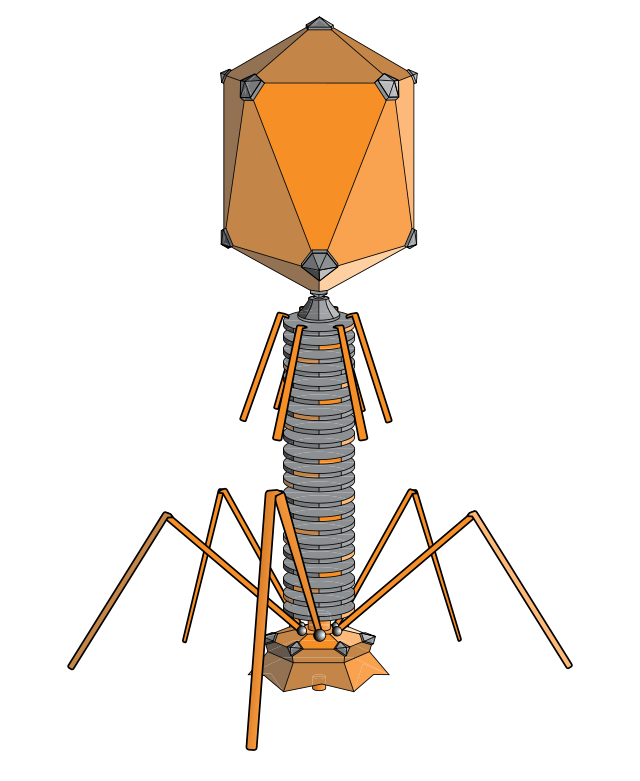
The name Bacteriophage means Bacteria eater. But they don’t actually eat bacteria but they do kill bacteria. Each species of phage only kills one species of bacteria. For example there are over 100 species of E coli and there are over 100 species of Phage that kill them. The species of Phage pictured below attacks is called  T4 and attacks E coli 


The top part of the Phage is called the cuspid. It contains the DNA wound up tightly like a spring. Below the cuspid the thin spot is called the collar. The bumpy part is called the tail and the 6 appendages are called long tail fibers. the part on the bottom is the base plate.
Wherever there are bacteria, Phage are close by. They are  even in our body, on the mountain tops and in the deepest oceans.Every two days  they kill half the bacteria on earth. Because bacteria can  reproduce in as little as 30 minutes  Phage are never able to wipe out all bacteria.


When a phage finds a bacteria species that they are able to kill, the Phage attach their long tail fibers to the bacteria with a sticky glue. After they are attached, they move their base plate near the surface of the bacteria.The points that stick out from the bottom of the base plate attach to the bacteria with a stronger glue. Then the base plate gives off a chemical that softens the skin of the bacteria. Then the DNA shoots out of the caspit, down the tail and into the bacteria with a force 6 times as great as a champagne cork.


Once inside the bacteria the DNA takes over the bacteria. The DNA uses the bacteria’s energy to duplicate itself. Once it has duplicated itself 50 or more times ,the bacteria splits open killing the bacteria and sending more Phage to attack other bacteria.this can take as little as 15 minutes


The drawing is from wikipedia

Saturday, June 8, 2013

Hospital Feeds Patients Listeria Tainted Meat in New Zealand

Bay Cuisine pre-packaged meat was found to be infected with Listeria. They are the sole supplier of pre packaged meat for  Hawke’s Bay Hospital. Two woman, one 60 and one 81 years old died  in the Hawke’s Bay Hospital after they ate the infected meat.. Two other patients have listeriosis but are recovering.  
Bay Cuisine has issued a recall on the affected products. Bay Cuisine supplies grocery stores as well as hospitals. Bay Cuisine has been charged under New Zealand’s Food Act which if convicted could face a fine up to $5000. They may also be charged under the Animal Products act which carries a fine of $500,000.
listeriosis can take 30 days before there are symptoms.There probably will may be other cases in the future. It can be dangerous for pregnant women and their unborn children, newborn babies, frail elderly, and anyone whose immune system is already weakened. In the United states 20% of the people with listeriosis die.
There is presently a company trying to get spray approved for use on food products. The spray uses Phages to kill listeria bacteria and is used in the United States.

Tuesday, June 4, 2013

Vaccine Ineffective Against New Strain of Whooping Cough

The National Institute of Health said last year was a record year for Whooping Cough. There were 41000 cases. The epidemic started out in Washington State. The NIH wants to make sure everyone gets their vaccinations even though the vaccine is no longer effective on one strain of the bacteria that cause Whooping  Cough.  That strain of Whooping Cough bacteria is missing a protein that the vaccine targets. These Whooping Cough bacteria are not controlled by the vaccine. So the vaccine will protect everyone from Whooping Cough.


Whooping Cough is a highly contagious airborne disease that is spread by coughing and sneezing. It affects the lungs and the airways and can be deadly in children. Sometimes a small child will cough so hard that they are unable to breathe. They can turn blue and die.

Whooping cough  was once a dreaded disease of childhood. It killing 5,000 to 10,000 Americans a year from the 1920s through the 1940s It is now a risk mostly to infants, to whom it is fatal in about 1 percent of cases.
Early symptoms are hard to spot. For the first 10 the symptoms are similar to an allergy or a mild cold. The symptoms include runny nose, low grade fever, mild occasional cough, and apnea (a pause in breathing in infants)
The next stage lasts from one to 10 weeks. The Symptoms include fits of numerous, rapid coughs followed by a “whooping” sound, vomiting and exhaustion after the coughing fits. Then for two to three weeks the disease gradually subsides. The disease is contagious during the first two weeks of the second stage. You can reduce the severity of the disease by getting antibiotics in the early stages.


In Washington State they found same percentage of people that were vaccinated got
Whooping Cough as those who were not vaccinated. This suggests that the vaccine is not working with the people in Washington.. But we still have a much lower rate of infection than before we had the vaccine. Even If if the vaccine is less effective it is important to have children vaccinated. The vaccinations have been shown to reduce the severity of the disease. This could be the difference between life or death for a small child. All 18 deaths in 2012 were children under three year old who were too young to have the full vaccination treatment.


This Should be a Wake up call. Bacteria can mutate to become resistant to vaccinations as well as antibiotics.  The big advantage to using Phage Therapy to fight bacteria is that phage is a virus and can mutate. Whenever a bacteria mutates a phage can be found to kill the new bacteria. Usually the new phage can be found in anywhere from two days to four weeks. It will take a long time to make a new vaccine or new antibiotics. To find out more about Phage Therapy check out my article from last month entitled “ The Most Plentiful Organism on Earth”

Tuesday, May 14, 2013

Please Don't Amputate Your Foot


People from all over the world that are facing amputation go to the Republic of Georgia to get treatment. In Georgia they use Bacteriophage, phage for short, to treat bacterial infection that are resistant to antibiotics. In tests they have proved to be 80 to 90% effective.
Phage are viruses that kill bacteria.The Phage will insert their DNA into a bacteria. Then they will use the bacteria to reproduce themselves over and over again. When the bacteria becomes stuffed with phage it will burst open, killing the bacteria and spilling out 50 or more Phage. These Phage will attack and kill more bacteria.

Each Phage will only attack one type of bacteria. Antibiotics kill several types of bacteria, the good bacteria that help us digest food along with the bad that cause infections.

In treating infections several types of Phage are use together in what is called a cocktail. By using a Cocktail they can still kill the bacteria even if it develops resistance to one of the phage. Phases are designed for an individual because many times there are more than one type of bacteria in an infections. Cocktails can contain as many as 100 phases .

Besides Amputations there are many other conditions that are caused by drug resistant bacteria. In fact over 100,000 people die each year from drug resistant bacteria. These conditions can also be treated by Phage.

In 1921 Felix dHerelle was the first to use Phage Therapy. He treated dysentery. During the early years there were mixed results with Phage Therapy. As the science improved so did the results.By the 1940’s Phage Therapy was used in the US. With the discovery of antibiotics the US stopped using Phage. Germany and the USSR used Phage Therapy during WWII to treat

their soldiers. After the war the USSR continued to use Phage Therapy and did a lot of research on Phage.. Because of the cold war the research findings did not reach the US. Some of the research is still not available because it is not translated into English.

Because of our current laws and regulations Phage can not be used for medicine in the United States. Phage Therapy can not be patented because it is a living organism. Drug companies will not spend money on Phage because without exclusive rights they can’t make a profit.

Current drug laws would require the Phage Cocktails to go through the approval processes even if all the individual  Phages have been approved. In different parts of the country
there can be different bacteria prevalent. This would cause a need to get a tremendous number of cocktails to get approved. It costs eight hundred million to get an antibiotic to market. To get all of the cocktails approved would probably cost close to the national debt.

Phage Therapy has been safely used for 90 years.  The FDA needs a different standard for testing Bacteriophage than for medicines that have been formulated by man. A drug without a record of safety.

To bring Phage Therapy to market in the US we need to develop more public awareness. We need to bring pressure to bear on the Congress and the FDA to change regulations. As long as it costs as much as it does under the present regulations nothing will ever get done and people will continue to die .

If you would like to help bring about change so that we can use Phage Therapy please leave me a note on the blog and I will get back to you.

To find out more about peoples personal experiences with Phage therapy check out this link http://www.popsci.com/scitech/article/2009-03/next-phage