Showing posts with label bacteriophage. Show all posts

Tuesday, September 15, 2015

Bacterial research: New method to treat antibiotic resistant MRSA: Bacteriophages ♦ Combo of three antibiotics can kill deadly staph infections ♦ Strategies to decrease bacterial colonization

Genome mining effort discovers 19 new natural products in four years It took a small group of researchers only four years -- a blink of an eye in pharmaceutical terms -- to scour a collection of 10,000 bacterial strains and isolate the genes responsible for making 19 unique, previously unknown phosphonate natural products, researchers report. Each of these products is a potential new drug. One of them has already been identified as an antibiotic
New method to treat antibiotic resistant MRSA: Bacteriophages A senior molecular biology major knows MRSA as the infection that took his dad's leg. Now he is exacting revenge on the bacteria by unlocking the power of a new MRSA-killer: bacteriophage.
Combo of three antibiotics can kill deadly staph infections Three antibiotics that, individually, are not effective against a drug-resistant staph infection can kill the deadly pathogen when combined as a trio, according to researchers. They have killed the bug -- methicillin-resistant Staphylococcus aureus -- in test tubes and laboratory mice, and believe the same strategy may work in people.
Strategies to decrease bacterial colonization Among the bacterial infections that are most difficult to treat, chronic infections associated with bacterial biofilms are one of the most hazardous. Bacterial biofilms are densely packed communities of microbial cells surrounded with secreted polymers. A chemist's new doctoral thesis has studied ways to decrease the bacterial colonization.
Researchers work to improve antibiotic effectiveness A new group of antibiotics has been discovered that may provide relief to some of the more than two million people in the United States affected by antibiotic resistance.


b

Monday, November 17, 2014

Phage Therapy Cures Gingervitus

One thing I haven't mentioned in my articles on phage therapy is that you can travel to Poland or  the Republic of Georgia and get treated with phage therapy. This is a good solution that many people in Europe who have antibiotic resistant bacteria take advantage of. the only problem in the US insurance will not fit the bill because it is not approved by the FDA. The video below is of some one who made the trip to get a cure. this video from Great Britain shows how phages treat gingivitis
If you would like to help me in my campaign to make  phage therapy available Please go to my  My Campaign

Sunday, November 16, 2014

Saving Lives with Phage Therapy - Drug Trials

This is a video about a phage therapy phase one drug trial  done in Texas This study was paid for by a private firm. So far there is no money for phase 2
In France , Belgium and Switzerland they are starting a phage therapy phase 1&2 drug trial . This trial will be on burn victims who have developed infections in their wounds.This study was paid for by the government.with 5.6 million Euro’s
Phase three trials are usually much larger and require the most money.

My goal is to start a non-profit to encourage the government to pay for more trials plus raising money to help with this research. To learn more about phage therapy or to contribute go click on. Link to Campaign

Friday, November 14, 2014

.Cure for Antibiotic Resistant Bacteria

In Komo Washington a young woman was near death, infections was taking over a young woman's body.Three years ago tho infections, MRSA and pseudomonas attacked Rachels lungs.Her Doctors tried virtually every antibiotic. Nothing worked because the bacterias were antibiotic resistant.
Luckily, her Mother knew a Scientist  who worked with phage therapy.She brought in the phage therapy cures from the Republic of Georgia  After the First treatment the MRSA went away Then the  pseudomonas infection went away
I am working to bring Phage Therapy To everybody, not just though who happen to know a scientist. There are Phages that kill every type of bacteria
To find out more about and help go to My Campaign


Monday, November 10, 2014

51 People Died in Germany Unnecessarily

During 2011, 51 people in Germany died from eating bean sprouts contaminated with  E.coli O104 H04. Two people died in the U.S. and 3,950 people were reported sick. The number who were sick was probably much higher because only a small number get reported to public health authorities.

This strain of E.coli was very hard to cure because of antibiotic resistance.

The doctors were offered Bacteriophage (phage) that could kill E.coli O104H04. It was being used by veterinarians to cure animals with the same type of bacteria. It was also available from labs that were doing research. The doctors said NO. If only they had said yes, some of the people could have been saved.

Germany is a signatory to the Helsinki Accords, which guarantees human rights.The most important human right is the right to life. In such an urgent case, they could have used bacteriophage. There is a doctor in France who presently uses bacteriophage in life-or-death cases. Yet Germany did not.

This is no wonder! Phage therapy has not been taught in medical school since the 1940s. The doctors from that era are long retired. Everyone has read about bacterial resistance but no one has heard of phage therapy. Not doctors, not their patients, not the politicians.

In a recent phage therapy conference, the the attendees were the same people who have been attending for years. The scientists and doctors who are familiar with this life-saving treatment are not doing a good job of expanding their base.

This is the reason I started my campaign to start a non-profit: to educate people about phage therapy, to financially support research. According to the FDA, it would cost 10 to 50 million to do a drug trial on a phage therapy cure. I may not ever raise enough money to do a trial. But I can do a lot of good by teaming up with other organizations to get trials done.

When I started this campaign, I knew it would be hard because I was talking about something that very few people have heard about. I do not have a PhD or a white doctor’s coat. What I do have is a passion. I have a plan. But it takes money to get this plan started. I need your help.

I know that everyone can not contribute large amounts of money. But even $5 dollars helps. Everything adds up. Here is a Link to the Campaign .  

Questions  email me


Wednesday, October 29, 2014

Saving Lives With Phage Therapy, THE VIDEO

I been very busy today. Didn't get a chance to write. Here is a video that covers the history of phage and shows pictures of phage attacking Bacteria CLICK  If You have a couple of bucks wearing a hole in your pocket, Stop by My Campaign and contribute  Link to Campaign

Tuesday, October 28, 2014

Saving Lives with Phage Therapy Four

We all have some bacteriophage(Phage for short) in our body. Our Digestive tract is lined with mucus. Sugar molecules are on the outer layer of the mucus. Bacteriophage attach themselves to these sugar molecules and wait for bacteria to come. Bacteriophage kill about 2/3 of the bacteria that go pass.  Bacteriophage is our first line of defence against foodborne illness.
The only problem they have is in the stomach.The acid that helps digest your food also digests the bacteriophage. To help them get through we need to eat food that is base or tums would help.

Phage Therapy works by giving a patient a lot of one type of phage that will kill the type of bacteria that is making you sick...The bacteriophage pictured attacks one type of E.Coli
So far my fundraising Campaign is going very slow. I expected some slowness because most people don;t know what phage therapy is..
If we were were trying to cure cancer it might go a bit faster. Later When we are working on a single disease such as MRSA or Listeriosis it should be easier.
I know some of my friends and relatives are out of work so they can' t give, but every one knows someone that has money for a good cause. I am seeing my doctor next I definitely talk him into giving.and hopefully get him to talk to his friends.
Here is the Link to the Campaign

Monday, October 27, 2014

Saving Lives with Phage Therapy Three

Bacteriophage (phage for short) use bacteria as a womb. They inject their DNA into the bacteria. They take energy from the bacteria and make 50 or more phages within the bacteria. Then they break open the bacteria and the phages go on there way.Depending on the type of phage this takes about twenty minutes.
There are two advantages to this One, the phages grow faster than the bacteria so they can over take them. Second, the phages end up in the same area as the infection.
One thing bacteria do is to form which are clumps of bacteria. The have small holes running through the film so that the bacteria in the middle can get food. It is 100 times harder for antibiotics to kill of a biofilm than it is to kill off individual bacteria.. Antibiotics kill of the outer layers of bacteria, but they grow back out from the middle.
Bacteriophage on the other hand can kill off the bacteria in the biofilm because there are more phages born every 20 minutes  Check out my campaign  to start a nonprofit to promote bacteriophage as a cure.

I will write something about phage therapy every day this month untill the campaign is over.

Sunday, October 26, 2014

Saving Lives with Phage Therapy Two

One of the major advantage of phage over antibiotics is that a phage only kills type of bacteria. A Antibiotic can kill a wide range of bacteria, the bacteria that make us sick along with the bacteria that are beneficial.
The bacteria in your gut help you in many ways. Bacteria can help you digest food, assist your immune system and some believe it can regulate your weight. A disease called C.Diff comes about when people have been given a lot of antibiotics also fungal diseases can occur after a person is treated with antibiotics.Last year 14,000 people died in the United States from C. Diff.
Another problem with antibiotics is that they can cause serious side effects. Phage Therapy has no serious side effects,
I have started a campaign on to raise money for the purpose of funding drug trials to bring phage therapy to market.To finding out more go to after noon on Monday
I will write a short piece on page therapy every day till the campaign is over

Friday, April 4, 2014

4/4/14 Health News: Swimming Pool Urine Poses Health Risks ♦ Phage 'Cocktail' Wipes Out 99 % of E. Coli in Food ♦ SUPPLEMENTS NEED REVIEW BEFORE THEY CAN DO DAMAGE, NOT AFTERWARD

  SUPPLEMENTS NEED REVIEW BEFORE THEY CAN DO DAMAGE, NOT AFTERWARD

Nearly 100 severe hepatitis and liver failure illnesses — nearly half requiring hospitalization, including three transplants and one death — are raising new questions about the nation’s $32-billion-a-year supplements industry. This comes only three months after the prestigious Annals of Internal Medicine found that all those vitamin and mineral supplements peddled by the industry are...Continue Reading

Swimming pool urine combines with chlorine to pose health risks
WEST LAFAYETTE, Ind. - A new study shows how uric acid in urine generates potentially hazardous "volatile disinfection byproducts" in swimming pools by interacting with chlorine, and researchers are advising swimmers to observe "improved hygiene habits."Continue Reading

Phage 'cocktail' wipes out 99 percent of E. coli in meat, spinach
Treating food products with select bacteriophages - viruses that target and kill bacteria - could significantly reduce concentrations of E. coli, a Purdue University study shows. An injection of bacteriophages - also known informally as "phages" - nearly eradicated a toxin-producing strain of E. coli in contaminated spinach and ground beef, in some cases decreasing E. coli concentrations by about 99 percent. Continue Reading


Friday, February 14, 2014

2/14/14 Health News: New Strategy to Fight Bacterial Infections - Virus that Kills Anthrax - Food Bug Triggers Multiple Sclerosis - Giving Ourselves Cancer

Scientists Find New Strategy to Combat Bacterial Infections
Increasing numbers of bacteria are developing antibiotic resistance. This forms a significant challenge in the battle against bacterial infections. Alvin Lo and Han Remaut (VIB/Vrije Universiteit Brussel) have identified a chemical substance with the potential of acting as a new drug to treat bacterial infections, particularly urinary tract infections. In contrast to the most popular antibiotics, this candidate drug does not destroy pathogenic bacteria, but rather disarms them. The benefit of this new strategy is that other (useful) bacteria are unharmed .Continue Reading


Anthrax Agent Killed by New, Unusually Large Virus
From a zebra carcass on the plains of Namibia in Southern Africa, an international team of researchers has discovered a new, unusually large virus (or bacteriophage) that infects the bacterium that causes anthrax. The novel bacteriophage could eventually open up new ways to detect, treat or decontaminate the anthrax bacillus and its relatives that cause food poisoning., Continue Reading


Food Bug Toxin May Trigger Multiple Sclerosis
New research presented at a scientific meeting adds to a growing body of evidence that a toxin produced by a common food bug may trigger multiple sclerosis, an inflammatory disease of the central nervous system. Dr. Jennifer Linden Said. "We provide evidence that supports epsilon toxin's ability to cause BBB [blood-brain barrier] permeability and show that epsilon toxin kills the brain's myelin producing cells, oligodendrocytes; the same cells that die in MS lesions. Continue Reading


We Are Giving Ourselves Cancer
Despite great strides in prevention and treatment, cancer rates remain stubbornly high and may soon surpass heart disease as the leading cause of death in the United States. Increasingly, we and many other experts believe that an important culprit may be our own medical practices: We are silently irradiating ourselves to death. The use of medical imaging with high-dose radiation — CT scans in particular — has soared in the last 20 years. Our resulting exposure to medical radiation has increased more than sixfold between the 1980s and 2006, according to the National Council on Radiation Protection & Measurements. The radiation doses of CT scans (a series of X-ray images from multiple angles) are 100 to 1,000 times higher than conventional X-rays. Continue Reading  

Tuesday, October 29, 2013

10/29/2012 Daily Food News: Monsanto Stomps on Rights, Altered DNA, Bacteria Eating Viruses, Brain Trash

Genetically Modified Democracy: Monsanto and Congress Move to Stomp on Your Rights
Reliable sources in Washington D.C. have informed the Organic Consumers Association (OCA) that Monsanto has begun secretly lobbying its Congressional allies to attach one or more “Monsanto Riders” or amendments to the 2013 Farm Bill that would preempt or prohibit states from requiring labels on genetically engineered (GE) foods.Continue Reading


A New Biological Clock Measures Altered DNA, not Birthday Candles
Move over birthday candles, and step aside telomeres; there may be a new kind of biological clock in town. And this one may prove useful in predicting where age-related diseases such as cancer are most likely to strike..Continue Readyng


GAO Pushes for Removal of Social Security Numbers From Medicare IDs
The Centers for Medicare & Medicaid Services has been slow to act on data it has collected that could help it implement a technical solution for removing Social Security numbers from Medicare cards, a newly released Government Accountability Office report concluded. Continue Reading


Bacteria-eating Viruses Found That Fight C. diff 'Superbugs'
A potential new victory in the war against antibiotic-resistant "superbugs" lies in the discovery of specific viruses that eat bacteria - called bacteriophages. Researchers in the UK have isolated certain phages, which have been shown to target the infectious hospital bug Clostridium difficile. C. diff, as the superbug is known, is responsible for 250,000 infections in the US each year and results in 14,000 deaths, the researchers say. Unlike antibiotics, Dr. Clokie says phages "are specific in what they kill," noting that they usually infect only one specific species or strain of bacteria. By injecting their DNA into the bacterium, she notes that phages then replicate and cause the bacterial cell to "burst open." Once the dead bacterium is opened, the phages can then repeat the process on other host cells.Continue Reading


Taking Out the Brain's Trash: It May Be Why We Need Our Sleep

Among the many vital roles that sleep plays in our lives, our nightly rest may give us the chance to take out the cerebral trash, says a new study. No, we're not talking about some kind of Ambien-induced sleep-housework. We're talking about the process by which the brain refreshes itself by removing the build-up of mental metabolites such as beta-amyloid and tau -- the byproducts, if you will, of a day's cogitation.Continue Reading

Tuesday, October 1, 2013

New Ways to Control Bacterial Diseases

In Scotland University of Strathclyde scientists have developed a way of chemically bonding Bacteriophage to nylon. Most of the time Bacteriophage is stored in a liquid but when it is attached to nylon it can be stored dry. The nylon can be in the form of strips, beads and thread. The thread are used by surgeons to suture the cuts after an operation. The nylon strips can be laid over a open wound. Both  methods  are very good at stopping infections.

They are now going through the approval process and expect to have the new product available in Great Britain in 2015. I don’t know if they will be able to get the new product approved for use in the United States unless the FDA changed their policy on mutations.  Currently the FDA has stated that any product that mutates in the body will not be approved as medicine. It is true that the Bacteriophage bonded to the Nylon won’t mutate but  offspring still can mutate.

In India GangaGen Biotechnologies has attached  a protein that will kill the MRSA bacteria to a Bacteriophage. When the Bacteriophage attacks the MRSA virus the the protein emits an infrared light which kills the bacteria. Sense the bacteria is killed before the Bacteriophage can produce offspring.

Are these two inventions better than Phage Therapy. Bacteriophage can be sprayed  on  the area that the surgeon cut open making the Bacteriophage available to the entire wound, not just in the area where the wound is sutured.  In the second instance the Bacteriophage can insert their DNA into a bacteria and creates 50 or more offspring right in the area where the infection is located.

GangaGen Biotechnologies is also working on a Bacteriophage in which they have changed the DNA.  This Bacteriophage Can kills the bacteria but is unable to split the bacteria open. This could be a real advance because there are some types of bacteria  that have poison inside. When these bacteria are broken open they can cause a fever or in severe cases toxic shock. For these type of bacteria this seems like it could be a real breakthrough.

Saturday, June 22, 2013

The Most Plentiful Organism on Earth

If you count all the living organisms on earth: the plants, the animals, the bacteria, even the cockroaches, and add them together. you will still have more Bacteriophages. There are
10,000,000,000,000,000,000,000,000,000,000 bacteriophages on earth. Hopefully they didn’t count them by hand. Bacteriophage,called phage for short, are very small, 100 times smaller than a bacteria. We could not see them until the electron microscope was invented..These organisms  are viruses.


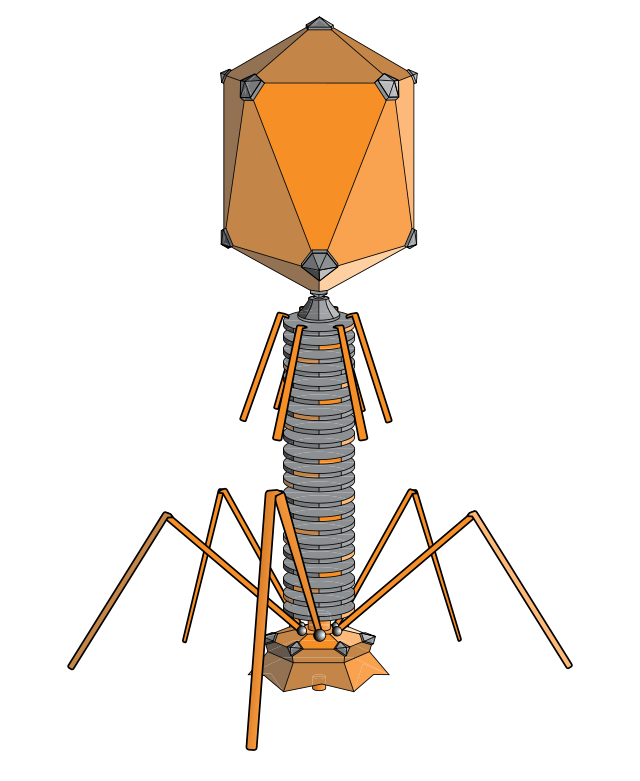
The name Bacteriophage means Bacteria eater. But they don’t actually eat bacteria but they do kill bacteria. Each species of phage only kills one species of bacteria. For example there are over 100 species of E coli and there are over 100 species of Phage that kill them. The species of Phage pictured below attacks is called  T4 and attacks E coli 


The top part of the Phage is called the cuspid. It contains the DNA wound up tightly like a spring. Below the cuspid the thin spot is called the collar. The bumpy part is called the tail and the 6 appendages are called long tail fibers. the part on the bottom is the base plate.
Wherever there are bacteria, Phage are close by. They are  even in our body, on the mountain tops and in the deepest oceans.Every two days  they kill half the bacteria on earth. Because bacteria can  reproduce in as little as 30 minutes  Phage are never able to wipe out all bacteria.


When a phage finds a bacteria species that they are able to kill, the Phage attach their long tail fibers to the bacteria with a sticky glue. After they are attached, they move their base plate near the surface of the bacteria.The points that stick out from the bottom of the base plate attach to the bacteria with a stronger glue. Then the base plate gives off a chemical that softens the skin of the bacteria. Then the DNA shoots out of the caspit, down the tail and into the bacteria with a force 6 times as great as a champagne cork.


Once inside the bacteria the DNA takes over the bacteria. The DNA uses the bacteria’s energy to duplicate itself. Once it has duplicated itself 50 or more times ,the bacteria splits open killing the bacteria and sending more Phage to attack other bacteria.this can take as little as 15 minutes


The drawing is from wikipedia

Tuesday, June 11, 2013

Dangers From Deli Meat

Dangers From Deli Meat

When you buy meat cut to order from a deli you are seven times more likely to get meat infected with Listeria then when you buy prepackaged meat. A Deli is a more dangerous for several reasons.

   First: Listeria can grow in a refrigerated  case especially in a moist environment when the
            door to the case is opened and closed leading to questions about the temperature
             inside the case

   Second: Several types of meat are cut on one slicer. If one peice of meat is contaminated            
                  then all the meats that touch that slicer can become contaminated.

   Third: Sometimes the meat can be left out.

   Fourth: Several workers are touching the meat.
\
   Fifth: Employee Hygiene  

     
This creates a dilemma for the meat supplier. If a meat gets a bacterial infection at one of the deli’s he supplies it can tarnish his reputation. One Company, Deli Brands is making sure that there meat is listeria free They are using Listex as a surface treatment along with Sodium Lactate  and sodium diacetate.  

Listex Is a culture of bacteriophages, phage for short, that effectively eliminating Listeria. Phages target the listeria but does not affect desirable bacterial species. They also do not alter the taste ,texture and color of the meat.  The sodium lactate and the sodium diacetate rid the meat of other undesirable bacteria.

Sodium Lactate is a salt Mixed with Lactate mixed with lactic acid. The lactate acid is not derived from milk so those with a milk allergy need not worry. Sodium diacetate is an acidic salt.

By changing to this treatment they improved the taste of their meat and reduced their costs. They also increased the shelf life to 70 days.

Because of the safety issues some grocery stores are buying precut meat in bulk and displaying it in their case.


Tuesday, June 4, 2013

Vaccine Ineffective Against New Strain of Whooping Cough

The National Institute of Health said last year was a record year for Whooping Cough. There were 41000 cases. The epidemic started out in Washington State. The NIH wants to make sure everyone gets their vaccinations even though the vaccine is no longer effective on one strain of the bacteria that cause Whooping  Cough.  That strain of Whooping Cough bacteria is missing a protein that the vaccine targets. These Whooping Cough bacteria are not controlled by the vaccine. So the vaccine will protect everyone from Whooping Cough.


Whooping Cough is a highly contagious airborne disease that is spread by coughing and sneezing. It affects the lungs and the airways and can be deadly in children. Sometimes a small child will cough so hard that they are unable to breathe. They can turn blue and die.

Whooping cough  was once a dreaded disease of childhood. It killing 5,000 to 10,000 Americans a year from the 1920s through the 1940s It is now a risk mostly to infants, to whom it is fatal in about 1 percent of cases.
Early symptoms are hard to spot. For the first 10 the symptoms are similar to an allergy or a mild cold. The symptoms include runny nose, low grade fever, mild occasional cough, and apnea (a pause in breathing in infants)
The next stage lasts from one to 10 weeks. The Symptoms include fits of numerous, rapid coughs followed by a “whooping” sound, vomiting and exhaustion after the coughing fits. Then for two to three weeks the disease gradually subsides. The disease is contagious during the first two weeks of the second stage. You can reduce the severity of the disease by getting antibiotics in the early stages.


In Washington State they found same percentage of people that were vaccinated got
Whooping Cough as those who were not vaccinated. This suggests that the vaccine is not working with the people in Washington.. But we still have a much lower rate of infection than before we had the vaccine. Even If if the vaccine is less effective it is important to have children vaccinated. The vaccinations have been shown to reduce the severity of the disease. This could be the difference between life or death for a small child. All 18 deaths in 2012 were children under three year old who were too young to have the full vaccination treatment.


This Should be a Wake up call. Bacteria can mutate to become resistant to vaccinations as well as antibiotics.  The big advantage to using Phage Therapy to fight bacteria is that phage is a virus and can mutate. Whenever a bacteria mutates a phage can be found to kill the new bacteria. Usually the new phage can be found in anywhere from two days to four weeks. It will take a long time to make a new vaccine or new antibiotics. To find out more about Phage Therapy check out my article from last month entitled “ The Most Plentiful Organism on Earth”

Monday, June 3, 2013

How Can We Keep Food Free From Bacteria

Some Methods of getting bacteria off our food  are unacceptable to the general public.  After using ammonia to make what the public called “pink slime” no meat producer would think of using ammonia as a disinfectant.  The public doesn't approve of using gamma radiation to treat food either. They seem to think that food would become  radioactive.
The USDA and the FDA  both have regulations about what can be used  on food to control bacteria.  These Products Can not  change the taste or appearance of the food in any way. and they must not negatively affect food safety or public health.   To be used a product must have a long history of safety or go through testing to prove that they are safe.  
A Dutch company has developed a product that uses bacteriophage to kill listeria bacteria on food. It has been approved  for use in the  United States and the European Union.  They are presently applying for approval in Australia and New Zealand.
Another process that has been highly effective is to spray beef carcasses with steam or hot water. This is used to get rid of E. coli 157 Using high powered washes has virtually eliminated listeria from hot dogs and lunch meats.  The use of chlorine, lemon juice and organic acids are generally accepted by the public.
All bacteria cannot be killed in the same way. When you use the antiseptic wipes at the grocery store it kills some species of bacteria and not others. Some species of bacteria are killed by steam and others are able to tolerate steam All  species of bacteria can’t be killed in the same way. This can cause a problem when there are different types of infectious bacteria on the same food.
From my point of view we should be developing bacteriophage sprays, not just for listeria, to do a better job of taking care of a variety of bacteria


Sunday, June 2, 2013

New Immune System Found In Humans and Animals

At San Diego State University they discovered a previously unknown  immune system that is in both humans and animals. There is a protective layer of mucus in all animals including humans. The Mucus starts in the mouth and goes through the gut. On the top layer of the mucus are sugar molecules. Bacteriophage attach themselves to the sugar molecules.

Bacteriophage, Phage for short, are viruses that infect bacteria. To kill the bacteria the phage  
injects its DNA into a bacteria. The phage reproduces itself 50 times or more inside the bacteria. Then it explodes the bacteria killing the bacteria. and sending more Phage into the gut to kill more bacteria.

To test this they put E coli and phage on cells that didn’t make mucus. They found that the E coli produced three times the damage compared to the cells that produced mucus.This is the first time that a symbiotic relationship was found between Phage and animals. Hopefully this research will help get phage therapy used as medicine.

Tuesday, May 14, 2013

Please Don't Amputate Your Foot


People from all over the world that are facing amputation go to the Republic of Georgia to get treatment. In Georgia they use Bacteriophage, phage for short, to treat bacterial infection that are resistant to antibiotics. In tests they have proved to be 80 to 90% effective.
Phage are viruses that kill bacteria.The Phage will insert their DNA into a bacteria. Then they will use the bacteria to reproduce themselves over and over again. When the bacteria becomes stuffed with phage it will burst open, killing the bacteria and spilling out 50 or more Phage. These Phage will attack and kill more bacteria.

Each Phage will only attack one type of bacteria. Antibiotics kill several types of bacteria, the good bacteria that help us digest food along with the bad that cause infections.

In treating infections several types of Phage are use together in what is called a cocktail. By using a Cocktail they can still kill the bacteria even if it develops resistance to one of the phage. Phases are designed for an individual because many times there are more than one type of bacteria in an infections. Cocktails can contain as many as 100 phases .

Besides Amputations there are many other conditions that are caused by drug resistant bacteria. In fact over 100,000 people die each year from drug resistant bacteria. These conditions can also be treated by Phage.

In 1921 Felix dHerelle was the first to use Phage Therapy. He treated dysentery. During the early years there were mixed results with Phage Therapy. As the science improved so did the results.By the 1940’s Phage Therapy was used in the US. With the discovery of antibiotics the US stopped using Phage. Germany and the USSR used Phage Therapy during WWII to treat

their soldiers. After the war the USSR continued to use Phage Therapy and did a lot of research on Phage.. Because of the cold war the research findings did not reach the US. Some of the research is still not available because it is not translated into English.

Because of our current laws and regulations Phage can not be used for medicine in the United States. Phage Therapy can not be patented because it is a living organism. Drug companies will not spend money on Phage because without exclusive rights they can’t make a profit.

Current drug laws would require the Phage Cocktails to go through the approval processes even if all the individual  Phages have been approved. In different parts of the country
there can be different bacteria prevalent. This would cause a need to get a tremendous number of cocktails to get approved. It costs eight hundred million to get an antibiotic to market. To get all of the cocktails approved would probably cost close to the national debt.

Phage Therapy has been safely used for 90 years.  The FDA needs a different standard for testing Bacteriophage than for medicines that have been formulated by man. A drug without a record of safety.

To bring Phage Therapy to market in the US we need to develop more public awareness. We need to bring pressure to bear on the Congress and the FDA to change regulations. As long as it costs as much as it does under the present regulations nothing will ever get done and people will continue to die .

If you would like to help bring about change so that we can use Phage Therapy please leave me a note on the blog and I will get back to you.

To find out more about peoples personal experiences with Phage therapy check out this link http://www.popsci.com/scitech/article/2009-03/next-phage