Showing posts with label cancer drugs. Show all posts

Wednesday, November 18, 2015

Bacterial Research; How depleting the gut microbiota protects from obesity ♦ Concerted action needed to control healthcare-related infection ♦ New technique could prevent dangerous biofilms on catheters

New information about bacterial enzymes to help scientists develop more effective antibiotics, cancer drugs New research now allows researchers to manipulate nature's biosynthetic machinery to produce more effective antibiotics and cancer-fighting drugs.
How depleting the gut microbiota protects from obesity By studying mice without microbiota, scientists were able to demonstrate how the absence of microbiota has a remarkable effect against obesity. Indeed, it triggers a surprising metabolic mechanism: white fat cells -- which in excess cause obesity and insulin resistance -- are transformed into cells similar to brown fat (they are called 'beige fat'), that protects the body against excess weight and its damaging consequences.
Responding to C. diff: Concerted action needed to control healthcare-related infection Appropriate use of antibiotics is a critical step toward controlling the ongoing epidemic of health care-related Clostridium difficile infection, according to a special article from experts
New technique could prevent dangerous biofilms on catheters Biofilms frequently coat the surfaces of catheters, and of various medical implants and prostheses, where they can cause life-threatening infections. New research shows that coating implants with a certain 'activator' can prevent Staphylococcus aureus, the leading cause of hospital-acquired infections, from forming biofilms

Monday, June 29, 2015

Cancer Research: Potential new class of cancer drugs developed ♦ Experimental treatment sends deadly leukemia into remission ♦ microRNA may provide therapy against pancreatic cancer

microRNA may provide therapy against pancreatic cancer Cancer researchers have found that a particular microRNA may be a potent therapeutic agent against pancreatic cancer. The need for new therapies for pancreatic cancer patients is great as only 7 percent of people with the disease survive more than 5 years after diagnosis. According to the National Cancer Institute, there will be an estimated 48,960 new cases of pancreatic cancer and 40,560 deaths from the disease in 2015.
E2F4 signature can predict progression of bladder cancer Investigators harnessed genomic data to discover that the previously identified E2F4 signature in breast cancer can be utilized to predict prognosis and response to therapy in bladder cancer.
Experimental treatment sends deadly leukemia into remission An experimental new treatment approach for a rare, deadly leukemia can send the disease into remission even in patients for whom the standard therapy has failed, a pilot study has found. The study is 'proof of principle' the cutting-edge approach could be used to treat many other cancers as well.
Development of new blood vessels not essential to growth of lymph node metastases The growth of metastases in lymph nodes -- the most common site of cancer spread -- does not require the development of new blood vessels, researchers have discovered, potentially explaining why antiangiogenesis drugs have failed to prevent the development of new metastases.
Potential new class of cancer drugs developed A new class of drug developed targets the Warburg effect to cut off cancer's energy supply, and researchers say that it has the potential to stop most kinds of cancer in its tracks.

Friday, May 22, 2015

Health News: $200 million settlement in 2012 meningitis outbreak ♦ MS Scientists identify cause of movement, balance problems ♦ Redesigned' antibodies may control HIV

Judge approves $200 million settlement in 2012 meningitis outbreak A Federal bankruptcy judge approved a $200 million settlement with the now-closed New England Compounding Center pharmacy following a 2012 fungal meningitis outbreak that killed 64 people and sickened more than 750 others across 20 states as a result of tainted drugs produced by the pharmacy. The settlement will be distributed among the victims and 14 former employees of the compounding center
Multiple sclerosis: Scientists identify cause of movement, balance problems New research into the causes of the excessive inflammation that drives multiple sclerosis has identified a faulty 'brake' within immune cells, a brake that should be controlling the inflammation. This points to a potential target for developing new therapies to treat multiple sclerosis.
Cancer drugs may hold key to treating Down syndrome and other brain disorders A class of FDA-approved cancer drugs may be able to prevent problems with brain cell development associated with disorders including Down syndrome and Fragile X syndrome.
'Redesigned' antibodies may control HIV With the help of a computer program called “Rosetta,” researchers have “redesigned” an antibody that has increased potency and can neutralize more strains of the AIDS-causing human immunodeficiency virus (HIV) than can any known natural antibody.
Potential new drug target for the treatment of rheumatoid arthritis A novel drug target for the treatment of rheumatoid arthritis has been identified, which focuses on the cells that are directly responsible for the cartilage damage in affected joints. Rheumatoid arthritis, an autoimmune disease that leads to stiff, deformed joints and often crippling pain. The immune system's attack on the body's own tissue leads to chronic, painful inflammation in the affected joints.

Friday, May 8, 2015

Cancer Research: Cancer drugs approved quickly but not to patient's benefit ♦ Scientists identify promising new melanoma treatment strategy ♦ Automated counting of tumor cells in blood

Fragments of tRNA suggest a novel mechanism for cancer progression Researchers discover that particular genetic fragments, of a type of RNA known as transfer RNA, or tRNA, appear to be capable of reducing the growth and spread of breast cancer cells.
Scientists identify promising new melanoma treatment strategy The enzyme GMPS drives melanoma growth, researchers report. The scientists propose a new strategy for targeting that protein that may help advance toward a new melanoma treatment strategy.
Automated counting of tumor cells in blood Biological and medical scientists have been using flow cytometry to count cancer cells for the past 40 years. But the large instruments are expensive and can only be operated by trained personnel. By contrast the PoCyton cytometer is cheap to produce, no bigger than a shoebox, and automated.
Cancer drugs approved quickly but not to patient's benefit,Highly priced cancer drugs get rushed approvals despite poor trial methodology and little effect on the longevity of patients, cautions one expert, who adds that drug reviewers don't look at the long term survival of patients who take them
3D 'organoids' grown from patient tumors could personalize drug screening Three dimensional cultures (or 'organoids') derived from the tumors of cancer patients closely replicate key properties of the original tumors, reveals a study. These 'organoid' cultures are amenable to large-scale drug screens for the detection of genetic changes associated with drug sensitivity and pave the way for personalized treatment approaches that could optimize clinical outcomes in cancer patients.

Monday, May 4, 2015

Devices Assess Cancer Drugs in Tumors

Although numerous drugs are available to treat cancers, determining which ones to use can be challenging. As tumors grow, they often become resistant to treatments. Cancer cells mutate quickly, which can help them adapt and survive. Other factors are also involved in resistance, including various aspects of the tumor’s microenvironment. Because these complex factors are challenging to recreate outside of the body, it’s difficult to test and predict how patient’s tumors will respond to different treatments.
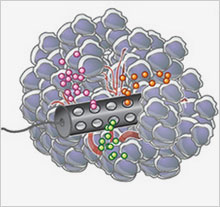
Illustration of cylindrical device inside a tumor.
An implantable device can release microdoses of up to 16 different drug treatments into a tumor. Image by Jonas et al., courtesy of Science Translational Medicine.
Two separate research groups set out to address this problem by creating tiny devices that can test how tumors within a patient respond to various drugs.
A team led by Drs. Oliver Jonas and Robert Langer at the Massachusetts Institute of Technology developed a small device—only 4 mm long and 820 μm in diameter—that can be implanted using a standard biopsy needle. The device contains reservoirs that release tiny doses of up to 16 individual drugs or drug combinations into distinct regions. After 24 hours, a second biopsy needle is used to retrieve the device, along with a small column of tissue around it. The tissue is then examined to assess the effects of the drugs on the tumor.
Using established mouse models of human melanoma, breast cancer, and prostate cancer, the researchers demonstrated that the device could accurately predict how effective treatments would be when used system-wide. Based on these results, the scientists are planning to launch a clinical trial in breast cancer patients next year.
“The approach that we thought would be good to try is to essentially put the lab into the patient,” Jonas says. “It’s safe and you can do all of your sensitivity testing in the native microenvironment.”
A microinjection device can deliver several candidate therapeutics into a tumor. On the left, a scan after injection with a 5-needle array. On the right, the column-like distribution of a tracking dye signal from a single needle in a tumor.Images by Klinghoffer et al., courtesy of Science Translational Medicine.
Another device was developed by a team led by Dr. Jim Olson at Fred Hutchinson Cancer Research Center and Dr. Richard Klinghoffer at Presage Biosciences, a company founded by Olson. Called CIVO, the device features an array of up to 8 needles that can inject small amounts of candidate drugs directly into tumors. The drugs are delivered as the needles are retracted, leaving column-like tracks of the drugs though the tumor. After 24-72 hours, tumor samples are taken and processed. The tumor’s response to each drug is assessed with a sophisticated image analysis system.
The researchers tested the microinjection system in mouse models of human lymphomas and lung cancers, as well as in canines. The cellular changes around the drug tracks predicted the animals’ response to the drugs. A screen of 97 compounds in mice also revealed a new anti-cancer agent for a type of resistant tumor. These results show that CIVO could potentially be used to identify drugs to treat resistant tumors.
The scientists tested CIVO in a clinical setting in 4 human lymphoma patients. No serious adverse events were reported in the small pilot study. Ongoing testing of the system now continues in a clinical trial.
“This sets the stage for a new type of pre-phase 1 clinical study in which multiple drugs or drug combinations can be tested simultaneously, directly in a patient’s own tumor, without toxicity associated with systemic drug delivery,” Klinghoffer says.


—by Harrison Wein, Ph.D.

Thursday, April 9, 2015

Cancer Research: Tumor cells that mimic blood vessels ♦ Biologists identify brain tumor weakness ♦ Cost of cancer drugs varies widely

Cost of cancer drugs varies widely based on who;s paying Uninsured cancer patients are asked to pay anywhere from two to 43 times what Medicare would pay for chemotherapy drugs, according to a new study. Uninsured patients who did not negotiate billed amounts for chemo drugs could expect to pay $6,711 for an infusion of the colorectal cancer drug oxaliplatin. However, Medicare and private health plans only pay $3,090 and $3,616 for the same drug, respectively.
Too much of a bad thing can be good in brain tumors DNA mutations can cause cancer but in some cases, more mutations may mean a better prognosis for patients. A comprehensive genomic analysis of more than 700 brain tumors has revealed one such subtype of the most malignant brain tumor, called glioblastoma, or GBM. This subtype possesses thousands of tumor-specific DNA errors or mutations instead of dozens observed in most glioblastoma cases. It is also associated with longer survival.
Biologists identify brain tumor weakness A new discovery could offer more effective drugs to combat brain tumors, scientists report. The study found that a subset of glioblastoma tumor cells is dependent on a particular enzyme that breaks down the amino acid glycine. Without this enzyme, toxic metabolic byproducts build up inside the tumor cells, and they die.
Tumor cells that mimic blood vessels could help breast cancer spread to other sites The ability of tumor cells to form tubular networks that mimic blood vessels can help drive metastasis, the spread of breast cancer to different sites in the body, a mouse model study has demonstrated. The researchers are now examining what it takes for tumor cells that have exited from a primary tumor into the bloodstream to then get out of the bloodstream and colonize a new site in the body.