Showing posts with label norovirus. Show all posts

Wednesday, December 23, 2015

Health News: New strain of norovirus hits Minnesota ♦ Understanding the sense of smell in cells ♦ Eyes turn into skin: How inflammation can change the fate of cells

New strain of norovirus hits Minnesota Health officials say common intestinal illness often comes from eating contaminated food, can be avoided with vigilant handwashing and food handling A new strain of norovirus, the most common cause of sudden intestinal illness, has shown up in Minnesota, and that could mean more norovirus illnesses this winter, state health officials warned today.
Eyes turn into skin: How inflammation can change the fate of cells Chronic inflammation can cause regenerating cells to grow into new, aberrant types; this is called metaplasia, and is a disorder linked to prolonged inflammation. A new study highlights a new concept of chronic inflammation and could lead to better treatments.
How graphic photos on cigarette packs help smokers consider quitting A new study is the first to provide real-world evidence of the effectiveness of smoking warning labels that include graphic photos of the damage caused by regular tobacco use.
A multitool for cells: Understanding the sense of smell in cells Cells have an infallible sense of smell that tells them which direction to grow in to move closer to the source of a scent. Now, researchers have now learned how this sense of smell works

Sunday, December 13, 2015

Frozen, raw oysters recalled due to Norovirus

The Hawaii State Department of Health (DOH) is issuing a recall notice for frozen, raw oysters imported from Korea and sold in bulk to distributors and food establishments in Hawaii. The individually quick frozen (IQF) raw oysters on the half shell are packaged under the Dai One Food Company label. The shellfish harvest dates are Feb. 10, 11, 12, and 13, 2015 and are listed on the required shellfish identification tags for all bulk shellfish cases.
“The department has already conducted product trace-backs and embargoed all of the suspect product on Nov. 24 at various local shellfish distributors and restaurants,” said Peter Oshiro, “Although this product is not sold directly to the public, a recall has been issued as an additional safeguard to further notify anyone who may possess the product that it is unsafe and should be destroyed.”
A product embargo prohibits businesses from using a product suspected of causing illness until a determination is made on the safety of the product. The department received reports of sporadic illnesses (11 total) in September, October, and November of this year that appeared to be linked to the consumption of raw oysters. Samples of the suspect oysters were sent to U.S. Food and Drug Administration Gulf Coast Seafood Laboratory in Alabama for testing, and the samples tested positive for Norovirus. With the positive lab results, DOH has ordered all of the embargoed product held by distributors and restaurants to be destroyed.
Norovirus symptoms include nausea, vomiting, abdominal cramps, diarrhea, fever, and headaches with onset usually within 12-48 hrs after consuming contaminated food. Anyone experiencing these symptoms should consult a physician and if foodborne illness is suspected, report it to the DOH Disease Investigation Branch at (808) 586-4586.
Department of Health food rules effective February 2014 require a consumer advisory at the point of sale for any restaurant or eatery serving raw or undercooked foods.  The advisory states, “Consuming raw or undercooked meats, poultry, seafood, shellfish, or eggs may increase your risk of foodborne illness.” Pregnant or immunocompromised individuals are also advised not to consume any raw or undercooked foods.
For more information on the department’s new restaurant rules and food safety program go to http://health.hawaii.gov/san/

Wednesday, December 9, 2015

Health News: Boston College illness outbreak is Norovirus ♦ Vermont dairy farm agrees to stop violating drug residue regulations ♦ Cannabidiol shows promise for children with severe epilepsy

Boston College illness outbreak is Norovirus City health experts and Chipotle Mexican Grill agreed Tuesday that as many as 80 mostly Boston College students sickened over the weekend likely were victims of the “vomiting disease” known as norovirus and not victims of the more serious nine-state E. coli O26 outbreak. Members of the Boston College men’s basketball team were among the..
Vermont dairy farm agrees to stop violating drug residue regulations A Vermont dairy farm family, which has had trouble keeping drug residues from showing up in the meat it sells for human consumption at or below tolerance levels, has agreed to a permanent injunction and consent decree with the federal government. Correia Family Farms was named in a complaint Monday for a permanent injunction .
Pharmaceutical CBD (cannabidiol) shows promise for children with severe epilepsy Around the globe there is high interest in the use of cannabidiol, for the treatment of people with epilepsy, especially children who have treatment-resistant forms of the disorder. Three studies highlight emerging efficacy and safety data of Epidiolex, a pharmaceutical liquid formulation of cannabidiol. A fourth study highlights possible interactions of CBD with existing anti-epileptic drugs in animal models of seizures.
Men's interest in babies linked with hormonal responses to sexual stimuli Young men's interest in babies is associated with their physiological reactivity to sexually explicit material, according to new research. Young men who reported more interest in babies showed a lower increase in testosterone in response to sexually explicit material than men who weren't as interested in babies.

Tuesday, December 8, 2015

Health News: Children Under 5 account for almost 30% of deaths from foodborne diseases ♦ Is there a Boston College connection to the Chipotle outbreak

Children Under 5 account for almost 30% of deaths from foodborne diseases A new report released by the World Health Organization (WHO) found that almost 30% of all deaths from foodborne diseases occur in children aged below five years. The "WHO estimates of the global burden of foodborne diseases" report estimates the global burden of foodborne diseases.
Norovirus outbreak following catered event sickens 200 people  An estimated 200 people have reported symptoms of norovirus following a catered event held Tuesday, Dec. 1, at a downtown Seattle office tower. Two people were hospitalized and eight were treated at local emergency rooms. City health officials reportedly closed all food vendors operating at the building while the investigation continues.
Is there a Boston College connection to the Chipotle outbreak Chipotle Mexican Grill started the week being blamed for more illnesses in a potentially expanded number of E. coli infections, sending its stock diving to another post-outbreak low. But the most recent allegations — while getting plenty of attention — are not yet proven facts. .
Fresh produce causes most US foodborne illness outbreaks Fresh produce is the cause of most foodborne illnesses in the U.S., reports the Center for Science in the Public Interest (CSPI). In a study of outbreaks that occurred between 2004 and 2013, the consumer advocacy group found that fresh produce, such as cilantro, cucumbers, cantaloupes and peppers, caused 629 outbreaks and almost 20,000 illnesses

Tuesday, June 9, 2015

Health News: 55 sick: Norovirus linked to NC Cowfish Sushi Bar illness ♦ Seven E. coli cases linked to SC daycare ♦Drug-induced tissue regeneration demonstrated

55 sick: Norovirus linked to NC Cowfish Sushi Bar illness The Mecklenburg County Health Department believes norovirus is what caused customers and employees at Cowfish Sushi Bar and Grill to become sick. Cowfish Sushi Bar and Grill Twenty-one employees and 34 customers reported flu-like symptoms, prompting the restaurant
Seven E. coli cases linked to South Carolina daycare The South Carolina Department of Health and Environmental Control (DHEC) announced Sunday that lab tests have confirmed seven cases of Shiga toxin-producing E. coli (STEC) associated with a daycare in Greenwood, SC. Four of these individuals have infections with the same bacteria strain, DHEC noted, and two of them are in the hospital. DHEC issued a public...
Factory Farming: The ignored elephant in the room The World Expo, being held in Milan, Italy, from May 1-Oct. 1, 2015, and themed, “Feeding the Planet, Energy for Life,” is bringing together 140 countries to unravel one of the world’s greatest challenges. Alongside the Expo, the U.S. brings its pavilion titled, “American Food 2.0: United to Feed the Planet.” Here the U.S. boasts...
A primordial form of energy production that still exists in mammals can be harnessed to achieve spontaneous tissue regeneration in mice, without the need for added stem cells, a scientist has demonstrated.

A world-first vaccine-style therapeutic approach to treat rheumatoid arthritis has been developed by researchers. Rheumatoid arthritis is a disease in which the immune system attacks healthy tissues, particularly in the joints, causing inflammation, pain and deformity.

Wednesday, May 27, 2015

Health News: 193 people sue restaurant after norovirus outbreak ♦ Cruise ship food safety problems ♦ A chip placed under the skin for more precise medicine

193 people sue restaurant after norovirus outbreak A restaurant in Exeter in the United Kingdom is facing a lawsuit from 193 diners who say they were sickened with norovirus after eating there just before Easter of this year. Plaintiffs in the lawsuit say that a franchise location of the Toby Pub & Carvery did not immediately shut down after becoming aware
Study dishes on cruise ship food safety problems  With more than 22 million passengers each year, cruise ships are a popular way to get out and see the world, but they’re also a great venue for spreading contagious foodborne illnesses to a large number of people.
Can you see what I hear? Blind human echolocators use visual areas of the brain Certain blind individuals have the ability to use echoes from tongue or finger clicks to recognize objects in the distance, and use echolocation as a replacement for vision. Research shows echolocation in blind individuals is a full form of sensory substitution, and that blind echolocation experts recruit regions of the brain normally associated with visual perception when making echo-based assessments of objects.
Revolutionary therapeutic dental adhesives with the aptitude to remineralize the resin-dentine bonding interface through biomimetic processes Dental health researchers report that clinical minimally invasive treatments require the elimination of dental caries-infected tissues in order to stop the progression of bacteria to the pulpal chamber and maximize the reparative potential of the remaining partially demineralized tissues.
A chip placed under the skin for more precise medicine It's only a centimeter long, it's placed under your skin, it's powered by a patch on the surface of your skin and it communicates with your mobile phone. The new biosensor chip is capable of simultaneously monitoring the concentration of a number of molecules, such as glucose and cholesterol, and certain drugs.

Thursday, May 14, 2015

Risk of Norovirus from Swimming

Simple tips can help swimmers stay safe in various swimming venues.
When most people think of norovirus, they think of people marooned on a cruise ship with raging stomach and intestinal illness, unable to leave their cabins. However, an outbreak at an Oregon lake underscores that swimming can also put the public at risk of catching the ugly bug. Fortunately, following a few easy and effective steps can help maximize the health benefits of swimming while minimizing the risk of getting sick.
In honor of Healthy and Safe Swimming week, experts from the Centers for Disease Control and Prevention and local and state health officials in Oregon report today on a summer 2014 outbreak that spread via swimming in a contaminated lake.
The norovirus outbreak in July 2014 linked to a lake near Portland, Oregon sickened 70 people. Those who swam in the lake were 2.3 times more likely to develop vomiting or diarrhea than those who visited the park but didn't go in the water. More than half of those who got ill were children between 4–10 years old. Experts believe the outbreak began after a swimmer infected with norovirus had diarrhea or vomited in the water and other swimmers swallowed the contaminated water. To prevent other people from getting sick, park officials closed the lake to swimmers for 10 days.
“Children are prime targets for norovirus and other germs that can live in lakes and swimming pools because they’re so much more likely to get the water in their mouths,” said Michael Beach, Ph.D, CDC’s associate director for healthy water. “Keeping germs out of the water in the first place is key to keeping everyone healthy and helping to keep the places we swim open all summer.”
Swimmers can help protect themselves, their families and friends by following a few easy and effective steps:
Keep the pee, poop, sweat, and dirt out of the water!
  • Don’t swim if you have diarrhea or have been vomiting
  • Shower before you get in the water
  • Don’t pee or poop in the water
  • Don’t swallow lake or pool water
Every hour—everyone out!
  • Take kids on bathroom breaks
  • Check diapers, and change them in a bathroom or diaper-changing area–to keep germs away from the water.
A free downloadable brochure and more tips about staying healthy and safe while enjoying pools and lakes this summer is available at CDC’s Healthy Swimming site.
Norovirus was the second-leading cause of outbreaks in untreated recreational water, such as lakes, from 1978-2010. Norovirus can live in water for several months or possibly even years. Swimming venues that are not treated with chlorine can pose a particular risk since there are no chemicals to kill the stomach virus.   
May 18–24, 2015, marks the 11th annual Healthy and Safe Swimming Week (formerly known as Recreational Water Illness and Injury Prevention Week). This observance highlights ways in which swimmers, parents, pool owners and operators, beach managers, and public health can maximize the health benefits of water-based physical activity, while minimizing the risk of recreational water–associated illness and injury.

Monday, April 6, 2015

Experienced severe diarrhea or vomiting--Could a Norovirus Vaccine be a Reality?


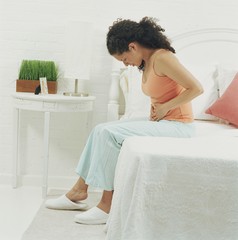
Female with stomach ache
Have you ever experienced severe diarrhea or vomiting? If you have, it’s likely you had norovirus. If you haven’t, chances are you will.
Anyone can get norovirus and you can get it more than once. It is estimated that a person will get norovirus about five times during their lifetime.
Norovirus affects about one in 15 people and contributes to 56,000 to 71,000 hospitalizations and 570 to 800 deaths in the U.S.
Norovirus spreads easily from contaminated food orsurfaces or from an infected person.  People with norovirus illness are contagious from the moment they begin feeling sick and for the first few days after they recover. Some people may be contagious for even longer.
Currently, there is not a vaccine to prevent norovirus infection or a drug to treat sick people. But, there is hope for a vaccine.
Coming together to find answers and move towards a vaccine
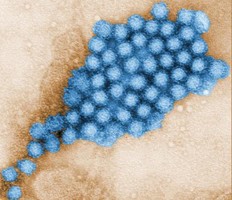
Transmission electron micrograph (TEM) image of some of the ultrastructural morphology displayed by norovirus virions, or virus particles.
In February 2015, the Bill and Melinda Gates Foundation, CDC foundation, and CDC brought together norovirus experts from around the world to discuss how to make the norovirus vaccine a reality. Participants came from 17 countries on six continents and included representatives from academia, industry, government, and private charitable foundations.
Important questions remain about norovirus:
  • How do humans develop immunity?
  • How long does immunity last?
  • Does immunity to one strain protect against infection from others?
  • How would a vaccine be used to prevent disease and protect those at highest risk?
The meeting was a step toward finding answers to these questions and making a norovirus vaccine a reality. (Photo: Microscopic view of norovirus particles)
=============
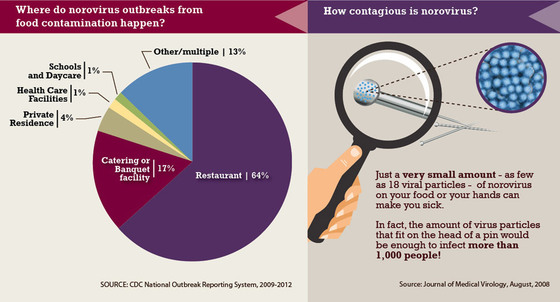
Where do norovirus outbreaks happen and how contagious is norovirus
=============
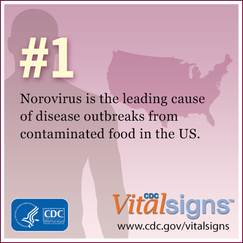
Norovirus is leading cause of disease outbreaks from contaminated food in the U.S.
Facts about norovirus
  • Leading cause of diarrhea and vomiting in the United States. Each year, norovirus causes 19 to 21 million illnesses (about one in 15 people) and contributes to 56,000 to 71,000 hospitalizations and 570 to 800 deaths in the U.S.
  • Global disease. Norovirus is also a major cause of diarrheal disease worldwide accounting for nearly 20% of all diarrheal cases. In developing countries, it is associated with approximately 50,000 to 100,000 child deaths every year.
  • Many names, same symptoms. Norovirus is the most common cause of diarrhea and vomiting (also known as gastroenteritis) and is often referred to as food poisoning or stomach flu. Norovirus is not related to the flu (influenza). Though they may share some of the same symptoms, the flu is a respiratory illness caused by influenza virus.
  • Serious for some, but not most. For most people, norovirus illness is not serious and they get better in one to three days. But it can be serious in young children, the elderly, and people with other health conditions and can lead to severe dehydration, hospitalization, and even death.  
  • Spreads quickly. Norovirus spreads quickly from person to person in enclosed places like nursing homes, daycare centers, schools, and cruise ships. It is also a major cause of outbreaks in restaurants and catered-meal settings if contaminated food is served.
=============
Protect yourself from norovirus infographic
Tips to protect against norovirus
While there is hope for a norovirus vaccine in the future, there are steps you can take now to protect yourself.
  • Practice proper hand hygiene. Wash your hands carefully with soap and water, especially after using the toilet and changing diapers and always before eating or preparing food. If soap and water aren't available, use an alcohol-based hand sanitizer. These  products can help reduce the number of germs on your hands, but they are not a substitute for washing with soap and water.
  • Take care in the kitchen. Carefully rinse fruits and vegetables and cook oysters and other shellfish thoroughly before eating.
  • Do not prepare food while infected. People with norovirus illness should not prepare food for others while they have symptoms and for at least two days after they have recovered from their illness.
  • Clean and disinfect contaminated surfaces. After throwing up or having diarrhea, immediately clean and disinfect contaminated surfaces using a bleach-based household cleaner, as directed on the product label. If no such cleaning product is available, use a solution made with five tablespoons to 1.5 cups of household bleach per one gallon of water.
  • Wash laundry thoroughly. Immediately remove and wash clothing or linens that may be contaminated with vomit or stool. Handle soiled items carefully—try not to shake them—to avoid spreading virus. If available, wear rubber or disposable gloves while handling soiled clothing or linens and wash your hands after handling. Wash soiled items with detergent at the maximum available cycle length and then machine dry.

Thursday, March 26, 2015

Health Research: BPA can adversely affect reproduction ♦ ink between genetic variation, alcohol dependence ♦ Norovirus candidate vaccine induces broad antibody responses

BPA can adversely affect reproduction of future generations of fish  Bisphenol A is a chemical that is used in water bottles, dental composites and resins used to line metal food and beverage containers. Often, rivers and streams become contaminated with BPA. Fish exposed to BPA will pass adverse reproductive effects onto their offspring Continue Reading
Patients who go home after knee replacement do as well as those discharged to rehab facility  Patients who go home after knee replacement and receive physical therapy at home do as well as those who go to an inpatient rehabilitation facility.   Continue Reading
Link between genetic variation, alcohol dependence found  A biological clue that could help explain why some drinkers develop a dependence on alcohol and others do not has been discovered. The findings help to identifying those at risk of addiction and designing better treatments to help stop drinking Continue Reading
Norovirus candidate vaccine induces broad antibody responses in trial participants  A multivalent candidate vaccine elicits broad antibody responses to a range of norovirus strains,, according to a new study.The results of the study indicate that a vaccine to norovirus may be available in the future.Continue Reading
Discovery of what attracts pregnant mosquitoes is used to fight malaria The battle against malaria is also a battle against its natural host, the mosquito, which means disrupting the insect's life cycle is every bit as important as putting nets over beds. Now, an international research team has discovered what attracts mosquitoes to lay their eggs in specific places Continue Reading

Saturday, March 14, 2015

Health News: Hidden hazards found in 'green' products ♦ Dairies illegally using antibiotics ♦ Onion extract improves high blood sugar ♦ Graphene fights cavities + more

Hidden hazards found in 'green' products  Common consumer products, including those marketed as 'green,' 'all-natural,' 'non-toxic' and 'organic' emit a range of compounds that could harm human health and air quality, researchers have found. But most of these ingredients are not disclosed to the public.Continue Reading
Dairies found illegally using antibiotics  A small number of dairy farms have been found using animal antibiotics in ways not approved by law, according to a new study by the U.S. Food and Drug Administration’s Center for Veterinary Medicine. Continue Reading
Onion extract may improve high blood sugar and cholesterol  The extract of onion bulb, Allium cepa, strongly lowered high blood glucose (sugar) and total cholesterol levels in diabetic rats when given with the antidiabetic drug metformin, according to a new study.Continue Reading
Study contaminated food causes 14%: of norovirus outbreaks  According to new work by researchers from the Netherlands, New Zealand and the U.S. Centers for Disease Control and Prevention about 14 % of all norovirus outbreaks are attributed to contaminated food. Noroviruses are one of the leading causes of gastroenteritis worldwide. Continue Reading

Graphene: A new tool for fighting cavities  Dental diseases, which are caused by the overgrowth of certain bacteria in the mouth, are among the most common health problems in the world. Now scientists have discovered that a material called graphene oxide is effective at eliminating these bacteria, some of which have developed antibiotic resistance Continue Reading

Monday, December 15, 2014

Shellfish contamination prompts closure and multi-state recall

Shellfish contamination in Mason County prompts closure and multi-state recall
At least a dozen people ill after eating raw oysters from Hammersley Inlet
Washington State health officials issued an emergency closure for harvesting and ordered a recall for all shellfish originating from a portion of Mason County’s Hammersley Inlet after several people who ate raw oysters became ill.
At least a dozen people who ate raw oysters in November became ill with symptoms often linked to norovirus, a common stomach virus that spreads easily through contaminated food or surfaces and person-to-person contact. Laboratory tests confirmed norovirus in two cases.
The Department of Health used its shellfish tracking system, which tags all commercially harvested shellfish with harvest locations and dates, to investigate the situation. Agency staff visited several shellfish harvest sites and took shellfish samples, one of which later tested positive for norovirus. During the investigation no apparent sources of contamination were identified among companies in Hammersley Inlet that harvest and ship shellfish. During a site visit of the surrounding properties, officials found a leaking septic system that may be the source of the problem. The property owner is working with the Mason County Health Department to permanently repair the failing system while a temporary fix has been put in place.
“This issue underscores the importance of protecting our water and shellfish with good sewage management, especially on properties near shellfish growing areas and their tributaries,” said Jerrod Davis, director for the Office of Shellfish and Water Protection. “Even one failing system can have serious consequences for the safety of our shellfish.”
All shellfish from the noted area are being recalled for the dates of November 10 to December 5. Shellfish included in the recall were sent to several states, including Oregon, Nevada, Florida, Minnesota, Illinois, California, New York, Maine, Georgia, Massachusetts, New Jersey and Virginia.

Thursday, October 23, 2014

10/23/14 Health News: Food Justice for Babies ♦ Norovirus outbreak in Arizona school ♦ DIETARY SUPPLEMENTS CONTAINED BANNED DRUGS AFTER FDA RECALLS

Food Justice for Babies
There’s only one day a year that’s dedicated just to food. Every October 24 is Food Day, a nationwide celebration of healthy, affordable and sustainable food. While Food Day strives to inspire us to improve our diets and our food policies, the 2014 Food Day places a special emphasis on food access and food justice.Continue Reading
Arizona school’s norovirus outbreak linked to over 100 students
I was chatting with a couple of guys at a birthday party of one of Sam’s friends this past weekend and relayed that I do food safety stuff. One dude said “I hate this time of year: between the colds, pink eye and norovirus our kids pick up at school we’ll all be sick until Thanksgiving.”  Continue Reading

DIETARY SUPPLEMENTS CONTAINED BANNED DRUGS AFTER FDA RECALLS

A new study finds that a high percentage of dietary supplements still contained banned drugs at least six months after being recalled by the U.S. Food and Drug Administration (FDA). Approximately half of all FDA class-I drug recalls since 2004 have involved dietary supplements adulterated with banned pharmaceutical ingredients. Previous studies have found that dietary... Continue Reading

Sunday, October 12, 2014

10/12/14 Health News: Yogurt Protects Against Mercury Poisoning ♦ INCREASE IN ANIMAL ANTIBIOTIC USE IN DENMARK ♦ NOROVIRUS SUSPECTED AT INDIANA SCHOOL

DENMARK SEES SMALL INCREASE IN ANIMAL ANTIBIOTIC USE
Denmark’s latest numbers on the country’s antimicrobial use and resistance are in. The total consumption of antimicrobial agents by the country’s animals in 2013 was about 128 tons — a 4-percent increase over the previous year. According to the new DANMAP (Danish Antimicrobial Resistance Monitoring and Research Program) report, the increase is mainly attributed to... Continue Reading
NOROVIRUS SUSPECTED AS NEARLY 130 CHILDREN AT INDIANA SCHOOL ARE SICKENED
About 130 children were out sick for two days this past week at a northwest Indiana elementary school, and district officials said that Norovirus was most likely to blame. “Twenty-seven percent of our population is significant, and it’s a concern,” Lake Central School Corporation Assistant Superintendent Al Gandolfi said about Peifer Elementary School in Schererville, IL.... Continue Reading
Probiotic Yogurt May Protect Against Mercury Poisoning During Pregnancy

You probably already know probiotics found in yogurt are good for your immune system. Now a new study shows that they may protect against environmental toxins including mercury when you're expecting. Continue Reading

Friday, June 13, 2014

6/13/14 Health News: TIME FOR SPROUT WARNING LABEL? ♦ Superbug Research ♦ Food Service Workers Can Prevent Norovirus ♦ Drug Diversion in Hospitals Exposes Patients to Infection

TIME FOR SPROUT WARNING LABEL?
Another sprout-related outbreak linked to Evergreen Fresh Sprouts – this time according to the CDC a total of 17 persons infected with the outbreak strain of Shiga toxin-producing Escherichia coli O121 (STEC O121) have been reported from five states.  The number of ill persons identified in each state is as follows:  Idaho (3), Michigan (1),... Continue Reading
Funding Superbug Research is Critical
Though largely preventable, C. diff. claims at least one American every 19 minutes. And someone in the U.S. contracts a C. diff. infection (CDI) every minute. In late 2013, the CDC classified CDIs as one of three most "urgent" health threats facing the nation and requiring aggressive action. Continue Reading
Restaurants, Food Service Workers Can Prevent Norovirus
Norovirus outbreaks on cruise ships may grab headlines, but contaminated food served by restaurants sickens many more people, federal officials said. The Centers for Disease Control and Prevention said that nearly one-third of the 20 million people sickened every year are poisoned by contaminated food. Waiters, cooks and other handling meals cause two-thirds of food-related outbreaks. "Norovirus outbreaks from contaminated food in restaurants are far too common." said Dr. Tom Frieden, director of the CDC.Continue Reading
Drug Diversion in Hospitals Exposes Patients to Infection

Health care workers diverting patients' pain medications for their own use have been linked to six infectious disease outbreaks over the last decade, putting thousands of patients at risk, according to a new report. The report published June 2 in Mayo Clinic Proceedings outlines infection outbreaks that have occurred in the past 10 years as a result of drug diversion -- the use of prescription drugs for unintended, illegal purposes -- committed by health care providers who stole or tampered with their patients' injectable medications.Continue Reading