Showing posts with label Drug. Show all posts

Thursday, December 24, 2015

Health News:.FDA Alert: Potential contamination of drug shipments from explosions in Tianjin City ♦ Tooth fillings of the future may incorporate bioactive glass

.FDA Alert: Potential contamination of drug shipments from explosions in Tianjin City . The U.S. Food and Drug Administration issued an alert December 22 to drug compounders and manufacturers claiming that drug shipments from Tianjin, China, may be contaminated with chemicals following two large explosions at Tianjin Dongjiang Port Ruihai International Logistics Co., chemical warehouse in August. The alert was issued after regulators detected hydrogen cyanide in two shipments of drugs from Tianjin Tianyao Pharmaceuticals Co., Ltd. which is located 18 miles from the explosion site
Tooth fillings of the future may incorporate bioactive glass A few years from now millions of people around the world might be walking around with an unusual kind of glass in their mouth, and using it every time they eat. Engineers have made some promising findings about the ability of 'bioactive' glass to help reduce the ability of bacteria to attack composite tooth fillings -- and perhaps even provide some of the minerals needed to replace those lost to tooth decay
Even in the healthcare landscape as it existed before the ACA, cancer survivors in states without expanded Medicaid were less likely to have a personal doctor and more likely to report inability to see a doctor due to cost.
By asking, ;what's the worst part of this?' physicians can ease suffering When patients suffer, doctors tend to want to fix things and if they cannot many doctors then withdraw emotionally. But by turning toward the suffering, physicians can better help their patients and find more meaning in their work, write authors of a new report

Sunday, October 11, 2015

Health News:Privatized meat inspection jeopardizes food safety ♦ Lab-grown 3D intestine regenerates gut lining in dogs ♦ Major flu drug report underway

Privatized meat inspection experiment jeopardizes food safety An analysis based on inspection documents and non-compliance reports obtained through the Freedom of Information Act reveals large numbers of defects being missed in the USDA's controversial pilot project for privatized poultry inspection. In the name of budget-cutting, more defective and unsanitary poultry contaminated
Lab-grown 3D intestine regenerates gut lining in dogs Working with gut stem cells from humans and mice, scientists have successfully grown healthy intestine atop a 3-D scaffold made of a substance used in surgical sutures
Major flu drug report underway A new landmark report reveals that antiviral drugs called NAIs (like Tamiflu) have been successful in reducing deaths in flu patients in hospital. The report also reveals that preventative use of the same drugs helps fight flu infection in the home.
Women and men react differently to infidelity A recent Norwegian study shows that men and women react differently to various types of infidelity. Whereas men are most jealous of sexual infidelity, so-called emotional infidelity is what makes women the most jealous. Evolutionary psychology provides an explanation for why this can be

Dying at home leads to more peace, less grief, but requires wider support Dying at home could be beneficial for terminally ill cancer patients and their relatives, according to research. The study shows that, according to questionnaires completed by their relatives, those who die at home experience more peace and a similar amount of pain compared to those who die in hospital, and their relatives also experience less grief. However, this requires discussion of preferences, access to a comprehensive home care package and facilitation of family caregiving.

Sunday, June 28, 2015

Drug Resistance Research: Antibiotic may be the answer to many multidrug-resistant ♦ Infectious bacterium's natural defenses ♦ Revisiting the restriction of antibiotics

Common antibiotic may be the answer to many multidrug-resistant bacterial infections The common antibiotic azithromycin kills many multidrug-resistant bacteria very effectively — when tested under conditions that closely resemble the human body and its natural antimicrobial factors.
Researchers examine infectious bacterium's natural defenses Antibiotics fight bacteria by targeting enzymes essential to the bacterium's survival, like those involved in rebuilding the bacterium's cellular wall. With many deadly bacteria able to resist antibiotics, scientists must work to design new compounds that target important functions in the bacteria to stop them from multiplying. As a spinoff from their research aimed at fighting a specific parasite, researchers may have found a way around an infectious bacterium’s natural defenses.
Re-energizing antibiotics in the war against infections In principle, antibiotics suppress infections either by killing the bacteria, which is called a bactericidal effect or by merely inhibiting their growth, by what is called a bacteriostatic effect. After the treatment has been stopped, growth-inhibited bacteria, however, can re-emerge from their dormancy to start multiplying again with latent infections relapsing back into full-blown attacks.
Antibiotic resistance, and multidrug resistance, is a major public health threat. A new study finds conditions where restricting certain antibiotics may increase the frequency of multiple drug resistance.

Thursday, May 7, 2015

Near-atomic resolution of protein structure by electron microscopy holds promise for drug discovery


  • A new study shows that it is possible to use an imaging technique called cryo-electron microscopy (cryo-EM) to view, in near-atomic detail, the architecture of a metabolic enzyme bound to a drug that blocks its activity. This advance provides a new path for solving molecular structures that may revolutionize drug development, noted the researchers.
  • The protein imaged in this study was a small bacterial enzyme called beta-galactosidase; the drug to which it was bound is an inhibitor called phenylethyl-beta-D-thiogalactopyranoside (PETG), which fits into a pocket in the enzyme. Enzymes are typically proteins that act to catalyze biochemical reactions in the cell. Understanding what an enzyme looks like, both with and without a drug bound to it, allows scientists to design new drugs that can either block that enzyme's function (if the function is responsible for a disease), or enhance its activity (if lack of activity is causing a problem).
  • The study appeared online May 7, 2015, in Science Express. Sriram Subramaniam, Ph.D., of the National Cancer Institute’s (NCI) Center for Cancer Research, led the research. NCI is part of the National Institutes of Health.
  • “This represents a new era in imaging of proteins in humans with immense implications for drug design,” said NIH Director Francis S. Collins, M.D., Ph.D. “This near-atomic level of imaging provides detailed information about the keys that unlock cellular processes.”
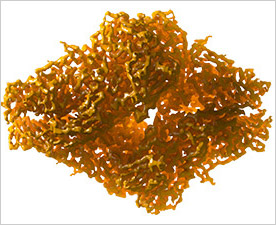
  • Image of a cryo-EM magnified structure
  • 3.2 Å resolution cryo-EM structure of β-galactosidase from 2014
  • Drug development efforts often involve mapping contacts between small molecules and their binding sites on proteins. These mappings require the highest possible resolutions so that the shape of the protein chain can be traced and the hydrogen bonds between the protein and the small molecules it interacts with can be discerned.
  • In this study, the researchers were able to visualize beta-galactosidase at a resolution of 2.2 angstroms (or Å — about a billionth of a meter in size), which is comparable to the level of detail that has thus far been obtained only by using X-ray crystallography. At these high resolutions, there is enough information in the structure to reliably assist drug design and development efforts.
  • To determine structures by cryo-EM, protein suspensions are flash-frozen at liquid nitrogen temperatures (-196°C to -210°C , or -320°F to -346°F) so the water around the protein molecules stays liquid-like. The suspensions are then imaged with electrons to obtain molecular images that are averaged together to discern a three-dimensional (3D) protein structure.
  • “The fact that cryo-EM technology allows us to image a relatively small protein at high resolution in a near-native environment, and knowing that the structure hasn’t been changed by crystallization, that’s a game-changer,” said Dr. Subramaniam.
  • In the study, using about 40,000 molecular images, the researchers were able to compute a 2.2 Å resolution map of the structure of beta-galactosidase bound to PETG. This map not only allowed the researchers to determine the positioning of PETG in the binding pocket but also enabled them to pick out individual ions and water molecules within the structure and to visualize in great detail the arrangement of the amino acids that make up the protein.
  • Illustration of a sample and cryo-EM cartridge
  • Carbon grid with frozen protein sample prepared for loading into cryo-electron microscope cartridge
  • Dr. Subramaniam and colleagues have recently used cryo-EM to understand the functioning of a variety of medically important molecular machines, such as the envelope glycoproteins on HIV and glutamate receptors found in brain cells. Their new finding, however, represents the highest resolution that they or others have achieved to date for a structure determined by cryo-EM.
  • “Cryo-EM is positioned to become an even more useful tool in structural biology and cancer drug development,” said Douglas Lowy, M.D., acting director, NCI. “Even for proteins that are not amenable to crystallization, it could enable determination of their 3D structures at high resolution.”

Thursday, February 26, 2015

2/26/15 Health News: Salmonella Outbreak Grows to 59 Cases ♦ E. coli Vaccine Effective ♦ 120 treated after meningitis death ♦ Treatment for drug-resistant tuberculosis discovered

TEXAS SALMONELLA OUTBREAK GROWS TO 59 CASES   At least 59 people have been found ill in a Salmonella outbreak connected in part to the Ten in Texas steakhouse in Dalhart, TX. One of the restaurant’s customers who was sickened, Frances Childers, is filing a lawsuit against the restaurant. Her attorneys say that she suffered from kidney failure alongside abdominal pains, nausea and muscle aches. Childers Continue Reading
STUDY: E. COLI VACCINES ARE EFFECTIVE BUT ECONOMIC INCENTIVE NEEDED Despite the proven effectiveness of vaccines designed to decrease the presence of E. coli bacteria in cattle by as much as 98 percent, beef producers are not likely to widely adopt the practice of vaccinating their herds until there is a clear economic incentive,Continue Reading
120 treated after meningitis death in Brevard jail. The Florida Department of Health in Brevard County confirmed the week of February 16 that a teenager died from meningitis at the Brevard Regional Juvenile Detention Center in Cocoa prompting health officials to treat 120 potentially exposed children and staff for the disease February 21. Continue Reading
Tissue engineering: Scientists grow leg muscle from cells in a dish  Scientists have generated mature, functional skeletal muscles in mice using a new approach for tissue engineering. The scientists grew a leg muscle starting from engineered cells cultured in a dish to produce a graft. The subsequent graft was implanted close to a normal, contracting skeletal muscle where the new muscle was nurtured and grown  Continue Reading

Potential treatment for drug-resistant tuberculosis discovered  A new small molecule drug has been discovered that may serve as a treatment against multidrug resistant tuberculosis, a form of the disease that cannot be cured with conventional therapies. While standard anti-tuberculosis drugs can cure most people of Mycobacterium tuberculosis infection, improper use of antibiotics has led to new strains of the bacterium resistant to the two most powerful medications, isoniazid and rifampicin. Continue Reading


Monday, February 2, 2015

2/2/15 Health News: Synthetic Marijuana Contaminated Holiday Bread ♦ Effect of BPA and estradiol on sperm ♦ Breast cancer ♦ Prescription painkillers, widely double birth defects

Tests Show Synthetic Drug Contaminated Holiday Bread From CA Bakery
Independent lab tests of the holiday bread sold in early January by a Santa Ana, CA, bakery and linked to reports of dizziness, palpitations and other symptoms show that it was probably deliberately contaminated with synthetic cannabinoid, Continue Reading
Effect of BPA and estradiol on sperm development seen by researchers
A direct link between bisphenol A, or BPA, and disrupted sperm production has been discovered by researchers. They say the chemical disrupts the delicate DNA interactions needed to create sperm. This work may have unearthed the physiological mechanism that could account for decreased sperm counts seen in several human studies.Continue Reading
Breast cancer prevention drug benefit varies among at-risk women, study finds
The findings of study may help women and their doctors make decisions about who may get the most benefit out of a breast cancer prevention drug Continue Reading
Prescription painkillers, widely used by childbearing age women, double birth defects  
Women unaware that prescription opioid-based medications such as codeine, oxycodone, hydrocodone, or morphine, used to treat severe pain, may increase the risk for serious birth defects of the baby's brain, spine, and heart, as well as preterm Continue Reading
New links between obesity, cardiovascular disease found
Novel methods have been applied in a recent study to detect binding of fatty acids to CD36 and their effect on internalization of oxidized LDL. Continue Reading

Monday, January 26, 2015

Gastroade Xtra (OTC Drug for Horses} Recalled

Cox Veterinary Laboratory, Inc. is voluntarily recalling the lots of Gastroade Xtra identified below down to the consumer level distributed nationwide. Gastroade Xtra was previously marketed by Cox Veterinary Laboratory as an OTC drug for use in horses, and contains Omeprazole. This recall has been initiated due to information from the FDA that Gastroade Xtra must have an approved new animal drug application to be legally marketed in the United States. Gastroade Xtra is not approved by the FDA. In addition, some lots may be sub-potent and pose a risk of continued ulceration. As a consequence, Cox Veterinary Laboratory has ceased all production and sales of Gastroade Xtra and is recalling the product.
Because the FDA has not approved Gastroade Xtra, the safety and efficacy of the product has not yet been established. To date, however, there have been no reported adverse events associated with the use of Gastroade Xtra.
Gastroade Xtra is labeled for the care of gastric ulcers in horses. Gastroade Xtra is a paste that is packaged in a 32 ml tube bearing the name Gastroade Xtra, Omeprazole 2.28g.
Aided with the information provided by the FDA, Cox Veterinary Laboratory is notifying its distributors and customers by a letter sent certified mail directly and through this press release of this voluntary recall. Cox Veterinary Laboratory will arrange for a return of all recalled product. Consumers and distributors that have unused Gastroade Xtra should stop using this product immediately and contact Cox Veterinary Laboratory to arrange for the return of the product.
Horse owners, caretakers and veterinarians should report to the FDA any adverse events, including ineffectiveness, in horses that received unapproved omeprazole products. Information on reporting adverse events for approved or unapproved animal drugs can be found at: http://www.fda.gov/animalveterinary/safetyhealth/reportaproblem/ucm055305.htm. Complaints about approved and unapproved animal drug products can be reported by calling a consumer complaint coordinator, within your FDA District Office or by filing a Veterinary Adverse Drug Reaction report.
Affected lots include Batch 0052 (UPC 091037382986) manufactured 5/29/2014.
Questions regarding this voluntary recall should be addressed to Jeanne Buffington by email at jeanne@coxvetlab.com from Monday to Friday, 10 am to 4pm, EST.
Consumers should contact their veterinary healthcare provider if they have experienced any problems that may be related to the use of this drug product.

Thursday, December 11, 2014

Scientists Pinpoint Factors Contributing to Resistance to Key Malaria Drug

photo of a Cambodian clinic
Clinic in Preah Vihear, Cambodia.
In two new studies, international research teams including NIAID scientists describe how certain genetic mutations make malaria-causing parasites resistant to artemisinin, a key drug for treating the disease. The findings are published in the Dec. 11, 2014, online issue of Science.
Plasmodium falciparum is the deadliest of the five species of malaria-causing parasites that infect people. Artemisinin, in combination with other drugs, is the first-line treatment for the disease. Over the past decade, use of artemisinin-based combination therapies has contributed to an estimated 30 percent decrease in malaria death rates worldwide.
However, the emergence and spread of artemisinin resistance in P. falciparum threatens this progress in malaria control and elimination. Researchers first detected artemisinin resistance in Cambodia, and it has now spread in Thailand, Vietnam, and Myanmar and is beginning to emerge in parts of Laos. Recently, NIAID researchers and collaborators identified a genetic marker of artemisinin resistance in P. falciparum—mutations in a gene called K13-propeller.
In the current studies, international teams including NIAID researchers from the laboratory of Rick Fairhurst, M.D., Ph.D., investigated whether K13-propeller mutations actually cause artemisinin resistance and, if so, by what mechanism.
photo of someone giving blood
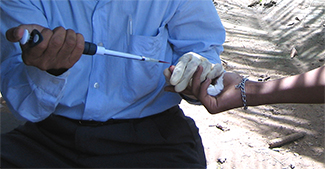
Malaria patient provides a blood sample.
In one of the studies, researchers genetically modified P. falciparumcollected from malaria patients in Cambodia, as well as reference parasites from various geographical origins. When scientists removed K13-propeller mutations, parasites were 70 to 140 times more likely to die after artemisinin exposure. When they added mutations to the K13-propeller gene, parasites were up to 70 times more likely to survive this drug exposure. Certain K13-propeller mutations conferred higher levels of survival to parasites recently collected from Cambodia than to older reference parasites, suggesting that additional genetic factors may be contributing to artemisinin resistance.
In the second study, researchers analyzed more than 1,000 P. falciparumsamples from 13 malaria-endemic regions of Southeast Asia and Africa, some with no evidence of artemisinin resistance and others where resistance is well-established. Using parasite isolates taken directly from malaria patients, they found that artemisinin resistance was associated with slower progression of blood-stage parasite development and changes in a certain cellular response that may enable the parasites to better withstand the effects of the drug.
These studies provide direct evidence that K13-propeller mutations cause artemisinin resistance and offer insights into the molecular basis of resistance. Understanding the genetic factors and mechanisms underlying drug resistance promises to aid development of new strategies to counter the threat that artemisinin resistance poses to global malaria control and elimination.
The study authors suggest a global K13 sequencing effort to track the spread of artemisinin resistance and mitigate its impact on malaria treatment and control programs.

Tuesday, July 29, 2014

Global Leaders Raise Alarm on Antibiotic Resistance

Poor diagnostic tools, inappropriate use of antibiotics and a lack of new replacement drugs are causing a global crisis of antimicrobial resistance, according to global health leaders.
"A post-antibiotic era - in which common infections and minor injuries can kill - far from being an apocalyptic fantasy, is instead a very real possibility in the 21st century," warned WHO's Assistant Director-General for Health Security Dr. Keiji Fukuda. The World Health Organization (WHO) recently issued its first-ever global report on antibiotic resistance, deeming it a serious, worldwide threat to public health.
"Unless we take significant actions to improve efforts to prevent infections and also change how we produce, prescribe and use antibiotics, the world will lose more and more of these global public health goods and the implications will be devastating," according to Fukuda.
At the NIH, experts said researchers play a critical role in the unending battle against antimicrobial resistance. In March, the National Institute of Allergy and Infectious Diseases (NIAID) published a report [PDF <1M, 15 pages] concerning the threat, laying out its strategy to refocus its research efforts to address key scientific challenges. Under the plan, NIAID will examine the comprehensive biology and genetic makeup of specific microbes to understand how bacteria become resistant and will also identify new targets for point-of-care diagnostics. In addition, it will develop vaccines to prevent infection with drug-resistant microbes and design new antibiotics, among other priorities.
"As long as antibiotics are used to kill bacteria, resistance will continue to emerge," the NIAID report noted, and as this resistance builds, scientists are in a race to 'outsmart' the bacteria by working around the mechanisms that cause resistance.
In a related commentary in the Journal of the American Medical Association (JAMA), NIAID Director Dr. Anthony S. Fauci and colleague Dr. Hilary D. Marston called antibiotic resistance "a global crisis." They urged colleagues around the world to act on many fronts at once, especially in developing countries, where "the challenges are compounded by limited capacity for surveillance and poorly regulated sales."
Global antibiotic consumption increased by an astonishing 36 percent between 2000 and 2010, according to a recent article published in The Lancet. Dr. Ramanan Laxminarayan and colleagues found much of the growth occurred in low- and middle-income countries where "antibiotics are used as a substitute for public health measures," and over-the-counter sales are unregulated.
Health authorities must promote more judicious use of antibiotics and develop new infection prevention measures, according to the NIAID report. This necessarily involves collaborations among partners from different disciplines and swiftness in identifying and acting on threats as they emerge. NIAID noted, "Because antibiotic resistance is a complex problem with many drivers, combating it requires a multifaceted approach."
Other scientists are more focused on developing tools to properly identify bacterial infections and prevent their spread in the first place. As Fauci and Marston noted, "The importance of accurate diagnostics at point-of-care in efforts to thwart antimicrobial resistance cannot be overstated." These tools can help expand surveillance and curb inappropriate antibiotic use, for instance by distinguishing between viral and bacterial causes of respiratory illnesses - the majority of which are viral but are often incorrectly treated with antibiotics.
Meanwhile, two prominent scientists in the U.K. are calling for a new world organization to fight antimicrobial resistance on a similar scale to the U.N. Intergovernmental Panel on Climate Change. In a recent editorial in Nature, Wellcome Trust Director Dr. Jeremy Farrar and University of Edinburgh's Professor Mark Woolhouse suggested the new group could marshal evidence and catalyze policy across governments and stakeholders. Antimicrobial resistance resembles climate change in that both operate on a global scale for which humans are responsible and the practices of one country affect many others, the authors observed.
"We need a new independent body that will not only monitor the spread of antimicrobial resistance, but also drive and direct efforts to contain it," said Farrar.
Some encouraging changes are already underway in the bacteria battle, Fauci and Marston noted in their recent article. Industry incentives, such as longer market exclusivity, are encouraging drug development and currently 14 novel antibacterial agents are being tested for their effectiveness in humans. Meanwhile, hospitals around the world are devising systems to prevent patients developing opportunistic infections during their stay.

The NIAID continues to fund research to add to the arsenal available to combat harmful bacteria. In one project, a potential novel class of antibiotics targeting resistant Staphylococcus aureus is now in a trial to test its safety. A new $12 million NIAID initiative aims to develop new diagnostics that can quickly detect the resistant bacteria commonly found in hospitals. Other potential tacks for stopping harmful bacteria include creating vaccines, enlisting harmless bacteria already in the microbiome to bolster the body's defenses and spurring monoclonal antibodies that attack bacterial proteins.
In the U.S., a recent assessment of antibiotic resistance by the CDC found more than two million people each year get infections that are resistant to antibiotics and at least 23,000 people die as a result. The report classified the threats posed by the antibiotic-resistant germs. Deemed most urgent were drug-resistant gonorrhea, carbapenem-resistant Enterobacteriaceae, and Clostridium difficile, a serious diarrheal infection usually associated with antibiotic use. C. difficile alone causes about 250,000 hospitalizations and at least 14,000 deaths in the U.S. every year.
"The bottom line is that we have to protect patients by protecting antibiotics," said CDC Director Dr. Tom Frieden. "The drugs we have today are endangered. And any new drugs we get could be lost just as quickly if we don't improve the way we prescribe and use them."
In its analysis of antimicrobial resistance data from 114 countries, the WHO emphasized that every part of the world is affected and a coordinated response is imperative. The study found resistance across many different types of infectious pathogens, but focused on antibiotic resistance in nine different bacteria responsible for common, serious diseases. These include bloodstream infections (sepsis), diarrhea, pneumonia, urinary tract infections and gonorrhea. It's of "high concern" that bacteria have developed some resistance to all -including last-resort - antibiotics in all regions of the world, the report said. Aside from the risk of serious illness and death, resistance also burdens health system budgets, with lengthier hospital stays and more intensive care needs.
At a recent meeting, the WHO's General Assembly, delegates urged member countries to strengthen their antimicrobial drug management systems, support research to prolong the lifespan of current antibiotics, and spur new diagnostics and treatments for microbial infections. The WHO is now preparing a draft global action plan against antimicrobial resistance to be voted on in 2015.
"This serious threat is no longer a prediction for the future," the WHO report noted. "It is happening right now in every region of the world and has the potential to affect anyone, of any age, in any country."

Thursday, March 20, 2014

U.S. Saves 15 Million With New TB Safety Regulations

Data indicate that cases and rates of TB disease continue to fall in the U.S.; however, a higher burden in some populations – such as foreign-born individuals and racial/ethnic minorities – keeps TB elimination out of reach.
Preliminary data from the CDC National TB Surveillance System show a total of 9,588 cases were reported in the U.S. in 2013, marking a 4.2 percent decline in the 2012 rate. Despite overall progress, the TB rate for foreign-born individuals is 13 times higher than among individuals born in the U.S., and the proportion of TB cases in the foreign-born group continues to increase.
Racial disparities persist. Hispanics, blacks and Asians face higher TB rates—7, 7 and 26 times higher, respectively—than whites. Persons infected with HIV and people who are homeless are also especially vulnerable to TB.
Although the proportion of drug-resistant cases remains relatively small, drug resistant TB is a concern because it is difficult and costly to treat and more often fatal. In 2012, multidrug-resistant TB accounted for 1.2 percent of cases (86 cases). Two cases of extensively-drug-resistant TB were reported in 2013. The authors note that eliminating TB in the U.S. requires continuing to address TB in affected populations and improvements in awareness, testing and treatment of TB disease.
Updated CDC recommendations for overseas tuberculosis screening of immigrants and refugees has resulted in better diagnosis of TB before individuals arrive in the United States. CDC reports the completion of implementation of new tuberculosis screening and treatment requirements for US-bound immigrants and refugees. Implementation of these requirements has resulted in twice as many cases of tuberculosis being diagnosed and treated before immigrants and refugees arrive in the U.S. compared with the previous screening program. Since the new requirements were implemented, reports of cases of foreign-born tuberculosis have declined. In addition, the increase in persons diagnosed and treated overseas is projected to result in a savings of more than $15 million in US health care costs.

Friday, January 31, 2014

12/31/14 Health News Bacteria Triggers Multiple Sclerosis - DDT Linked To Alzheimer's - Night Work 'Throws Body Into Chaos' - Drug Companies Sell You Stuff with Your Records

COMMON FOODBORNE BACTERIA MIGHT BE ‘TRIGGER’ FOR MULTIPLE SCLEROSIS Might it have been something they ate? Actor Michael J. Fox, race car driver Trevor Bayne, television personality Montel Williams, and Ann Romney are but a few of the celebrities among 400,000 Americans who were struck with multiple sclerosis in the prime of life. Most when diagnosed are 20 to 50 years old. Until now,... Continue Reading
DDT: Pesticide linked to Alzheimer's Exposure to a once widely used pesticide, DDT, may increase the chances of developing Alzheimer's disease, suggest US researchers. A study, showed patients with Alzheimer's had four times the levels of DDT lingering in the body than healthy people.Some countries still use the pesticide to control malaria. Continue Reading
Night Work 'Throws Body Into Chaos' Doing the night shift throws the body "into chaos" and could cause long-term damage, warn researchers. Shift work has been linked to higher rates of type 2 diabetes, heart attacks and cancer. Now scientists at the Sleep Research Centre in Surrey have uncovered the disruption shift work causes at the deepest molecular level. Experts said the scale, speed and severity of damage caused by being awake at night was a surprise..Continue Reading

Are Drug Companies Using Your Health Records to Sell You Stuff? New regulations in the Affordable Care Act restrict access to doctors by pharmaceutical companies. As a result, drug companies are finding their way behind the medical industry's closed doors via digital record-keeping systems. The problem is that consumers don't want health information used to sell them medical services. They also don't want their doctors' medical judgment to be compromised by the financial clout of the pharmaceutical industry. When doctors at the Heart of Wellness clinic in Olympia, Washington, log on to their network to update patient data, they see advertising. Sometimes it's just house ads from Practice Fusion, the software company that operates their system, and sometimes it's full-color ads for Continue Reading

Tuesday, December 3, 2013

12/3/13 Health News: Drug Resistance Law Proposed, Herbal Supplements Contain No Herbs, India Running Out of Water


India's Running Out of Water For Agriculture
India is now the world's third-largest grain producer after China and the United States. The adoption of higher-yielding crop varieties and the spread of irrigation have led to this remarkable tripling of output since the early 1960s. Unfortunately, a growing share of the water that irrigates three-fifths of India's grain harvest is coming from wells that are starting to go dry. This sets the stage for a major disruption in food supplies for India's growing population continue reading

Herbal Supplements Are Often Not What They Seem
Not-So-Herbal Supplements: A study using DNA testing offers perhaps the most credible evidence to date of adulteration, contamination and mislabeling in the herbal supplement industry.
Americans spend an estimated $5 billion a year on unproven herbal supplements that promise everything from fighting off colds to curbing hot flashes and boosting memory. But now there is a new reason for supplement buyers to beware: DNA tests show that many pills labeled as healing herbs are little more than powdered rice and weeds.continue reading


About 80 percent of all antibiotics distributed in the U.S. are for food animals. They're commonly used to promote growth and to prevent, control and treat disease. Overuse can promote the prevalence of antibiotic-resistant bacteria in the food supply and ultimately cause resistant infections in humans. In September, the U.S. Centers for Disease Control and Prevention released a report noting that, although the majority of drug-resistant infections.continue reading


Friday, October 18, 2013

Italy: Drug Resistance Bacteria Found in 84% of Chicken.

A survey conducted by Altroconsumo on the presence of antibiotic-resistant bacteria in poultry, found antibiotic resistance E Coli in 84% of samples tested. This is over Twice the antibiotic resistance found in Sweden which has a 40% rate.  
Antibiotic resistance is a serious and widespread problem, because it threatens to render ineffective important therapies against bacterial infections. It also affects the food chain, since antibiotics used by farms also spread into the environment. Thus was born the idea of making a European test to clarify the real extent of the phenomenon. They analyzed 250 samples of chicken breasts.. With the result that caused a sensation: 84% of 45 samples bought in Italy, in Milan and Rome, were found E Coli with bacteria resistant to antibiotics.

There is therefore no immediate danger, as long as the meat is well cooked and consumed ensure compliance with the normal rules of hygiene: wash your hands when handling raw meat, carefully wash cutlery and utensils used for meat and keep separate foods in the refrigerator raw and cooked.The problem is that these bacteria can pass on their mechanism of resistance to other bacteria in our bodies, "That antibiotic resistance is a serious and widespread problem: in animal husbandry is used about 50% of all antibiotics sold,in Italy for the rest of the problem is caused by the indiscriminate use of antibiotics in human medicine.

As we found out in the United States, with 278 people sick from drug resistant E Coli, everyone does not follow the correct sanitary practices. Because drug resistant bacteria is harder to cure it means longer time in the hospital  with more extensive medical care.

Drug resistance is spreading to the beneficial bacteria in our gut. The beneficial bacteria can spread the resistance to harmful bacteria making the problem worse.