Showing posts with label foodborne. Show all posts

Tuesday, June 9, 2015

Antibiotic Resistance in Foodborne Germs is an Ongoing Threat

The news about trends in antibiotic resistance in foodborne germs is mixed. According to human illness data posted online today by CDC, the ongoing public health threat of antibiotic resistance in foodborne germs continued to show both positive and challenging trends in 2013. The National Antimicrobial Resistance Monitoring System (NARMS) tracks changes in the antibiotic resistance of six types of common foodborne germs found in sick people, retail meats, and food animals.
The good news from the 2013 NARMS Annual Human Isolates Report is that multidrug resistance (resistance to three or more classes of antibiotics) in Salmonella has not increased, remaining at 10% of infections. However, resistance in some types of Salmonella is increasing. For example, multidrug resistance in a common Salmonella serotype called I4,[5],12:i:- was 46%, more than double the rate from two years before.Campylobacter, another germ that is transmitted by food, showed one in four samples from sick people are still resistant to quinolones like ciprofloxacin.

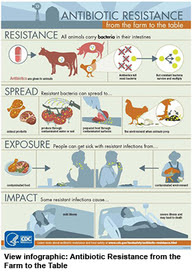
Antibiotic resistance--from farm to table

Most Salmonella and Campylobacter infections cause diarrheal illness that resolves within a week without antibiotics. However, these germs can also cause infection of the bloodstream and other sites. When germs are resistant, antibiotics may be ineffective, increasing the chance of a severe illness.
NARMS is a collaboration among state and local public health departments, CDC, the U.S. Food and Drug Administration (FDA), and the U.S. Department of Agriculture (USDA). NARMS helps protect public health by providing information about bacterial resistance, the ways in which resistance is spread, and how resistant infections differ from susceptible infections. Understanding frequency and trends in antibiotic resistance helps doctors to prescribe effective treatment and public health officials to investigate outbreaks faster.
The FY 2016 President’s Budget requests additional funding for CDC to improve early detection and tracking of drug-resistant Salmonella and other urgent antibiotic resistance threats.  The proposed initiative would allow CDC to check nearly every Salmonella sample and many more Campylobacter samples for resistance more quickly.

Thursday, May 14, 2015

CDC data show progress in reducing some foodborne infections

While some diseases decreased, overall infections from foodborne illness remain the same
In 2014, rates of infection from a serious form of E. coli and one of the more common Salmonella serotypes decreased compared with the baseline period of 2006-2008. Meanwhile, some other less common types of Salmonella increased. Campylobacter and Vibrio rose again in 2014, continuing the increase observed during the past few years, according to data published today by the Centers for Disease Control and Prevention. Today’s report summarizes the rates of infection per 100,000 population and tracks illness trends for key foodborne illnesses.
Infection with Shiga-toxin producing E. coli O157, which can sometimes lead to kidney failure, decreased 32 percent when compared with 2006-2008 and 19 percent when compared with the most recent three years. These infections are often linked to consumption of undercooked ground beef and raw leafy vegetables. Salmonella Typhimurium, which has been linked to poultry, beef, and other foods, was 27 percent lower than it was in 2006-2008, continuing a downward trend begun in the mid-1980s. Two other less common types of Salmonella, Javiana and Infantis, more than doubled for reasons that are unclear. Salmonella Javiana is concentrated in the southeastern United States, but has been spreading within the Southeast and to other areas of the country. However, when all Salmonella serotypes are combined, there was no change in 2014. Campylobacter increased 13 percent and Vibrio increased 52 percent compared with 2006-2008. Yersinia has declined enough to meet the Healthy People 2020 goal.
The data are from FoodNet, CDC’s active surveillance system that tracks nine common foodborne pathogens in 10 states and monitors trends in foodborne illness in about 15 percent of the U.S. population. Today’s report compares the 2014 frequency of infection with the frequency in the baseline period 2006-2008 and in the three most recent years. Overall in 2014, FoodNet logged just over 19,000 infections, about 4,400 hospitalizations, and 71 deaths from the nine foodborne germs it tracks. Salmonella and Campylobacter were by far the most common– accounting for about 14,000 of the 19,000 infections reported.
“We’re cautiously optimistic that changes in food safety practice are having an impact in decreasing E.coli and we know that without all the food safety work to fight Salmonella that more people would be getting sick with Salmonella than we are seeing now,,” said Robert Tauxe, M.D., deputy director of CDC’s Division of Foodborne Waterborne and Environmental Diseases. “The increasing use of whole genome sequencing to track foodborne illness cases will also help; however, much more needs to be done to protect people from foodborne illness.”  
The recent decline in the incidence of Shiga toxin-producing E. coli (STEC) O157 follows several years of increasing scrutiny for beef products. Since 1994, the Food Safety and Inspection Service of the U.S. Department of Agriculture has taken STEC O157:H7 extremely seriously and made a number of changes in its regulatory oversight of the beef industry to protect public health.
"We are encouraged by the reduction of STEC O157:H7 illnesses, which reflects our science-based approach to beef inspection, and we look forward to seeing further reductions in Salmonella and Campylobacter infections as our improved standards for poultry take effect later this year, " said Al Almanza, Deputy Under Secretary for Food Safety at USDA. "Data sources like FoodNet allow us to be strategic in developing our food safety policies, and we will do everything within our power to keep reducing cases of foodborne illness from all meat and poultry products."
Under the provisions of the FDA Food Safety Modernization Act, the U.S. Food and Drug Administration is planning to publish major new regulations in 2015. The regulations are geared toward ensuring produce safety, implementing preventive controls on processed foods, and improving the safety of imported foods.
“Prevention of illness is the fundamental goal of our new rules under the FDA Food Safety Modernization Act,” said Michael Taylor, deputy commissioner for Foods and Veterinary Medicine at FDA.  “We have worked with a wide range of stakeholders to devise rules that will be effective for food safety and practical for the many diverse elements of our food system. Once the rules are fully implemented, FoodNet will help us evaluate their impact.”
The FoodNet report also includes results of culture-independent diagnostic tests (a new method for diagnosing intestinal illnesses without needing to grow the bacteria) done in the many hospital laboratories in the FoodNet sites. In 2014, the results of more than 1,500 such tests were reported. More than two-thirds of the tests were for Campylobacter. Other tests performed were for STEC, Salmonella, Shigella and Vibrio. Some of the tests had a positive result. However, the infections were not confirmed by culture, and so CDC experts did not include them in the overall FoodNet results for 2014.
For more information on avoiding illnesses from food, please visit www.foodsafety.gov

Thursday, July 10, 2014

7/10/14 Health News: HAZARDOUS CHEMICALS USED IN FOOD PACKAGING ♦ IMPACT OF FOODBORNE PARASITES ♦ WASHINGTON STATE SUBJECTS POT TO MICROBIOLOGICAL TESTS

UN REPORT RANKS GLOBAL HEALTH IMPACT OF FOODBORNE PARASITES
When it comes to food safety concerns, foodborne parasites might not receive as much attention in the U.S. compared to bacteria such as E. coli and Salmonella. Globally, however, foodborne parasites affect the health of millions of people annually, causing debilitating and potentially deadly conditions and sometimes living within humans for years. A new report... Continue Reading
STUDY: 175 HAZARDOUS CHEMICALS USED IN FOOD CONTACT PACKAGING
According to a new study by the Food Packaging Forum, 175 chemicals with known hazardous properties are legally used in the production of food contact packaging in Europe and the U.S. Food packaging and other materials coming in contact with food (e.g. foils, cans, pans, storage containers) continuously release mixtures of synthetic substances into food... Continue Reading
WASHINGTON STATE SUBJECTS POT TO MICROBIOLOGICAL TESTS ON DAY ONE
After just one day of recreational marijuana sales in Washington state, and more than six months in Colorado, the questions that remain are mostly about those pot-infused food products. And, when it comes to food safety, Washington state is off to a safer start than Colorado. Only in those two states now can anyone age... Continue Reading

Albertsons to Pay $3.4 Million to Settle Illegal Disposal of Hazardous Waste

The Albertsons company was ordered Tuesday to pay more than $3 million to settle a lawsuit accusing the grocery chain of illegal disposal, transportation, storage and mismanagement of hazardous waste at its 188 California locations. Continue Reading

Wednesday, June 4, 2014

Norovirus is the number one Food Borne Disease

Preventing norovirus infections, food service has a key role
About 20 million people get sick from norovirus each year, most from close contact with infected people or by eating contaminated food. Norovirus is the leading cause of disease outbreaks from contaminated food in the US. Infected food workers cause about 70% of reported norovirus outbreaks from contaminated food.
Norovirus often gets attention for outbreaks on cruise ships, but those account for only about 1% of all reported norovirus outbreaks. Norovirus is very contagious, and outbreaks can occur anywhere people gather or food is served. People with norovirus usually vomit and have diarrhea. Some may need to be hospitalized and can even die. Infected people can spread norovirus to others through close contact or by contaminating food and surfaces. Food service workers who have norovirus can contaminate food and make many people sick. In norovirus outbreaks for which investigators reported the source of contamination, 70% are caused by infected food workers.
The food service industry can help prevent norovirus outbreaks by:
  • Making sure that food service workers practice proper hand washing and avoid touching ready-to- eat foods, such as raw fruits and vegetables, with their bare hands before serving them.
  • Certifying kitchen managers and training food service workers in food safety practices.
  • Requiring sick food workers to stay home, and considering use of paid sick leave and on-call staffing, to support compliance.

Many Ships are trying to protect their passengers by using hand sanitizer. This is ineffective on norovirus It should be killed by washing with soap and water.  

Friday, January 31, 2014

12/31/14 Health News Bacteria Triggers Multiple Sclerosis - DDT Linked To Alzheimer's - Night Work 'Throws Body Into Chaos' - Drug Companies Sell You Stuff with Your Records

COMMON FOODBORNE BACTERIA MIGHT BE ‘TRIGGER’ FOR MULTIPLE SCLEROSIS Might it have been something they ate? Actor Michael J. Fox, race car driver Trevor Bayne, television personality Montel Williams, and Ann Romney are but a few of the celebrities among 400,000 Americans who were struck with multiple sclerosis in the prime of life. Most when diagnosed are 20 to 50 years old. Until now,... Continue Reading
DDT: Pesticide linked to Alzheimer's Exposure to a once widely used pesticide, DDT, may increase the chances of developing Alzheimer's disease, suggest US researchers. A study, showed patients with Alzheimer's had four times the levels of DDT lingering in the body than healthy people.Some countries still use the pesticide to control malaria. Continue Reading
Night Work 'Throws Body Into Chaos' Doing the night shift throws the body "into chaos" and could cause long-term damage, warn researchers. Shift work has been linked to higher rates of type 2 diabetes, heart attacks and cancer. Now scientists at the Sleep Research Centre in Surrey have uncovered the disruption shift work causes at the deepest molecular level. Experts said the scale, speed and severity of damage caused by being awake at night was a surprise..Continue Reading

Are Drug Companies Using Your Health Records to Sell You Stuff? New regulations in the Affordable Care Act restrict access to doctors by pharmaceutical companies. As a result, drug companies are finding their way behind the medical industry's closed doors via digital record-keeping systems. The problem is that consumers don't want health information used to sell them medical services. They also don't want their doctors' medical judgment to be compromised by the financial clout of the pharmaceutical industry. When doctors at the Heart of Wellness clinic in Olympia, Washington, log on to their network to update patient data, they see advertising. Sometimes it's just house ads from Practice Fusion, the software company that operates their system, and sometimes it's full-color ads for Continue Reading

Saturday, January 4, 2014

1/4/2014 Health News: Study of 5-Hour Energy Ingredient, Foodborne Illness, Doctor Facing 9 Possible Murder Charges

OREGON DEMANDS DOCUMENTS ON 5-HOUR ENERGY INGREDIENTS
The Oregon Department of Justice is demanding that the makers of 5-Hour Energy hand over data supporting its advertising claims that the drink is doctor-recommended and that consumers won’t “crash” when its effects wear off. According to The Oregonian, the state is part of a 33-state investigation into the accuracy of the caffeinated drinks marketing... Continue Reading

HOW TO BREAK A FOODBORNE ILLNESS STORY
Daily, weekly, monthly and yearly, people get sick from eating food. The Centers for Disease Control and Prevention (CDC) estimates that at least 48 million of us get sick each year, with 125,000 hospitalizations and 3,000 deaths. Many of those sickened are the “canaries in the coal mine” – people who are the first to... Continue Reading

Oklahoma Agents Seize Doctor’s Records After Deaths
OKLAHOMA CITY — Narcotics investigators have seized medical records from the office of a former Oklahoma City-based doctor who faces possible murder charges after eight patients died of prescription drug overdoses and another allegedly caused a fatal traffic accident.continue reading

Saturday, August 24, 2013

United States; Three thousand Killed by Foodborne Disease Each Year

Food sickens 48 million, hospitalizes 125,000 and kills 3,000 of us yearly in the United States.
We have the science to do a much better job. We need safer food for our children. For a solution to this problem check out this article.

The following foods accounted for 88.5% of all the produce-associated outbreaks between 1996 and 2010. The CDC defines an outbreak as two or more people experiencing a similar illness after eating the same food.
34 outbreaks associated with sprouts (bean, alfalfa).
30 outbreaks associated with leafy greens such as lettuce and spinach.
17 outbreaks associated with tomatoes.
14 outbreaks associated with melons such as cantaloupe and honeydew.
10 outbreaks associated with berries, such as raspberries, blueberries, blackberries, and strawberries.
6 outbreaks associated with fresh herbs such as basil and parsley.
3 outbreaks associated with green onions.
This is just fresh produce it doesn’t include meats or foods that have been processed.

Wednesday, July 10, 2013

Faster Way to Check Foods for Pathogens

Instantlab has developed a system that checks for pathogens cheaper and faster than using traditional labs. So far it can check for Listeria, Salmonella and E coli. The are working on adding other pathogens such as Vibrio, a genus of bacteria that can be found in seafood. The system is called Hunter and is small so it can be used on sight. This way they don’t have to send the samples to a lab to test them. It not only can check foods but can check for pathogens on surfaces in the food processing center.

It can get results on listeria within 24 hours significantly faster than traditional methods of pathogen testing, The bacterial genus Listeria is an increasingly prevalent and dangerous global food pathogen, and can be found in foods as diverse as dairy, produce, meat, and poultry products. Contamination by Listeria can happen at any point in the food processing chain, making it important to test final food products as well as the environment including surfaces and machinery along the entire food processing
line.

It can also detect Salmonella in 10 hours. Salmonella bacteria are incredibly resilient and the cause of salmonellosis, the most frequently reported source of foodborne illness with symptoms including diarrhea, fever, abdominal cramps, and sometimes vomiting. Salmonellosis can also result in a wide range of secondary illnesses, including typhoid fever and septic (blood-borne) illness, as well as long-lasting complications for those with compromised immune systems.
According to the Centers for Disease Control and Prevention, Salmonella is responsible for an estimated 1.2 million cases of salmonellosis annually in the United States, and results in $365 million in direct medical costs each year. Its victims are most likely to be five years of age or younger, and food poisoning cases caused by Salmonella have increased by 10 percent in recent years. A diverse range of foods, including raw chicken, eggs, sprouts, produce, ground turkey, and peanut butter have been implicated in Salmonella-related foodborne illnesses. Due to the nature of the pathogen (many different strains and a presence in a number of different foods, sometimes at very low levels), rapid Salmonella detection can present challenges for traditional test.
The big advantage in using the Hunter system is that it is easier to tell all seven forms of E coli that are harmful to humans. It can tell the difference between harmful E coli and the E coli that doesn't harm people’
Escherichia coli, or E. coli, is commonly found in the lower intestine of warm blooded organisms.  Although most strains of E. coli are innocuous – and often even beneficial – to daily human life, some strains (such as O157:H7) are highly pathogenic to humans. This toxicity is particularly acute for the elderly, the young, and those with compromised immune systems. Infection with these pathogenic strains can result in hemorrhagic diarrhea and even kidney failure. Although only some strains of E. coli are considered dangerous, they can be found in diverse food items such as grains, eggs, produce, poultry, fruits, dairy, and meats.
The most important thing about the Hunter system is its speed. The faster pathogens are found the fewer people get sick.