Friday, September 5, 2014

New Recommendation on Diabetes Prevention and Control


The Community Preventive Services Task Force recommends lifestyle change programs like those offered through the National Diabetes Prevention Program as an effective way to prevent or delay type 2 diabetes. Additionally, the task force notes that combined diet and physical activity programs are cost-effective.  
The Community Preventive Services Task Force recommends combined diet and physical activity promotion programs for people at increased risk of type 2 diabetes based on strong evidence of effectiveness in reducing new cases of diabetes.  
Combined diet and physical activity promotion programs also increase the likelihood of returning to normal blood sugar and reducing diabetes and cardiovascular disease risk factors, including overweight, high blood glucose, high blood pressure, as well as abnormal lipid levels.  
The findings from the task force’s review show that combined diet and physical activity promotion programs to prevent type 2 diabetes among people at increased risk are cost-effective.  
Based on the evidence, combined diet and physical activity promotion programs are effective across a range of counseling settings. Programs commonly include specific weight loss, diet and physical activity goals, individual and/or group sessions, and individually tailored diet and exercise plans. Higher intensity programs (with more sessions or longer program length) lead to greater effects.  
The recommendation is based on reviews of all available studies, conducted on behalf of the Task Force by a team of specialists.  
What can the National Diabetes Prevention Program Do for You – or for Someone You Care About?
The lifestyle change programs offered through the National Diabetes Prevention Program, led by CDC, can help participants adopt the healthy habits needed to prevent type 2 diabetes.  
Research shows that modest weight loss and regular physical activity can help prevent or delay type 2 diabetes by up to 58% in people with prediabetes. Modest weight loss means 5% to 7% of body weight, which is 10 to 14 pounds for a 200-pound person. Getting at least 150 minutes each week of physical activity, such as brisk walking, also is important.  
The National Diabetes Prevention Program teaches participants strategies for including physical activity into daily life and eating healthy. Lifestyle coaches work with participants to identify emotions and situations that can spoil their success, and the group process encourages participants to share strategies for dealing with challenging situations. Find a program in your community.  
A structured lifestyle change program is critical to reducing type 2 diabetes among people at high risk. Increasing the availability of healthy food choices and opportunities for physical activity also can make it easier for everyone to make healthier choices.  They’re both important.   

Italian Meatless Pasta Sauce Recalled

Tullia’s is recalling Italian Meatless Pasta Sauce code 530140. This recall has been initiated because a records review by the Washington State Department of Agriculture revealed that one batch of sauce produced with the 530140 code had a pH level high enough to allow the growth of Clostridium botulinum. If present, this organism can cause botulism, a serious and potentially fatal foodborne illness.
Foodborne botulism is a severe type of food poisoning caused by the ingestion of foods containing the potent neurotoxin formed during growth of the organism. Foodborne botulism can cause the following symptoms: general weakness, dizziness, double-vision and trouble with speaking or swallowing. Difficulty in breathing, weakness of other muscles, abdominal distension and constipation may also be common symptoms. People experiencing these problems should seek immediate medical attention. Consumers are warned not to use the product even if it does not look or smell spoiled
Recalled sauce is packaged in 16 OZ. and 32 OZ. clear glass bottles with white caps. The code can be found on the label and is in blue ink. The only code of Tullia’s Italian Meatless Pasta Sauce recalled is 530140.
The recalled sauce was sold in the following markets in the Spokane area: Rosauer’s; Yoke’s; Egger’s (West Rosewood); Trading Company Stores (Spokane); Main Market; and Albertson’s (Wandermere Mall).
Tullia’s has made the decision to recall this product to ensure the safety of their customers. Consumers who have purchased recalled sauce are urged to return it to the place of purchase for a refund or replacement. Consumers with questions may contact the company at 509-879-0325 during the hours of 3PM to 5PM PST.
Label, Tullia’s Italian Meatless Pasta Sauce, 32 oz.

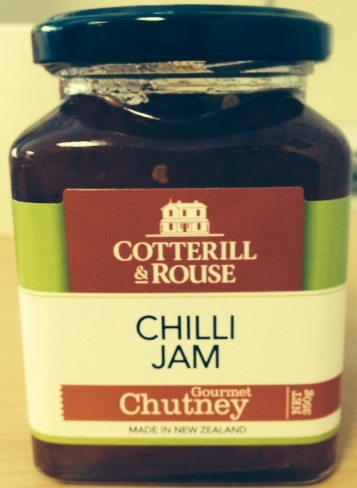
New Zealand: Cotterill & Rouse Chilli Jam 350g Recalled

Wilson Consumer Products Is recalling Cotterill & Rouse Chilli Jam in a 350g glass container with a ‘best before’ date of 17.11.15-1.  The best before date is located above the nutrition information panel on the product label  and includes the product batch number (-1) The Product is being recalled due to the risk of glass contamination.
This Product is sold in supermarket and food outlets throughout  New Zealand
Consumers are advised to check for the batch number.The affected product should not be consumed. Food Products containing glass can cause injury. If you have consumed this product and have health concerns please contact your doctor for health advice.
Customers may return this product to their retailer for a full refund or call (09) 379-5350 or 0800 867 776 with any queries.
The recall does not affect any other Cotterill & Rouse Products.
Wilson consumer Products Limited
26-28 hobson Street
Auckland Central
Auckland
picture of recalled product

Ireland: Easy Cook Rice Recalled Due to Insect Contamination

Ireland: Easy Cook Rice  Recalled Due to Rice Weevils Contamination

Product:
Dunnes Stores ‘my family favourites’ Easy Cook Rice, pack size: 1 kg.
Batch Code:
14 122; best before: 02/05/2016
Country Of Origin:
Netherlands
Message:

Dunnes Stores is recalling one batch of its ‘my family favourites’ Easy Cook Rice, due to the presence of rice weevils in a limited number of packs. Dunnes Stores advises that customers who have purchased the implicated rice can return the product to their local store.

FDA Explores New Uses for MRI Scans


Some say a picture is worth a thousand words, but when that picture is used to study a brain, its worth is immeasurable.
Creating such images is the task of Sergei Liachenko, M.D., Ph.D., director of the bio-imaging program at the Food and Drug Administration’s National Center for Toxicological Research. Working in a small lab on the NCTR campus south of Little Rock, Ark., Liachenko and his team, in collaboration with the Center for Drug Evaluation and Research, are studying the effects of various chemicals on a live rat’s brain. Their goal is to prove that studying a live animal with a research-grade magnetic resonance imaging device can be at least as accurate, if not more so, as studies performed under current research procedures.
“We are trying to demonstrate that imaging can be used for testing physical damage to the brain, known as neurotoxicity,” Liachenko says, “and when it comes to studying neurotoxicity, the more detailed a picture we can take, the better.”
That’s where MRI comes in. It provides a three-dimensional and very sophisticated view of the brain.
How Does MRI Work and What are Its Benefits?
MRI machines use very powerful magnets to bring the water in the body’s cells to a “resonant” state. The machine then sends a resonating radio frequency, which travels through the body and is reflected back. The machine uses the information from this reflection to form a three-dimensional image of the area being scanned. MRI is widely used in hospitals to help identify diseases.
Currently, most scientists look for the damaged brain tissue by sampling multiple pathology slices of the brain of a deceased animal. But Liachenko and his CDER colleague Joseph Hanig are concerned this method could miss some damage because the entire brain is not tested. By contrast, MRI can picture the whole brain in contiguous slices, allowing every part to be examined for changes or damage.
“This assessment allows the entire brain to be scanned and produced in a 3-D representation, so we can view the tissues in different projections, and we don’t need to worry about missing potential damage because it’s in an area that was not examined,” says Liachenko.
Another benefit to using an MRI device is the ability to test a single rodent efficiently, repeatedly and safely. “It’s just a magnetic field, and we’re using what’s considered the safest imaging modality. That’s why we can put the same animal in the machine many times,” Liachenko says.
Studying the same animal over a long period of time, Hanig adds, “gives us more data that’s arguably more accurate than data from multiple subjects.” In addition, these MRI assessments are similar to those made in humans and therefore they could be connected with clinical research.
Yet another important advantage of using the MRI is that the imaging takes hours to complete and analyze, while conventional histological analysis procedures take weeks. This change in time frame, along with fewer subjects being used, could make imaging a more cost effective option.
Imaging at FDA
MRI is used all over the globe to investigate live animals, but what is unique to NCTR, in collaboration with CDER, is its study to develop MRI biomarkers of neurotoxicity. By using a set of compounds that cause known damage to the brain, the researchers can check the efficiency of the MRI scans compared to the conventional methods by making sure the MRI machine finds the same problems, and perhaps even more.
“Should the biomarkers prove to be reliable and the qualification is met, it will send a huge message to the pharmaceutical community that this method is good for assessing for potential brain damage,” Liachenko says. “In our view, this MRI research will create the opportunity to provide much safer drugs to people, and that’s the reason for our work.”

Thursday, September 4, 2014

Canada: Raw Pork Recalled

V&T Meat and Food, Calgary, Alberta and Hiep Thanh Trading, Edmonton, Alberta, are recalling certain raw pork products from the marketplace due to possible E. coli O157:H7 contamination. Consumers, food service establishments, retailers, distributors and manufacturers in Alberta, should not consume, serve, use, or sell certain raw pork products sold by these two retailers/distributors because the raw pork products may be contaminated with E. coli O157:H7.
All raw pork products sold from these locations, during the identified time periods, are affected by this recall.
Company name
Address
City
Affected Selling Dates
V&T Meat and Food
3012-17 Avenue SE, #6
Calgary, AB
Between July 14, 2014 and
September 2, 2014, inclusively
Hiep Thanh Trading
10718-98 Street NW
Edmonton, AB
Between July 10, 2014 and
September 3, 2014, inclusively
These raw pork products may have been sold by other retailers. Consumers who are unsure if they have the affected products are advised to check with their retailer.
What you should do
Check to see if you have recalled products in your home. Recalled products should be thrown out or returned to the store where they were purchased.
Food contaminated with E. coli O157:H7 may not look or smell spoiled but can still make you sick. Symptoms can include nausea, vomiting, mild to severe abdominal cramps and watery to bloody diarrhea. In severe cases of illness, some people may have seizures or strokes, need blood transfusions and kidney dialysis or live with permanent kidney damage. In severe cases of illness, people may die.

Basil Pesto Pasta Recalled Due to Listeria

Tjs Place of Kirkland Washington is voluntarily recalling approx. 20 containers of Basil Pesto Pasta packed in 8 oz plastic tubs because it has the potential to be contaminated with Listeria monocytogenes, an organism which can cause serious and sometimes fatal infections in young children, frail or elderly people, and others with weakened immune systems. Although healthy individuals may suffer only short-term symptoms such as high fever, severe headache, stiffness, nausea, abdominal pain and diarrhea, listeria infection can cause miscarriages and stillbirths among pregnant women.
The recalled Basil Pesto Pasta was sold between the dates 8/18/14 and 8/21/14. The Basil Pesto Pasta affected by this recall has a sticker on the side of the container with either of the following codes: 0825, 0826, 0827, 0828
Basil Pesto Pasta was distributed in convenience stores, pharmacies, cafes and espresso stands located in King and Snohomish counties in Washington State.
The potential for contamination was discovered after routine testing by the Washington State Department of Agriculture (WSDA) revealed the presence of Listeria monocytogenes in a container of the Basil Pesto Pasta.
Tjs Place has suspended production and distribution of the product while WSDA and the company continue to investigate the source of the problem.
Consumers who have purchased the recalled product are urged not to eat it and to dispose of it or return it to the place of purchase for a full refund. Consumers with questions may contact the company at 425-444-3700 between the hours of 2pm and 4pm.
Label, 8 oz. Basil Pesto Pasta