Showing posts with label Clostridium. Show all posts

Wednesday, December 9, 2015

Northern Ireland: Crayfish Soup recalled due to possible Clostridium contamination

Lidl is recalling all batches and ‘best before’ dates of its 'Deluxe' Crayfish Soup with Saffron from stores in Northern Ireland as a precautionary measure because of the possible presence of Clostridium species. The safety of the product cannot be demonstrated.
Product details
Product: 'Deluxe' Crayfish Soup with Saffron
Pack size: 570 ml
'Best before' dates: All dates
Batch no: All batches
No other Lidl products are known to be affected.
If you have bought above product, do not eat it. Instead, return it to the store where it was bought for a full refund.

Sunday, July 19, 2015

Canada: Smoked fish recalled due to possible Clostridium botulinum.

The Canadian Food Inspection Agency (CFIA) is warning the public not to consume the products described below because they may permit the growth of Clostridium botulinum.
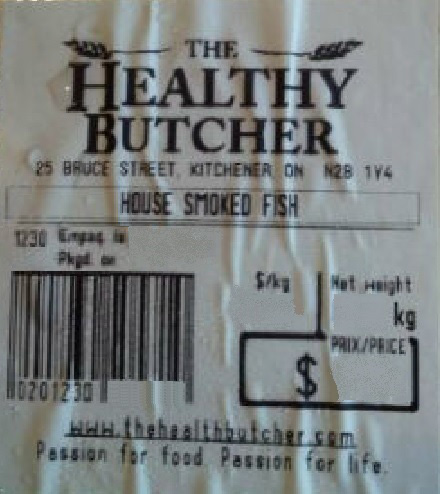
The affected products were sold in variable weight packages, with or without a label, at The Healthy Butcher retail locations in Ontario.
Products
Brand Name
Common Name
Code(s) on Product
UPC
The Healthy Butcher
Smoked Kolapore Rainbow Trout
Pkgd. on dates up to and including 2015.JL.16
Starting with 0202159
The Healthy Butcher
House Smoked Fish
Pkgd. on dates up to and including 2015.JL.16
Starting with 0201230
What you should do
Check to see if you have the products in your home. If the products are in your home, do not consume them.
Food contaminated with Clostridium botulinum toxin may not look or smell spoiled but can still make you sick. Symptoms can include nausea, vomiting, fatigue, dizziness, blurred or double vision, dry mouth, respiratory failure and paralysis. In severe cases of illness, people may die.
  • Smoked Kolapore Rainbow Trout - Variable
  • House Smoked Fish - Variable

Thursday, July 16, 2015

Pickles ,chili sauce and BBQ sauces recaled

Homemade of Leavenworth, Washington is recalling pickle and sauce products because they may have been improperly produced. Washington State Department of Agriculture routine sampling discovered that a bottle of Homemade Bread and Butter Pickles had a pH level high enough to allow the growth of Clostridium botulinum. Required records were not available to support that safe processing guidelines were followed on all sauce and pickle products produced at Homemade.
Food borne botulism is a severe type of food poisoning caused by the ingestion of foods containing the potent neurotoxin formed during growth of the organism. Food borne botulism can cause the following symptoms: general weakness, dizziness, double-vision and trouble with speaking or swallowing. Difficulty in breathing, weakness of other muscles, abdominal distension and constipation may also be common symptoms. People experiencing these problems should seek immediate medical attention. Consumers are warned not to use the product even if it does not look or smell spoiled.
Recalled products are packaged in clear glass bottles with metal caps. There are no lot codes or expiration dates on recalled products. The following products have been recalled:
  • Bread and Butter Pickles (16 oz./454 g)
  • Icicle Pickles (16 oz./454 g)
  • Pickled Beets (16 oz./454 g)
  • Chili Sauce (12 oz./340 g)
  • Lite BBQ Sauce (12 oz./ 340 g)
  • Medium BBQ Sauce (12 oz./340 g)
  • Hot BBQ Sauce (12 oz./340 g)
  • Horseradish BBQ Sauce (12 oz./340 g)
The recalled products were sold from small retailers and fruit stands in Chelan and Douglas counties in Washington State.
Homemade has made the decision to recall all pickle and sauce products to ensure the safety of their customers. To date the company has not been notified of illness associated with their products. Robert Eadie, owner of Homemade, believes that “the health of customers is a priority for my company, which is why I am working with the Washington State Department of Agriculture and a recognized process authority to take steps necessary to ensure the safety of my products.”
Consumers who have purchased recalled pickles and sauces are urged to return it to the place of purchase for a refund. Consumers with questions may contact the company at 509-548-5301 Monday through Friday during the hours of 9AM to 5PM PST.

Saturday, May 16, 2015

Health News: Irritable Bowel Syndrome caused by a foodborne pathogen ♦ GMO-Free label created by USDA ♦ CVS pays $22 million to resolve Painkiller probe

Irritable Bowel Syndrome caused by a foodborne pathogen Millions of people suffer from the effects of irritable bowel syndrome (IBS) — chronic bloating, abdominal pain, gas, diarrhea or constipation — although the malady itself, let alone the cause, has been notoriously difficult to diagnose. Now, however, a physician at Cedars-Sinai Medical Center in Los Angeles has developed two blood tests that can accurately detect the
GMO-Free label created by USDA The Agriculture Department has developed a new government certification and labeling for foods that are free of genetically modified ingredients. USDA’s move comes as some consumer groups push for mandatory labeling of the genetically modified organisms, or GMOs. The certification is the first of its kind, would be voluntary
CVS pays $22 million  to resolve Florida Painkiller probe The U.S. Attorney’s Office in Tampa announced May 13 that CVS Health Corp., will pay $22 million in a settlement to resolve allegations that 2 of its pharmacies in central Florida sold painkillers that were not prescribed for legitimate medical purposes. Federal agents discovered that the pharmacies ordered about 3 million oxycodone pills in 2011 and ignored red flags that the prescriptions were not legitimate.  
Study provides new insights into Clostridium spores Researchers have established how clostridia bacteria emerge from spores. This could help them understand how these bacteria germinate and go on to produce the deadly toxin responsible for botulism, a lethal form of food poisoning, or cause food spoilage.
Debate: Is the long term use of psychiatric drugs harmful? The benefits of psychiatric drugs have been exaggerated and the harms underplayed due to poor trial designs, argues an expert in a new article. But another expert and a patient contend that the evidence supports the use of these drugs.


Friday, February 13, 2015

Smoked Herring Recalled due to Clostridium botulinum

Moscahlades Bros Inc. of Paterson, NJ is recalling Hellas Golden Double Smoked Herring because it has the potential to be contaminated with Clostridium botulinum, a bacterium which can cause life­ threatening illness or death. Consumers are warned not to use the product even if it does not look or smell spoiled.
Botulism, a potentially fatal form of food poisoning, can cause the following symptoms: general weakness, dizziness, double-vision and trouble with speaking or swallowing. Difficulty in breathing, weakness of other muscles, abdominal distension and constipation may also be common symptoms. People experiencing these problems should seek immediate medical attention.
Hellas Golden Double Smoked Herring was distributed to IL, MD, MI, MA, NC, NY, and NJ. The product was sold in retail stores.
The product is in vacuum pack clear plastic packaging with a white label. The brand name is HELLAS from KARAGOUNIS BROS SA and imported by MOSCAHLADES BROS INC. There are two lots. LOT# L180314F33, Production date 18/3/14, Best Before 18/3/15, shipped March 2014. The second lot production date is 14/10/2014, Best Before 14/10/2015, Lot# L141014F33 shipped October 2014.
During a routine inspection by FDA of Karagounis Bros SA in Greece it was discovered the herring was uneviscerated.
Consumers who have purchased Hellas Golden Double Smoked Herring are urged to return the product at the place of purchase. Consumers with questions may contact Moscahlades Bros lnc., at 973-881-1960, Monday through Friday, 9am-5pm, Eastern Standard Time.

Saturday, October 11, 2014

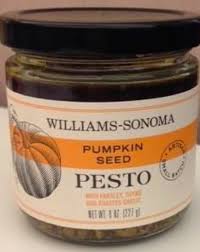
Pumpkin Seed Pesto Sauce Recalled Due to Clostridium Botulinum

California Department of Public Health (CDPH) warned consumers today not to eat Williams-Sonoma Pumpkin Seed Pesto sauce because it may have been improperly produced, making it susceptible to contamination with Clostridium botulinum.
Ingestion of botulism toxin from improperly processed jarred and canned foods may lead to serious illness and death.
The manufacturer of the product, California Olive and Vine, LLC, of Sutter, California, initiated the voluntary recall after CDPH determined that the product had been improperly processed. The product was packaged in eight ounce glass jars with screw-on metal lids. The recalled product can be identified by the following stock keeping unit (SKU) numbers: 6404305 and 6389043. The Williams-Sonoma Pumpkin Seed Pesto has been sold nationwide at Williams-Sonoma retail stores since September 2014.    
Botulinum toxin is odorless and colorless. Consumers that have any of these products or any foods made with these products should discard them immediately. Double bag the jars in plastic bags and place in a trash receptacle for non-recyclable trash. Wear gloves when handling these products or wash your hands with soap and running water after handling any food or containers that may be contaminated.
Botulism is a rare but serious paralytic illness caused by a nerve toxin that is produced by the bacterium Clostridium botulinum. The initial symptoms frequently experienced are double or blurred vision, drooping eyelids, and dry or sore throat. Progressive descending paralysis, usually symmetrical, may follow. Infants with botulism appear lethargic, feed poorly, are constipated, have a weak cry, and poor muscle tone.
CDPH recommends consumers experiencing any ill effects after consuming these products should consult their healthcare provider. Consumers that observe the product being offered for sale are encouraged to report the activity to the CDPH toll free complaint line at (800) 495-3232.


Thursday, October 2, 2014

10/2/14 Health News:New method tracks foodborne disease outbreaks ♦ Cinnamon oil kills E. coli ♦ RISKS OF UNPASTEURIZED MILK ♦ Clostridium botulinum spore germination

Study sheds light on Clostridium botulinum spore germination
A newly published research study by scientists at the UK Institute of Food Research (IFR) has identified part of the mechanism by which the resistant endospores of the dangerous foodborne pathogen Clostridium botulinum (the cause of botulism) are able to germinate. Continue Reading
New method helps track foodborne disease outbreaks
A new computer-assisted method developed jointly by the German Federal Institute for Risk Assessment (BfR), the IBM Almaden Research Centre and the Johns Hopkins Bloomberg School of Public Health analyses sales data to help identify contaminated foods involved in disease outbreaks. Continue Reading
Cinnamon oil kills pathogenic E. coli strains
A newly published study by researchers at Washington State University in the USA has found that an essential oil from cassia cinnamon (Cinnamomum cassia) is an effective antibacterial agent against several strains of non-O157 Shiga toxin-producing E. coli (STEC). Continue Reading
KY HEALTH OFFICIAL WARNS RESIDENTS ABOUT THE RISKS OF UNPASTEURIZED MILK

The Kentucky Department for Public Health has not been able to identify the source of the E. coli outbreak that sickened five children in early September. However, on Tuesday the department put out a warning to residents about the danger of consuming unpasteurized milk and other food products sometimes associated with E. coli. All five... Continue Reading