Showing posts with label outbreaks. Show all posts

Tuesday, May 19, 2015

Health News: Third of Brits at risk of food poisoning ♦ Five salmonella outbreaks food inspectors didn't see coming ♦ Bacteria contribute to immune suppression in skin

Third of Brits at risk of food poisoning from deadly chickens  Campylobacter is found on raw chicken and is the most common cause of food poisoning in Britain, causing an estimated 100 deaths annually. Currently, over 280,000 people contract food poisoning a year. FSA director Nina Purcell said: "More than a quarter of a million people – 280,000 – fall ill each year due to campylobacter food poisoning.
Five salmonella outbreaks food inspectors didn't see coming  Federal inspectors are inside every meat and poultry processing plant in this country. The problem is, their efforts sometimes fail to identify salmonella — a potentially deadly pathogen that sickens more than a million Americans each year, about 200,000 from contaminated poultry.
Genome-wide DNA study shows lasting impact of malnutrition in early pregnancy  Children whose mothers were malnourished at famine levels during the first 10 weeks of pregnancy had changes in DNA methylation known to suppress genes involved in growth, development, and metabolism documented at age 59.
Bacteria contribute to immune suppression in skin after repeated schistosome exposure Our two square meters of skin act as a defensive barrier against environmental pathogens but is also covered by beneficial commensal bacteria. A study explores this delicate balance and reports that when schistosome parasites repeatedly penetrate the skin, they are cloaked in skin bacteria, leading to a tightly controlled and limited immune response, due in part to this cloaking mechanism.
Losing weight can reduce risk of death, ventilator use in lung transplant patients Obesity is a complicating factor for many surgical patients.Researchers have shown that losing weight can have a positive impact on outcomes for lung transplant patients.

Thursday, February 12, 2015

Outbreaks from raw milk on the rise

snip of raw milk small

Outbreaks caused by raw milk increased over a six-year period, according to a newly released CDC study. The study reviewed outbreaks caused by raw milk--milk that has not been pasteurized to kill disease-causing germs--in the United States that were reported to CDC from 2007-2012. The study analyzed the number of outbreaks, the legal status of raw milk sales in each state, and the number of illnesses, hospitalizations, and deaths associated with these outbreaks.
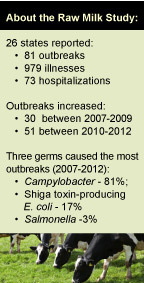
Study findings: 26 states reported 81 outbreaks, 979 illnesses, 73 hospitalizations; outbreaks increased: 30 (2007-2009) and 51 (2010-2012);

More states are legalizing the sale of raw milk even though this leads to an increase in the number outbreaks.
Findings also showed that the number of states that have legalized the sale of raw milk has also increased. In 2004, there were 22 states where the sale of raw milk was legal in some form; however, this number increased to 30 in 2011. Eighty-one percent of outbreaks were reported in states where the sale of raw milk was legal.
Children were at the highest risk for illness from raw milk. About sixty percent of outbreaks involved at least one child younger than five years of age.
Raw milk is a risk for human health.
You cannot look at, smell, or taste raw milk to determine if it is safe. Cows and other animals can appear healthy and clean, but can still have germs, like Salmonella and E. coli, which can cause illnesses in humans.
Milk cannot be collected without introducing some bacteria-- even under ideal conditions of cleanliness. Unless the milk is pasteurized, these bacteria can multiply.
Even raw milk supplied by "certified," "organic," or "local" dairies has no guarantee of being safe. Raw milk from grass-fed animals is not considered safe either.
=============
How does milk get contaminated?
Milk contamination may occur from:
  • Cow feces coming into direct contact with the milk
  • Infection of the cow's udder (mastitis)
  • Cow diseases (e.g., bovine tuberculosis)
  • Bacteria that live on the skin of cows
  • Environment (e.g., feces, dirt, processing equipment)
  • Insects, rodents, and other animal vectors
  • Humans, for example, by cross-contamination from soiled clothing and boots
=============
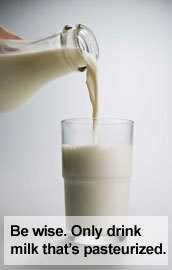
Image: milk being poured into a glass; text: Be wise. Only drink milk that's pasteurized.

Is it true that raw milk has more enzymes and nutrients than pasteurized milk?
While it’s true that the heating process of pasteurization does inactivate some enzymes in milk, the enzymes in raw animal milk are not thought to be important in human health. Some nutrients are somewhat reduced in raw milk, but the United States diet generally has plenty of other sources of these nutrients. For example, vitamin C is reduced by pasteurization, but raw milk is not a major source of vitamin C.

Tuesday, December 23, 2014

Increased Outbreaks Associated with Unpasteurized Milk,

Elisabeth A. Mungai , Casey Barton Behravesh, and L. Hannah Gould
The number of US outbreaks caused by unpasteurized milk increased from 30 during 2007–2009 to 51 during 2010–2012. Most outbreaks were caused by Campylobacter spp. (77%) and by unpasteurized milk purchased from states in which unpasteurized milk sale was legal (81%). Regulations to prevent distribution of unpasteurized milk should be enforced.
Pasteurization is an effective way to improve milk safety; however, in the United States, illness related to consumption of unpasteurized milk continues to be a public health problem. The first statewide requirements that dairy products be pasteurized were enacted in Michigan in 1948 . In 1987, the US Food and Drug Administration banned the interstate sale or distribution of unpasteurized milk.
However, the laws regulating intrastate sales are set by each state. Regulations for intrastate sales of unpasteurized milk vary from complete bans to permitting sales from farms or retail outlets. Even in states in which sale of unpasteurized milk is illegal, milk can often be obtained through other means. For example, some states allow cow-share or herd-share agreements, in which buyers pay farmers a fee for the care of a cow in exchange for a percentage of the milk produced
Consumption of unpasteurized milk has been associated with serious illnesses caused by several pathogens, including Campylobacter spp., Shiga toxin–producing Escherichia coli, and Salmonella enterica serotype Typhimurium Despite the health risks associated with consuming unpasteurized milk, the demand forunpasteurized milk has increased. Recently, many state legislatures have considered relaxing restrictions on the sale of unpasteurized milk. We report that the number of outbreaks associated with unpasteurized milk increased from 2007 through 2012.
State and local health departments voluntarily report outbreaks to the Foodborne Disease Outbreak Surveillance System of the Centers for Disease Control and Prevention through a standard web-based form (http://www.cdc.gov/nors). We reviewed outbreaks reported during 2007–2012 in which the food vehicle was unpasteurized milk. Outbreaks attributed to consumption of other dairy products made with unpasteurized milk, such as cheese, were excluded. We analyzed outbreak frequency, number of illnesses, outcomes (hospitalization, death), pathogens, and age groups of patients. Data on the legal status of unpasteurized milk sales in each state were obtained from the National Association of State Departments of Agriculture and an online search of state regulations. The sources from which unpasteurized milk was obtained or purchased were categorized according to the description from the state outbreak reports, when available.
During 2007–2012, a total of 81 outbreaks associated with unpasteurized milk were reported from 26 states. These outbreaks resulted in 979 illnesses and 73 hospitalizations. No deaths were reported. The causative agent was reported for all outbreaks. Of the 78 outbreaks with a single etiologic agent, Campylobacter spp. was the most common pathogen, causing 62 (81%) outbreaks, followed by Shiga toxin–producing E. coli (13 [17%]),Salmonella enterica serotype Typhimurium (2 [3%]), and Coxiella burnetii[1%]). Three outbreaks were caused by multiple pathogens. The number of outbreaks increased from 30 during 2007–2009 to 51 during 2010–2012. During 2007–2009, outbreaks associated with unpasteurized milk accounted for ≈2% of outbreaks with an implicated food; during 2010–2012, this percentage increased to 5%. The number of outbreaks of Campylobacter spp. infection also increased, from 22 during 2007–2009 to 40 during 2010–2012
Conclusions
Within this 6-year period, the number of outbreaks associated with nonpasteurized milk increased. The number of outbreaks caused by Campylobacter spp. nearly doubled. The average number of outbreaks associated with unpasteurized milk was 4-fold higher during this 6-year period (average 13.5 outbreaks/year) than that reported in a review of outbreaks during 1993–2006 (3.3 outbreaks/year) This increase was concurrent with a decline in the number of states in which the sale of unpasteurized milk was illegal, from 28 in 2004 to 20 in 2011 and with an increase in the number of states allowing cow-share programs (from 5 in 2004 to 10 in 2008) The decision to legalize the sale of unpasteurized milk or allow limited access through cow-share programs may facilitate consumer access to unpasteurized milk The higher number of outbreaks in states in which the sale of unpasteurized milk is legal has been reported elsewhere
The legal status of unpasteurized milk sales in 1 state can also lead to outbreaks in neighboring states. In a 2011 outbreak of Campylobacter spp. infections associated with unpasteurized milk in North Carolina, where sales of this product were prohibited, milk was purchased from a buying club in South Carolina, where sales were legal. Another outbreak of Campylobacter spp. infection in 2012 implicated unpasteurized milk from a farm in Pennsylvania, where sales are legal; cases from this outbreak were reported from Maryland, West Virginia, and New Jersey, all of which prohibit sale of raw milk  All patients residing outside Pennsylvania had traveled to Pennsylvania to purchase the milk
Outbreaks associated with unpasteurized milk continue to pose a public health challenge. Legalization of the sale of unpasteurized milk in additional states would probably lead to more outbreaks and illnesses. This possibility is especially concerning for vulnerable populations, who are most susceptible to the pathogens commonly found in unpasteurized milk (e.g., children, senior citizens, and persons with immune-compromising conditions). Public health officials should continue to educate legislators and consumers about the dangers associated with consuming unpasteurized milk.
Ms. Mungai is a surveillance epidemiologist at the Atlanta Research and Education Foundation and at the Centers for Disease Control and Prevention. Her interests include infectious disease epidemiology and food safety.

Thursday, October 2, 2014

10/2/14 Health News:New method tracks foodborne disease outbreaks ♦ Cinnamon oil kills E. coli ♦ RISKS OF UNPASTEURIZED MILK ♦ Clostridium botulinum spore germination

Study sheds light on Clostridium botulinum spore germination
A newly published research study by scientists at the UK Institute of Food Research (IFR) has identified part of the mechanism by which the resistant endospores of the dangerous foodborne pathogen Clostridium botulinum (the cause of botulism) are able to germinate. Continue Reading
New method helps track foodborne disease outbreaks
A new computer-assisted method developed jointly by the German Federal Institute for Risk Assessment (BfR), the IBM Almaden Research Centre and the Johns Hopkins Bloomberg School of Public Health analyses sales data to help identify contaminated foods involved in disease outbreaks. Continue Reading
Cinnamon oil kills pathogenic E. coli strains
A newly published study by researchers at Washington State University in the USA has found that an essential oil from cassia cinnamon (Cinnamomum cassia) is an effective antibacterial agent against several strains of non-O157 Shiga toxin-producing E. coli (STEC). Continue Reading
KY HEALTH OFFICIAL WARNS RESIDENTS ABOUT THE RISKS OF UNPASTEURIZED MILK

The Kentucky Department for Public Health has not been able to identify the source of the E. coli outbreak that sickened five children in early September. However, on Tuesday the department put out a warning to residents about the danger of consuming unpasteurized milk and other food products sometimes associated with E. coli. All five... Continue Reading

Saturday, September 13, 2014

9/13/14 Health News: FIVE KENTUCKY CHILDREN HIT WITH KIDNEY DISEASE ♦ Food Safety Loophole ♦ New method helps track foodborne disease outbreaks

FIVE KENTUCKY CHILDREN HIT WITH KIDNEY DISEASE USUALLY CAUSED BY E. COLI
Five children were reportedly in a Louisville, KY, hospital on Friday being treated for hemolytic uremic syndrome (HUS), which is a potentially fatal kidney disease typically caused by an E. coli infection. Three of the children are from Hardin County, one is from Oldham County, and one is from Boone County. Their ages were not... Continue Reading


Food Safety Loophole Remains Intact Under New FDA Standards
The process for reviewing chemicals added to the nation's food supply is being overhauled by the U.S. Food and Drug Administration, but food safety advocates warn that the changes won't prevent unsafe additives from making their way into your meals.  Hundreds of chemicals that the FDA has little power to regulate, and most consumers have likely never heard of, are secretly … continue reading


New method helps track foodborne disease outbreaks

A new computer-assisted method developed jointly by the German Federal Institute for Risk Assessment (BfR), the IBM Almaden Research Centre and the Johns Hopkins Bloomberg School of Public Health analyses sales data to help identify contaminated foods involved in disease outbreaks. Continue Reading

Monday, June 16, 2014

Incurable Chikungunya Virus Spreads to At Least 6 States

Chikungunya fever (CHIK) is an infection caused by the Chikungunya virus (CHIKV). The virus is spread through the bite of an infected mosquito, similar to West Nile and dengue viruses. The Chikungunya virus was first identified during an outbreak in 1952 in southern Tanzania, although it is suspected to have been present in Africa and Asia for much longer. It is not currently found in the United States.
Chikungunya fever outbreaks have been reported in Africa, southern Europe, Southeast Asia, India, and islands in the Indian and Pacific Oceans. In December 2013, a cluster of CHIK cases were reported from St. Martin, an island in the Caribbean. This is the first known occurrence of local CHIKV transmission in the Americas.
So fat the cases in the US have been to people who had been traveling to the Caribbean. But if someone who is infected is bitten by a mosquito in the US then the disease can be spread by local mosquitos.
Chikungunya virus is spread by two mosquito species: Aedes aegypti(primarily) and Aedes albopictus, both found in Florida. While the virus is not currently found in the state, introductions are possible if a CHIKV infected visitor or returning traveler is bitten by Florida mosquitoes in the early stages (the first week) of their illness. Infected mosquitoes can then spread the virus to other people they bite.
Prevention
The same actions to prevent other mosquito borne illness such as dengue and West Nile virus disease are effective for preventing CHIK. While traveling in areas where CHIK, dengue or other mosquito borne diseases are present remember to:
  • use EPA approved repellants such as DEET
  • wear comfortable clothing that protects skin from mosquito bites
  • select hotels or other residences with intact window and door screens
Signs and Symptoms
An infected person will typically become ill three to seven days after the mosquito bite, but symptoms can begin anywhere from two to 12 days post-bite. These symptoms can last 3-10 days. Up to 28% of people who are infected will not have any symptoms (asymptomatic), although they can still be infectious to mosquitoes for a short time if bitten. Persons at greatest risk for severe illness include newborn infants, those over 65 years of age, and those who have other health conditions. Treatment is symptomatic or supportive.
Symptoms may include:
  • Sudden high fever (usually >102º F) which may be continuous or intermittent
  • Severe joint pain that commonly involves the hands and feet
  • Joint swelling
  • Back pain
  • Rash usually 2-5 days after fever starts
  • Other symptoms may include headache, body ache, nausea, vomiting, and redness around the eyes. In unusual cases, infection can involve the brain, eyes, heart, kidney and other organs.
  • Fatal infections are rare, however many patients have chronic joint pain, arthritis, loss of energy and depression lasting weeks to years.
Chikungunya and Dengue
It is important to note that a person can be infected with CHIK and dengue viruses at the same time as they are both carried by the same types of mosquitoes. Therefore, it is important that providers consider both dengue fever and CHIK when evaluating suspect cases with travel to areas where both viruses are present. Testing is the only way for a health care provider to definitively differentiate CHIK and dengue fever.